
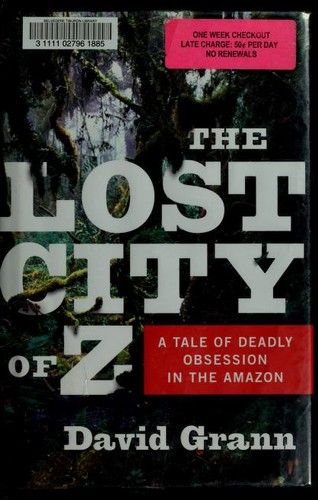
The Lost City of Z
A Tale of Deadly Obsession in the Amazon
In 1925, British explorer Percy Harrison Fawcett entered Brazil’s Mato Grosso with his son Jack and Jack’s friend Raleigh Rimell. They were searching for evidence of an ancient Amazonian society that Fawcett called “Z.” None returned. David Grann reconstructs the expedition, the career that led Fawcett toward it, and the succession of investigators and adventurers who tried to solve the disappearance. He also follows Fawcett’s trail himself, turning the investigation into a meeting point between biography, travel reporting, historical mystery, and archaeology. The result is not merely a survival story. It examines how imperial assumptions shaped exploration, why outsiders long underestimated Indigenous Amazonian societies, and how a powerful idea can consume both its originator and later seekers. Grann preserves the uncertainty surrounding Fawcett’s fate while showing that his broad conviction—that the Amazon once supported complex, settled communities—deserved more serious considerat…
Where to buy or borrow
Are you selling this book? Bookstores, publishers, authors and libraries can be listed here for free. Request a listing
About this book
Deep Overview
Fawcett emerges as a skilled surveyor, veteran, cartographer, and extraordinarily durable traveler whose Amazonian work was connected to the Royal Geographical Society and to boundary-mapping projects in South America. Repeated journeys persuaded him that the interior contained evidence of a large, sophisticated pre-Columbian society. He named his hypothetical destination “Z,” guarded its supposed location, and gradually made finding it the central purpose of his life. His conviction drew on Indigenous reports, colonial accounts, artifacts, landscape observations, and speculation. Grann neither reduces Fawcett to a crank nor accepts all his conclusions. He shows how field knowledge, cultural prejudice, intuition, mysticism, and obsession became inseparable in Fawcett’s thinking.
The 1925 expedition gives the book its narrative spine. Fawcett favored a very small party, believing that large expeditions were slow, conspicuous, and difficult to supply. He traveled with Jack and Raleigh from Cuiabá into the Mato Grosso, sending back letters before the party disappeared. The absence of conclusive remains or a verified final campsite allowed competing stories to multiply: starvation, illness, drowning, attack, voluntary disappearance, captivity, and increasingly fantastic legends. Search parties and would-be rescuers became part of the mystery, sometimes risking or losing their own lives.
Running beside this history is Grann’s investigation. Archival work leads him to Britain, the Fawcett family, geographical records, Brazilian witnesses, and eventually the Upper Xingu region. His journey is not framed as an attempt to imitate Fawcett’s physical heroics. It instead exposes the limitations of armchair certainty and brings Grann into contact with the Kalapalo, whose oral history has long been central to accounts of Fawcett’s last movements.
The book’s final transformation is archaeological. Research associated with Michael Heckenberger and Indigenous communities of the Upper Xingu revealed planned settlements, roads, earthworks, managed landscapes, and regional organization inconsistent with the old image of an Amazon incapable of supporting substantial societies. This does not establish that Fawcett’s precise “Z” existed as he imagined it, nor does it solve every question about his death. It shifts the meaning of his quest. The supposed wilderness was not historically empty, and the mystery of one vanished expedition opens into the much larger problem of how colonial violence, epidemic disease, environmental change, and scholarly assumptions obscured Indigenous histories.
Key Themes
**Exploration and empire:** Mapping, scientific inquiry, national borders, journalism, sponsorship, and imperial prestige overlap throughout the story. Exploration is never simply an individual contest with nature.
**The myth of empty wilderness:** The book challenges the idea that dense forest proves an absence of history. Landscapes that appeared pristine to outsiders could preserve the traces of earlier settlement and management.
**Evidence under uncertainty:** Letters, oral traditions, artifacts, maps, rumors, and archaeological remains carry different strengths and limits. Grann’s investigation depends on weighing them without forcing a complete solution.
**Indigenous knowledge and outsider narratives:** Indigenous people repeatedly guide, supply, warn, rescue, and inform explorers, yet traditional adventure accounts often reduce them to obstacles or scenery.
**Family and inherited quests:** Fawcett’s ambitions affect his wife Nina and their children, while Jack’s participation turns the final expedition into both a search for Z and a consequential father-son relationship.
Historical Context
The story also reflects a disciplinary transition. The gentleman explorer was giving way to professional archaeology and anthropology, while theories about environmental limits strongly influenced interpretations of Amazonian history. Scholars debated whether tropical soils could sustain large, settled populations. European and American observers also inherited legends of El Dorado and other lost civilizations, so claims about extensive ruins could be dismissed as fantasy even when the broader premise of complex settlement had merit.
Fawcett’s final expedition occurred in 1925, after the First World War had altered both his life and the culture of heroic exploration. His disappearance became a media phenomenon during an era when newspapers could finance expeditions, shape reputations, and turn incomplete reports into public mythology. Later archaeological research has complicated the assumptions of that period by documenting engineered landscapes and substantial pre-Columbian settlement in multiple parts of Amazonia.
Intended Audience
It may be less suitable for anyone seeking a comprehensive academic history of Amazonian archaeology or an exclusively Indigenous account of the region. The narrative remains centered on Fawcett and Grann, although it increasingly questions the outsider frameworks that made Fawcett’s legend possible. Readers wanting a neatly solved disappearance should also expect ambiguity rather than a final forensic verdict.
Reading Difficulty
The principal difficulty is interpretive rather than linguistic. Readers must distinguish among documented events, Fawcett’s beliefs, later testimony, family lore, and Grann’s cautious reconstruction. Some descriptions of disease, injury, death, colonial violence, and threats against Indigenous communities are disturbing. Maps or a basic regional atlas may help readers follow movement through Mato Grosso, the Xingu basin, and the wider Amazon.
Helpful Background Knowledge
Readers should also keep one distinction in mind: evidence for complex pre-Columbian Amazonian settlements does not automatically prove every feature of Fawcett’s theory or identify one specific site as Z. That separation between a broadly perceptive hypothesis and its speculative particulars is central to evaluating the book.
Why Read This Book?
The book also offers a strong example of responsible narrative uncertainty. Grann develops plausible conclusions without pretending that incomplete evidence has become certainty. It therefore works both as an adventure narrative and as a study in how historical knowledge is assembled from fragmentary, culturally unequal records.
Reader Takeaways
Readers may also reconsider the familiar opposition between civilization and wilderness. Amazonian forests can be ecologically rich environments, Indigenous homelands, and landscapes bearing evidence of long-term human intervention at the same time. Finally, the unresolved disappearance shows why compelling historical narratives require calibrated confidence: a plausible reconstruction is not the same as proof.
Strengths
The portrait of Fawcett is also notably balanced. His courage, field skill, discipline, and willingness to question prevailing assumptions appear beside secrecy, paternal authority, mystical speculation, and destructive fixation. Grann makes the explorer intelligible without requiring admiration or condemnation alone.
A further strength is the ending’s conceptual expansion. Archaeology does not deliver a sensational treasure-city revelation; it changes the reader’s model of Amazonian civilization. That is a more substantial payoff than a merely dramatic solution would have been.
Limitations and Cautions
Fawcett’s disappearance remains unresolved. The book presents evidence and a credible line of interpretation, but no verified remains or definitive account closes the case. Its thriller-like pacing can sometimes make evidence of different quality feel momentarily equivalent, so readers should watch the distinction between documentation, reported memory, and conjecture.
The book was published in 2009. Subsequent archaeological discoveries have further strengthened the case for extensive pre-Columbian settlement and landscape engineering across parts of Amazonia. Those later findings enrich the book’s broad conclusion but are naturally absent from its account.
Important Concepts, People, Places, and Institutions
**David Grann:** The journalist and author who reconstructs Fawcett’s life through archives, interviews, travel, and reporting, while examining how the legend continued to shape later seekers.
**Jack Fawcett and Raleigh Rimell:** Fawcett’s son and Jack’s friend, who joined the final expedition and disappeared with him. Their presence raises questions about loyalty, paternal influence, and shared risk.
**Nina Fawcett:** Percy’s wife, whose support, waiting, and defense of his reputation reveal the family cost of the quest.
**The City of Z:** Fawcett’s name for a hypothesized ancient settlement in the Brazilian interior. It is a target, a theory, and an organizing symbol rather than a site conclusively identified by the book.
**Mato Grosso and the Upper Xingu:** The Brazilian regions most closely associated with Fawcett’s final journey and with archaeological evidence that alters older interpretations of Amazonian settlement.
**The Kalapalo:** An Indigenous people of the Upper Xingu whose oral history and relationship with later investigators are crucial to evaluating Fawcett’s last known movements.
**Michael Heckenberger:** An archaeologist whose work with Upper Xingu communities documented planned settlements and regional systems, giving the book’s ending its larger historical significance.
**Royal Geographical Society:** The British institution connected to Fawcett’s surveying career and a major repository of records used to reconstruct his plans and movements.
**El Dorado:** A shifting European legend of wealth and hidden civilization. Fawcett did not simply adopt the conventional city-of-gold story, but his quest cannot be separated from its cultural afterlife.
**Amazonian Dark Earth and engineered landscapes:** Evidence of long-term habitation and environmental management that helps challenge the claim that Amazonian conditions prevented substantial settled societies.
Questions the Book Explores
When does perseverance cease to be admirable and become destructive obsession?
How did imperial institutions and mass media shape the image of the heroic explorer?
Why were claims of complex pre-Columbian Amazonian settlement dismissed for so long?
How should historians compare written archives, archaeological findings, oral history, and rumor?
What obligations do investigators have when pursuing mysteries embedded in living Indigenous communities?
Can a person be broadly right about the past while being wrong about important particulars?
Why do unresolved disappearances generate increasingly elaborate stories?
Reading Group Guide
Compare Fawcett’s confidence with Grann’s investigative caution. Notice where each man depends on guides, institutions, family members, and Indigenous knowledge despite the solitary-hero pattern attached to exploration narratives.
Discuss the treatment of evidence. Groups can identify moments grounded in contemporary documents, moments based on later recollection, and moments where Grann signals uncertainty. This makes a useful basis for considering why some explanations of the disappearance feel more persuasive than others.
Finally, examine the archaeology near the conclusion. Ask whether it vindicates Fawcett, revises him, or shifts attention away from him altogether. A productive discussion should separate the existence of complex Amazonian societies from the narrower question of whether Fawcett’s exact imagined city existed.
Discussion Questions
2. How does Grann create suspense without claiming to possess a definitive solution?
3. What does the book suggest about the difference between exploration and discovery?
4. How does Jack’s participation alter the moral meaning of Fawcett’s quest?
5. In what ways did newspapers, geographical societies, and sponsors help create the Fawcett legend?
6. How should the Kalapalo oral account be weighed beside written documents produced by outsiders?
7. Does the archaeological evidence vindicate Fawcett, or only one part of his larger theory?
8. How does the book challenge the idea of the Amazon as untouched wilderness?
9. What responsibilities does a modern journalist have when revisiting a mystery involving Indigenous communities?
10. Why do you think Fawcett’s disappearance attracted so many later searchers?
11. Where does the book draw a line between bravery and obsession?
12. How might the narrative differ if structured primarily around the history of Upper Xingu communities rather than Fawcett’s disappearance?
Sources and Verification
Fawcett’s ultimate fate remains unproven, and this profile does not present any proposed explanation as a settled fact. Page totals differ among bibliographic records because editions and counting conventions vary; the identity fields refer to the 2009 U.S. Doubleday hardcover.
Comments
No published comments yet.
Available editions
Hardcover
hardcover
- Publisher
- Doubleday
- ISBN-13
- 9780385513531
- Publication date
- Pages
- 352