
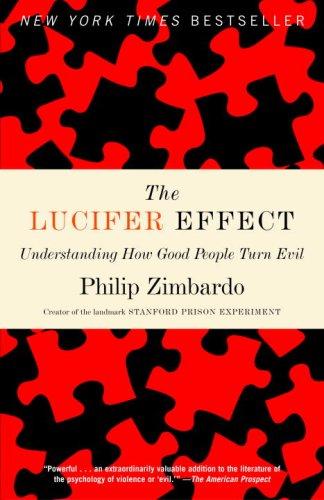
The Lucifer Effect
Understanding How Good People Turn Evil
Why do ordinary people sometimes participate in cruelty, humiliation, and organized violence? Social psychologist Philip Zimbardo argues that explanations centered only on defective character—the proverbial “bad apple”—overlook the power of situations and the institutions that construct them. The book’s central case is the 1971 Stanford Prison Experiment, in which students assigned to prisoner and guard roles occupied a simulated prison until the study was stopped after six days. Zimbardo uses his account of that project to examine conformity, obedience, deindividuation, role absorption, moral disengagement, and the diffusion of responsibility. He then connects these processes to abuses at Abu Ghraib prison and to broader instances of institutional wrongdoing. Although the Stanford study’s methods and interpretation have since faced substantial scholarly criticism, the book remains influential as an argument about how systems distribute power and normalize misconduct. Its final moveme…
Where to buy or borrow
Are you selling this book? Bookstores, publishers, authors and libraries can be listed here for free. Request a listing
About this book
Deep Overview
The book develops this position through an extensive account of the Stanford Prison Experiment. Conducted in 1971 in the basement of Stanford University’s psychology department, the simulation assigned male student volunteers to prisoner and guard roles. Zimbardo presents the study as a concentrated demonstration of how institutional roles, unequal power, anonymity, rules, and group expectations can alter conduct. He describes escalating humiliation and distress, resistance among prisoners, differences among guards, and his own immersion in the superintendent role. Christina Maslach, then a psychologist visiting the site, objected to what she saw; her intervention became important to the decision to terminate the planned two-week study after six days.
From this account, Zimbardo constructs a vocabulary for understanding transformation without reducing it to sudden personality change. Deindividuation can weaken a person’s ordinary sense of identity and accountability. Dehumanization makes another person’s suffering easier to disregard. Diffusion of responsibility permits each participant to view someone else as the true decision-maker. Gradual escalation turns a sequence of individually manageable concessions into conduct that might have been rejected if demanded at the outset. Institutional authorization can further redefine cruelty as duty, discipline, security, or loyalty.
The analysis then moves beyond the laboratory simulation. Zimbardo discusses obedience research associated with Stanley Milgram, historical cases of collective violence, organizational misconduct, and the abuse of Iraqi detainees by U.S. personnel at Abu Ghraib. He argues that focusing exclusively on a few perpetrators can conceal command decisions, operating procedures, inadequate supervision, political pressures, and institutional cultures that made abuse more likely. His “bad barrel” metaphor directs attention toward environments that select, reward, protect, or fail to stop harmful behavior.
The concluding emphasis is not that people are powerless. Zimbardo treats awareness of situational pressure as a condition of resistance. He advocates personal responsibility, skepticism toward unjust authority, recognition of shared humanity, and models of ordinary heroism. That hopeful turn establishes the book’s deepest tension: circumstances can exert enormous influence, but moral agency still matters.
Later archival scholarship has disputed important features of the Stanford study, including the spontaneity attributed to guard behavior, the influence of experimenter expectations, and the quality of the evidence. Consequently, the experiment should not be treated as conclusive proof of a universal transformation from goodness to evil. The book is most productively read as an influential—and contested—framework for examining power, complicity, institutional design, and accountability.
Key Themes
• Systems behind situations: Rules, hierarchies, ideologies, incentives, and leadership decisions create the settings in which individuals act. Institutional analysis therefore extends responsibility rather than simply excusing direct perpetrators.
• Power and assigned roles: Unequal authority can change expectations on both sides of a relationship, particularly when one group controls another group’s movement, privacy, information, or basic needs.
• Dehumanization and moral disengagement: Harm becomes easier when victims are reduced to labels, numbers, enemies, or obstacles and when abusive acts are redescribed as necessary procedures.
• Gradual escalation: Serious misconduct may develop through small concessions and normalized practices rather than through one unmistakable decision to become cruel.
• Conformity, obedience, and inaction: Harmful systems depend not only on aggressive actors but also on compliant participants, passive witnesses, and people who defer responsibility upward.
• Accountability across levels: The book asks readers to judge personal choices while also investigating the authorities and structures that enabled those choices.
• Heroism as resistance: Zimbardo presents heroism as the positive counterpart to the Lucifer effect—the willingness to oppose an unjust group, role, or command despite social cost.
Historical and Intellectual Context
The book’s later discussion was shaped by a different historical crisis: photographs released in 2004 documented abuse of Iraqi detainees at Abu Ghraib prison. Zimbardo’s involvement as an expert witness for the defense of U.S. Army reservist Ivan Frederick gave him access to material he used to argue that the abuse could not be understood solely through the character of individual guards.
The ethical and methodological standards governing human-subject research also changed significantly after the early 1970s. Contemporary readers therefore encounter the Stanford study both as a famous episode in social psychology and as a case through which research ethics, experimenter influence, and scientific storytelling are debated. Archival criticism published after The Lucifer Effect has made that second context essential to any present-day reading.
Intended Audience
Readers seeking a brief introduction may find the book longer and more repetitive than necessary. Those wanting a balanced history of the Stanford study should not rely on it alone, because Zimbardo is simultaneously the narrator, principal investigator, participant-observer, and defender of the experiment’s significance.
Reading Difficulty
No advanced statistical knowledge is required. Readers should nevertheless evaluate the difference between an illustrative case, a controlled experiment, a retrospective interpretation, and evidence that supports a general causal claim.
Helpful Background Knowledge
For the Abu Ghraib chapters, a short overview of the U.S.-led Iraq War, military detention operations, and the 2004 disclosure of abuse photographs will clarify the institutional stakes. Readers do not need specialized knowledge of criminal justice or military organization, but they should remember that responsibility within a hierarchy can be distributed among direct actors, supervisors, policymakers, and organizational procedures.
Why Read This Book?
The book is also worth reading because it occupies an important place in psychology’s public history. Its power and its weaknesses reveal how a dramatic study can shape popular ideas about human nature. Read alongside later archival analysis, it becomes both an argument about institutional evil and a case study in the need to scrutinize influential scientific narratives.
Reader Takeaways
Readers may also become less confident in predictions about what they themselves would do under pressure. At the same time, the book’s contested evidentiary foundation offers another lesson: persuasive stories about human behavior should be tested against methods, records, alternative explanations, and later scholarship. Moral vigilance and scientific skepticism are both appropriate responses.
Strengths
The comparison between the Stanford simulation and Abu Ghraib also makes abstract social-psychological processes concrete. The final treatment of resistance and heroism prevents the argument from collapsing into fatalism, while the detailed notes and references provide pathways into the research traditions being discussed.
Limitations and Cautions
Zimbardo’s multiple roles created additional problems. He was the principal investigator, acted as prison superintendent, became personally absorbed in the setting, and later served as the experiment’s most influential interpreter. The book acknowledges some of these conflicts but does not provide the independent perspective available in later scholarship.
Its comparisons among simulations, prisons, military abuse, genocide, corporate wrongdoing, and other forms of harm can illuminate common mechanisms, but they can also flatten important differences in history, ideology, scale, and coercion. Readers should therefore treat the book’s model as a set of questions and hypotheses rather than as a settled law of human behavior.
Important Concepts, People, Places, and Institutions
• Stanford Prison Experiment: The 1971 simulated-prison study around which much of the book is organized. Zimbardo interprets it as evidence of situational and institutional power; later researchers have contested that interpretation and the study’s methods.
• Stanford University: The institution where the simulation was conducted in the basement of the psychology department.
• Christina Maslach: A psychologist whose objection to the treatment of participants helped confront Zimbardo with the study’s ethical deterioration. She represents the possibility of resisting a normalized situation from an outsider’s perspective.
• Craig Haney and Curtis Banks: Members of the Stanford research team whose involvement matters to the study’s design and execution, although public accounts often attach the experiment primarily to Zimbardo.
• Stanley Milgram: Psychologist whose obedience research provides a major intellectual comparison. Both bodies of work ask how authority and context can induce conduct that conflicts with personal values.
• Abu Ghraib prison: The detention facility in Iraq where U.S. personnel abused detainees. Zimbardo uses the case to move from experimental social psychology to questions of military organization and command responsibility.
• Ivan Frederick: A U.S. Army reservist convicted for his role in Abu Ghraib abuse. Zimbardo served as an expert witness for his defense and uses the case to examine individual culpability within a damaging system.
• Dispositional explanation: An account that attributes behavior primarily to personality, character, intention, or pathology.
• Situational explanation: An account emphasizing immediate pressures, roles, expectations, group processes, and environmental conditions.
• Systemic explanation: Analysis of the institutions, leadership decisions, ideologies, rules, and incentives that create and sustain particular situations.
• Deindividuation: A reduction in felt personal identity or accountability, often associated with anonymity and immersion in a group role.
• Dehumanization: The treatment of people as less than fully human, making exclusion, humiliation, and violence easier to rationalize.
• Moral disengagement: Psychological processes that detach harmful conduct from ordinary moral standards through euphemism, displaced responsibility, victim-blaming, or favorable comparison.
• Bad apples and bad barrels: Zimbardo’s contrast between blaming deviant individuals and examining the environments that cultivate or permit misconduct.
• Heroic imagination: The capacity to anticipate moral tests, resist unjust authority, and act on behalf of others despite social or personal risk.
Questions the Book Explores
• What happens when institutional roles provide some people with extensive control over others?
• How do anonymity, dehumanization, conformity, and diffusion of responsibility reduce moral restraint?
• Why do organizations often isolate blame at the lowest level of a hierarchy?
• When does explaining situational influence become an excuse, and when does it reveal additional layers of responsibility?
• How can observers recognize that a group’s abnormal behavior has become internally normal?
• What enables a person to resist authority or group consensus when intervention carries a cost?
• Can institutions be designed to make ethical action easier and abuse more difficult?
Reading Group Guide
Pay attention to moments when language changes the moral meaning of an action. Terms associated with discipline, procedure, security, or obedience may conceal who is harmed and who is responsible. Compare active cruelty with passive participation and ask whether the book treats them differently enough.
For a present-day discussion, pair the Stanford chapters with a concise account of the later archival criticism. Rather than debating only whether the experiment was “real” or “fake,” consider which conclusions the available evidence can support. End with the heroism chapters: discuss whether individual courage is an adequate remedy for defective systems or whether structural reform must come first.
Discussion Questions
2. Does emphasizing situational power reduce individual responsibility, expand responsibility to additional actors, or do both at once?
3. How does Zimbardo’s participation as prison superintendent affect your trust in his narrative?
4. What safeguards might have prevented the Stanford simulation from escalating?
5. Which differences between the Stanford simulation and Abu Ghraib limit Zimbardo’s comparison?
6. How do labels, uniforms, numbers, and physical environments change relationships between groups?
7. What forms of inaction does the book treat as morally significant?
8. How should later criticism of the Stanford Prison Experiment change the way this book is read?
9. Can an argument about systemic influence remain valuable when its best-known supporting case is methodologically weak?
10. Where is the boundary between legitimate obedience and surrender of moral judgment?
11. What conditions make dissent from a group more likely to succeed?
12. Is Zimbardo’s model of everyday heroism practical, or does it place too much responsibility on isolated individuals?
Sources and Verification
Comments
No published comments yet.
Available editions
Paperback
paperback
- Publisher
- Random House Trade Paperbacks
- ISBN-13
- 9780812974447
- Publication date
- Pages
- 576