Social Psychology
Category
Social Psychology
Related subcategories
Books in this category
Primary category
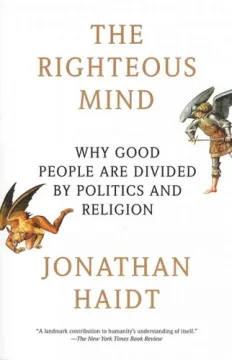
The Righteous Mind
Why Good People Are Divided by Politics and Religion
Why do sincere, decent people reach sharply opposed conclusions about politics, religion, and morality? Social psychologist Jonathan Haidt argues that moral judgment usually begins with rapid intuition, while conscious reasoning often arrives afterward to explain or defend what already feels right. He then presents morality as a plural system: people respond to several concerns—including care, fairness, loyalty, authority, sanctity, and liberty—but cultures and political groups assign them different weight. The final part examines humanity’s capacity to form cohesive groups, proposing that the same moral instincts that make cooperation, institutions, and religious communities possible can also produce tribalism and hostility. Combining psychological research, evolutionary argument, anthropology, political analysis, and memorable metaphors, The Righteous Mind offers a framework for interpreting disagreement without assuming that one’s opponents are merely ignorant or malicious. Its cen…
Primary category
The Happiness Hypothesis
Finding Modern Truth in Ancient Wisdom
In The Happiness Hypothesis, social psychologist Jonathan Haidt examines enduring claims about happiness, virtue, love, adversity, self-command, and meaningful living. Rather than accepting ancient wisdom as timeless truth—or dismissing it as obsolete—he compares ideas drawn from religious and philosophical traditions with findings from psychology, neuroscience, and evolutionary thought. The book begins with the divided mind, memorably represented as a conscious rider attempting to guide a much larger elephant of automatic feeling and intuition. It then moves outward into reciprocity, self-serving judgment, relationships, circumstances, moral development, sacredness, and purpose. Haidt’s central conclusion is that flourishing is not produced by introspection or pleasure alone. It emerges through a workable alignment among temperament, habits, relationships, commitments, values, and social life. The result is an accessible investigation of what ancient traditions understood about human…
Primary category
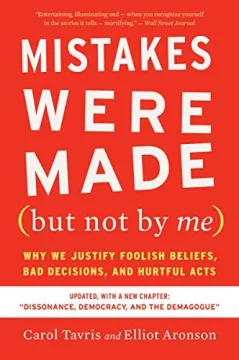
Mistakes Were Made (But Not by Me)
Why We Justify Foolish Beliefs, Bad Decisions, and Hurtful Acts
Why do intelligent, decent people defend poor decisions long after the evidence has turned against them? Carol Tavris and Elliot Aronson answer through cognitive dissonance: the discomfort produced when facts or actions collide with a favorable view of oneself. Rather than revise that self-image, people often reinterpret evidence, alter memories, blame others, or intensify their original commitment. The authors trace this machinery of self-justification from private quarrels to professional judgment, criminal investigations, political allegiance, prejudice, and international conflict. Their central warning is not merely that people deceive others, but that sincere self-deception can make error remarkably durable. At the same time, the book argues that defensiveness is not destiny. By separating wrongdoing from a total condemnation of the self, individuals and institutions can become more capable of correcting errors, making meaningful apologies, and learning before a small mistake har…
Primary category
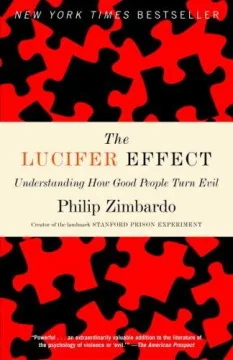
The Lucifer Effect
Understanding How Good People Turn Evil
Why do ordinary people sometimes participate in cruelty, humiliation, and organized violence? Social psychologist Philip Zimbardo argues that explanations centered only on defective character—the proverbial “bad apple”—overlook the power of situations and the institutions that construct them. The book’s central case is the 1971 Stanford Prison Experiment, in which students assigned to prisoner and guard roles occupied a simulated prison until the study was stopped after six days. Zimbardo uses his account of that project to examine conformity, obedience, deindividuation, role absorption, moral disengagement, and the diffusion of responsibility. He then connects these processes to abuses at Abu Ghraib prison and to broader instances of institutional wrongdoing. Although the Stanford study’s methods and interpretation have since faced substantial scholarly criticism, the book remains influential as an argument about how systems distribute power and normalize misconduct. Its final moveme…
Articles in this category
No published articles are currently connected to this category in this language.