
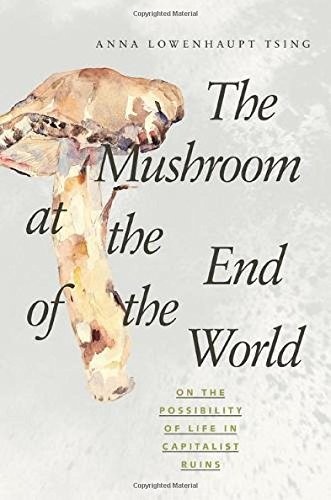
The Mushroom at the End of the World
On the Possibility of Life in Capitalist Ruins
This interdisciplinary work follows matsutake mushrooms from disturbed forests into an international commodity network centered on Japanese demand. Tsing moves among mushroom ecologies, forest management, migration histories, commercial picking, scientific research, wholesale trade, and cultural practices of exchange. Rather than treating the commodity chain as a single orderly system, she presents it as a collection of locally distinct social and ecological worlds that meet only partially. The Oregon matsutake trade receives sustained attention. Its pickers include Southeast Asian refugees and immigrants, Indigenous participants, military veterans, and others seeking livelihoods or autonomy outside conventional employment. The book connects their activities to buyers, exporters, Japanese importers, scientists, land managers, trees, fungi, and landscapes shaped by logging and other disturbances. Comparative material from Japan, China, and Finland expands the inquiry beyond one forest…
Where to buy or borrow
Are you selling this book? Bookstores, publishers, authors and libraries can be listed here for free. Request a listing
About this book
The Oregon matsutake trade receives sustained attention. Its pickers include Southeast Asian refugees and immigrants, Indigenous participants, military veterans, and others seeking livelihoods or autonomy outside conventional employment. The book connects their activities to buyers, exporters, Japanese importers, scientists, land managers, trees, fungi, and landscapes shaped by logging and other disturbances. Comparative material from Japan, China, and Finland expands the inquiry beyond one forest or market.
Matsutake becomes a way to investigate how capitalism acquires value from processes it neither creates nor fully controls. Wild mushrooms depend on complex forest relationships and resist plantation-style standardization. Yet traders can translate irregular harvests into graded inventory and commercial value. Tsing uses this tension to examine supply chains, precarious labor, ecological disturbance, and what she calls salvage accumulation.
The book is also an argument about method. Its short chapters accumulate through juxtaposition rather than forming a conventional linear proof. Tsing asks readers to notice multiple histories and forms of life at once, much as a listener follows independent lines in polyphonic music. The resulting account challenges stories in which economic development, scientific mastery, or human progress supplies history with a single direction.
Deep Overview
The Oregon matsutake trade receives sustained attention. Its pickers include Southeast Asian refugees and immigrants, Indigenous participants, military veterans, and others seeking livelihoods or autonomy outside conventional employment. The book connects their activities to buyers, exporters, Japanese importers, scientists, land managers, trees, fungi, and landscapes shaped by logging and other disturbances. Comparative material from Japan, China, and Finland expands the inquiry beyond one forest or market.
Matsutake becomes a way to investigate how capitalism acquires value from processes it neither creates nor fully controls. Wild mushrooms depend on complex forest relationships and resist plantation-style standardization. Yet traders can translate irregular harvests into graded inventory and commercial value. Tsing uses this tension to examine supply chains, precarious labor, ecological disturbance, and what she calls salvage accumulation.
The book is also an argument about method. Its short chapters accumulate through juxtaposition rather than forming a conventional linear proof. Tsing asks readers to notice multiple histories and forms of life at once, much as a listener follows independent lines in polyphonic music. The resulting account challenges stories in which economic development, scientific mastery, or human progress supplies history with a single direction.
Key Themes
• Collaborative survival among organisms and people whose interests are not necessarily harmonious.
• Capitalist ruin as the damaged social and ecological landscape left by projects of extraction, simplification, and abandonment.
• Salvage accumulation: the conversion into capital of value produced through social and ecological arrangements outside direct capitalist control.
• Nonscalability and the limits of projects designed to expand without changing their basic relationships.
• Multispecies world-making involving fungi, trees, people, microbes, forests, and institutions.
• Disturbance as historically variable: damage can destroy established relations while also creating openings for unexpected forms of life.
• Patchiness, contingency, and uneven development across forests, markets, communities, and historical periods.
• Freedom as a situated and contested aspiration among people working in precarious conditions.
• Attention and observation as intellectual practices for recognizing relationships excluded by progress-centered narratives.
Historical and Intellectual Context
The account links the matsutake trade to several distinct histories. These include Japanese traditions that give matsutake special cultural and gift value; industrial transformations of forests; the experiences of Hmong, Mien, Khmer, and other Southeast Asian communities affected by war and migration; and changing systems of flexible contracting and international supply-chain management. The book therefore places contemporary mushroom commerce within histories of empire, violence, migration, forestry, and economic restructuring.
Intellectually, the work questions models that assume stable individuals, self-contained species, uniform environments, or systems capable of frictionless expansion. It replaces those assumptions with attention to assemblages, interdependence, historical contingency, and encounters across difference.
Intended Audience
General nonfiction readers may appreciate its unusual route into major questions about economic and ecological life. It is less suitable for someone seeking a practical mushroom-identification guide, a conventional natural history of matsutake, a comprehensive economic history of capitalism, or a straightforward policy program. Readers who prefer tightly sequential arguments may initially find its deliberately fragmented construction challenging.
Reading Difficulty
The short chapters make individual reading sessions manageable, although their connections are cumulative and sometimes indirect. The organization is intentionally polyphonic rather than conventionally linear: ethnographic encounters, historical accounts, ecological explanations, and theoretical reflections repeatedly interrupt and illuminate one another. Readers should expect to pause, revisit definitions, and trace concepts across separated chapters.
No formal scientific training is required. Familiarity with anthropology, political economy, ecology, or critical theory will help, but the book generally develops its central concepts through concrete cases.
Helpful Background Knowledge
Readers may also benefit from distinguishing resilience from Tsing’s more complicated idea of collaborative survival. The book does not simply celebrate nature recovering after damage. It asks what emerges within damaged environments, who benefits, what remains vulnerable, and how renewed life can coexist with exploitation.
Why Read This Book?
It also expands environmental thought beyond a simple opposition between untouched nature and destructive humanity. Its forests are historical landscapes shaped by human intervention, interspecies relations, industrial damage, management choices, and unexpected regeneration. This makes the book valuable for readers seeking language for life under ecological crisis without either denying devastation or relying on easy optimism.
Finally, it demonstrates an influential form of interdisciplinary inquiry. Tsing connects close observation, oral histories, commodity analysis, forest ecology, migration, and philosophical reflection without reducing one field to another.
Potential Reader Takeaways
Readers may also reconsider disturbance. It is neither automatically beneficial nor uniformly catastrophic: its meaning depends on histories, scales, affected species, and subsequent relationships. The capacity of matsutake to appear in damaged forests is not evidence that destruction is harmless.
The broader methodological takeaway is that noticing matters. Large systems become more intelligible when readers attend to irregular local encounters, divergent histories, and nonhuman participants rather than assuming that universal models explain every site in the same way.
Editorial Strengths
Its multisited approach prevents the commodity chain from appearing culturally or ecologically uniform. The meaning of matsutake changes as mushrooms pass among forests, pickers, buyers, exporters, scientists, and recipients. This supports the book’s argument that coordination does not require complete agreement or sameness.
The form reinforces the content. Short, differently focused chapters enact an assemblage whose elements retain partial independence. This can help readers experience the difficulty—and value—of following several histories simultaneously.
The book is also notable for combining severe attention to destruction with an account of possibility that avoids promising restoration to an untouched past. Its hope is conditional, unfinished, and grounded in unexpected collaboration.
Limitations and Reading Cautions
Its breadth is productive but creates limits. The book crosses many regions, disciplines, communities, and species, so not every subject receives equally sustained treatment. Some readers and reviewers have questioned whether particular theoretical generalizations extend beyond the ethnographic evidence presented.
This is an interpretive ethnography and work of interdisciplinary theory, not a quantitative assessment of the global mushroom industry or a comprehensive ecological monograph. It should therefore be read alongside more specialized historical, economic, or biological research when those forms of precision are required.
The language of survival and resurgence should not be mistaken for an argument that damaged ecosystems will repair themselves or that vulnerable workers flourish because they possess freedom outside formal employment. The book repeatedly holds possibility and exploitation together rather than resolving the tension.
Important Concepts
• Precarity: vulnerability arising from dependence on changing and often uncontrollable relationships.
• Collaborative survival: persistence made possible through relations among different beings, without requiring harmony or equal benefit.
• Salvage accumulation: capitalist appropriation of value produced through processes capital does not directly organize or control.
• Pericapitalist spaces: social and economic arrangements connected to capitalism but not completely governed by capitalist discipline.
• Translation: the conversion of objects and values across distinct economic and cultural patches—for example, turning irregularly gathered mushrooms into standardized commercial inventory.
• Scalability: the capacity of a project to expand without fundamentally transforming its elements or relationships; Tsing investigates what such expansion excludes.
• Nonscalability: dependence on situated relationships, histories, and differences that cannot be replicated unchanged everywhere.
• Patchiness: the uneven distribution of ecological conditions, histories, livelihoods, and economic practices.
• Disturbance: disruption that changes ecological or social relationships, producing losses as well as contingent openings.
• Polyphony: a model for attending to multiple autonomous historical or analytical lines at the same time.
• Latent commons: collaborative relationships already present within landscapes, though they are incomplete, vulnerable, and not necessarily organized as explicit political communities.
Questions the Book Explores
• How does capitalism profit from work and ecological production it does not directly control?
• Why do some organisms flourish in disturbed landscapes while others disappear?
• What is lost when scientific, commercial, or political projects demand uniformity and scalability?
• How can people and other species collaborate without forming harmonious or stable communities?
• What kinds of freedom are possible within precarious livelihoods?
• How do war, migration, race, and displacement enter the history of an apparently ordinary commodity?
• Can stories of history abandon guaranteed progress without collapsing into fatalism?
• What practices of observation help people perceive social and ecological relations that dominant economic narratives ignore?
Reading Group Guide
A third session can focus on scalability, forest history, and scientific knowledge. Compare attempts to standardize production with the ecological relationships on which matsutake depends. A final session can consider polyphony, collaborative survival, and the book’s political implications.
Keep separate columns for documented cases, conceptual claims, and the group’s interpretations. This helps prevent the mushroom from becoming only a metaphor and keeps discussion grounded in the ethnographic and ecological material. Princeton University Press has also published an official set of discussion prompts that can supplement group preparation.
Discussion Questions
2. How does the book distinguish living in damaged landscapes from celebrating or accepting the damage?
3. Which people, organisms, and institutions make the matsutake trade possible, and which receive the greatest benefits?
4. How does salvage accumulation differ from production organized directly by a firm?
5. What does the Oregon picking community reveal about the relationship between freedom and precarity?
6. Where does the book show collaboration without harmony, consensus, or equality?
7. How does the concept of scalability connect economic organization, scientific knowledge, and environmental management?
8. Does the polyphonic structure strengthen the argument, or does it make important claims harder to evaluate?
9. How do histories of war and migration remain present in contemporary forest livelihoods?
10. When does disturbance create opportunities for resurgence, and why should that possibility not excuse destruction?
11. What might an economic or environmental analysis miss when it treats humans as separate from other species?
12. Does the book offer a political program, a method of attention, or something else? What are the advantages and limits of its approach?
Sources and Verification
The account of structure, concepts, audience, strengths, and limitations was developed editorially from publisher materials, an official discussion guide, academic reviews, and scholarly discussions of the book. Evaluative statements are editorial judgments rather than verified claims of universal critical agreement.
Comments
No published comments yet.
Available editions
Hardcover
Original hardcover edition
- Publisher
- Princeton University Press
- ISBN-13
- 9780691162751
- Publication date
- Pages
- 352