
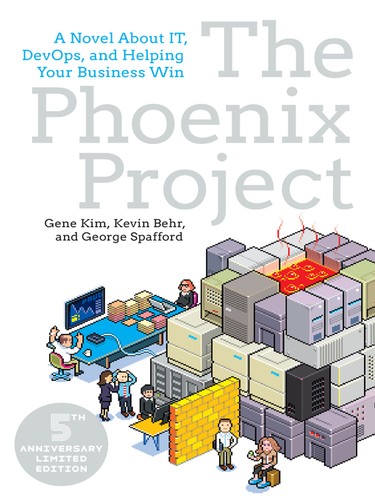
The Phoenix Project
A Novel About IT, DevOps, and Helping Your Business Win
When a critical business initiative at Parts Unlimited falls dangerously behind schedule, IT manager Bill Palmer is abruptly placed in charge of technology operations and given little time to restore order. He inherits unstable systems, conflicting priorities, exhausted employees, weak coordination, and a project whose failure could threaten the company. Guided by the enigmatic Erik, Bill begins treating technology work as a production system rather than an endless series of emergencies. The Phoenix Project uses a fictional corporate crisis to introduce DevOps, the Theory of Constraints, flow, feedback, controlled work in process, and continual learning. Its central argument is that reliable technology delivery depends less on isolated technical heroics than on understanding the entire value stream. By dramatizing the relationships among development, operations, security, executives, and business units, the novel shows how organizational design and management decisions shape technical…
Where to buy or borrow
Are you selling this book? Bookstores, publishers, authors and libraries can be listed here for free. Request a listing
About this book
The book connects IT operations and software delivery to ideas drawn from manufacturing, Lean management, quality improvement, and systems thinking. Concepts are introduced as Bill Palmer encounters practical consequences: outages, overloaded specialists, uncontrolled changes, audit demands, competing projects, and invisible queues of unfinished work. This narrative method makes abstract management principles concrete, though it also means the characters often serve explanatory roles. The selected fourth edition retains the novel’s enterprise-IT focus while presenting it to readers in a period when DevOps vocabulary is more established than it was at the work’s original 2013 publication.
Deep Overview
The novel gradually reframes this apparent collection of personnel and technology failures as a problem of system design. Work enters IT through many channels, priorities change faster than teams can complete tasks, and dependencies remain hidden until they cause delays. Because leaders reward visible activity and urgent escalation, the organization starts more work than it can finish. Local departments pursue their own targets while damaging the performance of the larger value stream.
Erik, a prospective board member and Bill’s mentor, pushes him to examine technology work through the lens of manufacturing and the Theory of Constraints. This leads Bill to identify bottlenecks, make work visible, reduce work in process, protect constrained resources, and distinguish among different forms of demand. Brent, a highly knowledgeable employee upon whom many systems depend, illustrates both the usefulness and danger of relying on a single heroic specialist. Every interruption directed toward Brent may solve an immediate problem, yet it also delays other critical work and prevents the organization from building broader capability.
The transformation extends beyond operations. Development, security, finance, audit, and senior leadership must recognize that software delivery and service reliability are shared business concerns. Faster movement cannot simply mean pushing more changes into production; it requires quicker feedback, safer experimentation, improved change practices, and learning from failures. The authors organize these ideas around the Three Ways: improving flow from business demand toward the customer, strengthening feedback from downstream work back toward its sources, and cultivating continual learning and experimentation.
The book’s deeper concern is managerial perception. Bill becomes effective not because he personally solves every technical issue, but because he learns to see queues, constraints, handoffs, conflicting incentives, and the cost of unplanned work. The Phoenix Project ultimately presents DevOps as an organizational operating model. Technology becomes capable of supporting business strategy when leaders stop treating IT as a separate service department and begin managing the full system through which ideas become reliable customer value.
Key Themes
**Constraints and work in process:** Starting too many tasks creates congestion and increases completion time. Identifying the limiting resource, controlling incoming demand, and finishing valuable work become more important than keeping everyone visibly busy.
**Feedback and operational learning:** Production incidents and downstream defects carry information about the delivery system. Shorter feedback loops allow teams to detect problems earlier and connect consequences with the decisions that produced them.
**Hero culture versus resilient capability:** Dependence on indispensable specialists may appear efficient during emergencies, but it makes the organization fragile. Shared knowledge, documentation, repeatable processes, and deliberate capacity building reduce that fragility.
**Business and IT alignment:** Technology work is presented as part of product delivery and competitive performance, not merely a cost center. Business leaders therefore share responsibility for priorities, risk, capacity, and technical debt.
**Continuous improvement:** Sustainable change emerges through repeated observation and experimentation rather than a single reorganization or tool purchase.
Historical and Intellectual Context
The book translates ideas associated with Lean production, the Toyota Production System, quality improvement, and Eliyahu M. Goldratt’s Theory of Constraints into enterprise technology work. Its instructional-novel format deliberately recalls Goldratt’s The Goal, which used a factory crisis to explain constraints and throughput. The Phoenix Project relocates that logic to a company where software, infrastructure, security, and business operations are tightly interdependent.
Modern readers may find terms such as DevOps, continuous delivery, value streams, and work-in-process limits more familiar than early readers did. Even so, the organizational problems dramatized in the story—competing priorities, overloaded experts, brittle systems, delayed feedback, and incentives that reward local optimization—remain broader than any particular generation of tools.
Intended Audience
Readers new to DevOps may appreciate the story-based introduction, while experienced practitioners can use the fictional situations to examine familiar organizational patterns. Those seeking detailed implementation instructions, current tool comparisons, software architecture guidance, or rigorous empirical research will need complementary material. Readers who strongly prefer subtle characterization or literary realism may also find the novel’s teaching-oriented dialogue conspicuous.
Reading Difficulty
The principal challenge is conceptual rather than linguistic. Readers must track how many small decisions combine into system-wide congestion and failure. The large cast represents different business and technical functions, so keeping their responsibilities straight may require attention early in the book. Some explanatory conversations pause the action to teach management principles, making the reading experience closer to a case study in novel form than to conventional commercial fiction.
Helpful Background Knowledge
A basic grasp of bottlenecks is also valuable: the capacity of an entire process is often limited by one constrained stage, even when other stages have spare capacity. Readers may additionally benefit from knowing that Lean approaches emphasize customer value, reduced queues and waste, smaller batches, visible work, and ongoing improvement. The novel itself develops these ideas, so preliminary reading is optional rather than necessary.
Why Read This Book?
Its particular value lies in linking operational reliability with business performance. Rather than presenting DevOps as a collection of engineering tools, it asks how executives select work, how managers protect capacity, how teams receive feedback, and how incentives influence behavior. That breadth makes the book useful as an entry point for organizational conversations, especially when technical and nontechnical participants need a shared example rather than another framework diagram.
Reader Takeaways
Readers may also reconsider whether their most celebrated problem-solvers are actually signals of organizational fragility. Repeated heroics can conceal missing documentation, weak automation, poor delegation, or excessive dependence on scarce knowledge. Incidents become opportunities to study the system rather than occasions to search immediately for an individual culprit.
More broadly, the book helps readers see technology risk and delivery capacity as leadership concerns. Product scope, operational stability, security, technical debt, and improvement work compete for the same finite resources and must be managed together.
Strengths
Its cross-functional scope is another advantage. Development, operations, security, audit, finance, project management, and senior leadership are shown as parts of one delivery system. This prevents DevOps from being reduced to an engineering technique or a new departmental label.
The narrative also provides memorable patterns that groups can reference in real discussions: the overloaded expert, invisible work, uncontrolled demand, constant expediting, and the conflict between urgent recovery and long-term improvement. The accessible format lowers the entry barrier for readers who might not choose a process-management textbook.
Limitations and Scope
Its treatment of DevOps reflects the enterprise concerns and vocabulary surrounding the work’s original 2013 publication. It is not a current technical guide to cloud platforms, platform engineering, site reliability engineering, observability, software supply chains, or modern security automation. Nor does it provide a detailed research basis for every managerial claim.
The factory analogy is illuminating but incomplete. Knowledge work includes ambiguity, discovery, and changing requirements that do not always behave like physical production. Readers should therefore treat the novel as a conceptual model and discussion catalyst, not as a universal implementation recipe.
Important Concepts and People
**Erik Reid:** A prospective board member who mentors Bill. He introduces the manufacturing analogy, constraints, the Three Ways, and questions that force Bill to diagnose the organization rather than chase isolated symptoms.
**Steve Masters:** The chief executive of Parts Unlimited. His demands connect the technology crisis to the survival and strategy of the wider company.
**Brent Geller:** A highly capable technical specialist whose knowledge is required almost everywhere. He embodies the organizational risks created by scarce expertise, interruptions, and hero dependence.
**Parts Unlimited:** The fictional automotive-parts company in which the story unfolds. It functions as a model of an established enterprise whose business performance has become inseparable from software and IT services.
**The Phoenix Project:** The company’s troubled strategic initiative. Its delays reveal systemic weaknesses extending far beyond the project team.
**DevOps:** An organizational approach intended to improve collaboration, flow, feedback, reliability, and learning across development, operations, and related functions.
**The Three Ways:** The book’s organizing principles: optimize system-wide flow, create rapid feedback, and foster continual experimentation and learning.
**Theory of Constraints:** A method centered on identifying and managing the factor that most limits system performance.
**Work in process:** Work that has begun but is unfinished. Excessive work in process increases queues, context switching, and lead time.
**The four types of work:** The book distinguishes business projects, internal IT projects, changes, and unplanned work so that hidden demand and lost capacity can be examined.
**Technical debt:** The accumulated future cost created by expedient or neglected technical decisions, often visible through fragility and slow change.
Questions Explored
How can leaders distinguish the immediate cause of an outage from the system conditions that made failure likely?
Why can maximizing the productivity of individual departments reduce the performance of the company as a whole?
How should constrained specialists and other scarce resources be protected without turning them into permanent gatekeepers?
What forms of feedback allow development, operations, security, and business teams to learn from one another?
When does urgent work represent genuine customer value, and when is it the recurring cost of unresolved weakness?
How can management create room for improvement when daily operations consume nearly all available capacity?
What does it mean to treat technology as part of the business value stream rather than as a separate support function?
Reading Group Guide
Track Brent’s role throughout the story. Note every kind of work that reaches him and consider which responses merely protect him temporarily and which reduce structural dependence on him. A second useful thread is unplanned work: identify what creates it, what planned work it displaces, and why its cost is difficult for executives to see.
Groups can assign participants to represent development, operations, security, audit, product leadership, and executive management. Revisit a major conflict from each perspective before judging the decision. Finally, separate the book’s enduring principles from practices tied to a particular technological era. Discuss which lessons transfer directly to the group’s environment and which require adaptation.
Discussion Questions
2. How does Bill’s understanding of leadership change as the story progresses?
3. Is Brent primarily an organizational asset, a constraint, or evidence of management failure? Why?
4. Which local performance measures appear reasonable but produce harmful system-wide behavior?
5. How does unplanned work alter the organization’s real capacity and its ability to make credible commitments?
6. Where does the manufacturing analogy clarify technology work, and where might it distort it?
7. How do fear, blame, and urgency affect the quality of operational learning?
8. Which responsibility for the Phoenix crisis belongs to IT, and which belongs to business leadership?
9. What would make the improvements survive after the immediate crisis and current leaders have passed?
10. Which principle from the book would be hardest to apply in your own organization, and what resistance would it encounter?
Sources and Verification
Comments
No published comments yet.
Available editions
Paperback
4th edition paperback
- Publisher
- IT Revolution
- ISBN-13
- 9781950508945
- Publication date