
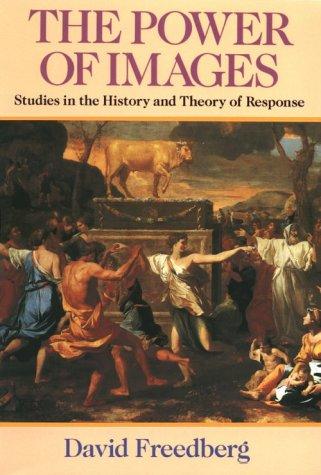
The Power of Images
Studies in the History and Theory of Response
Why do people pray before images, touch them, fear them, censor them, attack them, or respond to them sexually? David Freedberg argues that such behavior is not a marginal residue of superstition but evidence of a fundamental feature of visual experience: viewers frequently react to representations as though the depicted person or power were somehow present. Drawing on material from classical antiquity, Christianity, European popular devotion, legal punishment, magic, erotic art, and iconoclasm, he shifts attention from style and attribution to what images cause people to feel and do. Pilgrimage objects, votive offerings, effigies, visions, wax figures, and celebrated paintings consequently belong to one history of response. The book challenges the disciplinary boundary between “high art” and supposedly crude or irrational image use, proposing that embarrassment and aesthetic convention often conceal the bodily, emotional, and behavioral force of seeing.
Where to buy or borrow
Are you selling this book? Bookstores, publishers, authors and libraries can be listed here for free. Request a listing
About this book
Deep Overview
The opening chapters challenge the restriction of serious art history to culturally prestigious objects and disinterested contemplation. Images embedded in everyday devotion, folklore, ritual, or popular practice can disclose mechanisms that museum etiquette and critical vocabulary suppress. Freedberg also questions simple accounts of aniconism. Even traditions suspicious of figural representation may invest nonfigurative objects, places, signs, or materials with presence and efficacy. The deeper issue is not merely whether a culture permits pictures, but how visibility and material form mediate access to absent or invisible beings.
A major sequence follows the social production of image power. Consecration distinguishes a working sacred image from an ordinary artifact. Pilgrimage organizes movement toward a privileged object or site. Votive offerings establish reciprocal relations of petition and gratitude. Meditation employs visible forms to approach invisible realities. In such settings, looking is only one activity among many: people approach, touch, kiss, carry, dress, adorn, damage, or leave gifts before images. Stories of visions and miracles reinforce expectations that an image may act or that its prototype may become present through it.
Freedberg then examines resemblance and apparent life. Wax figures, effigies, portraits, and persuasive sacred representations can intensify the slippage between likeness and presence. An effigy may be honored or punished as a substitute for someone absent; injury to a likeness may symbolically or magically reach its subject. Erotic images reveal a related difficulty. Physical arousal can occur even while the viewer recognizes that the represented body is unavailable and artificial. Censorship attempts to regulate this power, but the censor’s anxiety may itself testify to an image’s anticipated effects.
Iconoclasm concentrates the book’s paradoxes. Image breakers may reject idolatry, political authority, obscenity, or falsehood, yet their attacks often treat representations as if they were vulnerable bodies: faces are scratched, eyes removed, and figures decapitated. Destruction thus denies an image’s authority while demonstrating belief in its potency. Freedberg concludes by reconsidering the distinction between representation and reality. His purpose is not to say that every viewer literally believes every image to be alive. Rather, he argues that the recurrent tendency to respond as if presence exceeded representation must be taken seriously. Art history, on this account, is incomplete unless it studies behavior, emotion, embodiment, and inhibition alongside objects, makers, styles, and meanings.
Key Themes
**Response and repression:** Viewers often inhibit or redescribe intense reactions because cultivated aesthetic discourse values distance, judgment, and self-control. Freedberg asks what such restraint conceals.
**Image agency and efficacy:** Consecration, miracle accounts, vows, ritual gestures, and magical practices attribute practical effects to images. Their power is not located only in appearance but in institutions, narratives, ceremonies, and expectations.
**Embodied viewing:** Fear, tears, desire, disgust, tenderness, and aggression demonstrate that vision is connected to the body rather than functioning as detached interpretation alone.
**The hierarchy of high and low images:** Votive objects, waxworks, effigies, and popular devotional pictures matter because they reveal responses often obscured when an object is protected by the category of fine art.
**Iconophilia and iconoclasm:** Love of images and violence against them are not simple opposites. Both may arise from attributing unusual presence or force to representation.
**Universality and cultural difference:** The book seeks recurrent patterns across periods and societies. That comparative ambition gives the argument its reach but also raises questions about whether historically distinct practices can be gathered under one psychological model.
Historical and Intellectual Context
The study also belongs to a broader late-twentieth-century reconsideration of spectatorship, popular culture, ritual, and the authority of disciplinary categories. Its attention to votive practice and pilgrimage connects art history with religious history and anthropology, while its treatment of arousal, fear, inhibition, and aggression moves toward psychology. Later scholarship in visual culture, image theory, material religion, iconoclasm, and neuroaesthetics has continued to engage questions the book helped make prominent. At the same time, critics have challenged its claims about broadly recurring or universal responses, emphasizing social class, politics, local theology, gender, colonial histories, and culturally specific ways of seeing.
Intended Audience
It is less suitable as a first, compact introduction to Western art or as a practical guide to interpreting individual masterpieces. The book assumes patience with extended argument, historical documentation, and examples drawn from several periods. Readers seeking a contemporary study of digital images or a primarily political account of monuments will need to supplement it with newer scholarship.
Reading Difficulty
The thematic chapter structure makes selective reading possible, but the cumulative argument is easier to appreciate when the opening discussion of response and repression is read first. Because individual cases come from different centuries and settings, readers must repeatedly distinguish the specific historical evidence from the broader theory built from it.
Helpful Background Knowledge
No specialized knowledge of a single artistic period is essential. It helps, however, to approach terms such as “belief,” “magic,” and “idolatry” critically, since they may describe polemical accusations as well as practices. Readers should also keep separate three questions that the book deliberately brings into contact: what an image depicts, what a community says the image is, and what people actually do in its presence.
Why Read This Book?
It is also valuable as a methodological provocation. Freedberg asks whether placing an object in a museum and calling it art changes the terms under which its effects can be acknowledged. That question remains productive wherever images generate public conflict, intimate attachment, or demands for removal. Even readers unconvinced by the full theory can use the book to test how adequately their preferred historical or political explanations account for emotion, sensation, and bodily action.
Reader Takeaways
The book also encourages attention to gestures. Touching, averting the eyes, damaging a face, offering a gift, or imposing a veil can reveal assumptions that verbal doctrine does not fully admit. Censorship and destruction may inadvertently confirm the importance of the objects they seek to neutralize. Finally, the reader gains a productive caution: recurring patterns do not erase historical difference. A strong account of image response must hold psychological continuities and culturally specific meanings in tension.
Strengths
Its organization is another advantage. Chapters isolate distinct mechanisms—consecration, pilgrimage, resemblance, arousal, censorship, iconoclasm—while contributing to a single theory of response. The book is particularly effective at revealing contradictions: the sophisticated viewer who feels bodily desire, the censor who magnifies what is prohibited, and the iconoclast who attacks an inert object as though it could be punished. Its insistence on embodied and emotional experience helped make questions of spectatorship and image efficacy harder for art historians to avoid.
Limitations and Cautions
The category of “response” can also become broad enough to gather together actions requiring different explanations. Devotional touch, sexual arousal, legal punishment of an effigy, and revolutionary monument destruction may share features without arising from one mechanism. Contemporary debates about monuments especially demonstrate that embodied reaction should be considered alongside ideology, collective memory, organized protest, and struggles over public space.
Finally, the book predates social media, networked circulation, synthetic imagery, and today’s extraordinary scale of visual reproduction. Its central questions remain applicable, but its historical evidence does not directly explain the speed, repetition, and algorithmic distribution of digital images.
Important Concepts, People, Places, and Traditions
**Response:** The book’s central category, encompassing emotional, physiological, behavioral, devotional, and destructive reactions rather than interpretation alone.
**Response and repression:** Freedberg’s account of how people react forcefully to images yet suppress, intellectualize, or deny those reactions under the discipline of aesthetic judgment.
**Aniconism:** The avoidance or prohibition of figural images. Freedberg contests the idea that aniconic traditions simply escape investment in visible or material forms.
**Consecration:** A rite or process that marks an image as sacred and efficacious. It helps explain why two materially similar objects may invite radically different conduct.
**Pilgrimage and votive practice:** Pilgrims travel to privileged images or shrines, while votive objects materialize petitions, promises, cures, gratitude, or remembered danger. Both turn spectatorship into reciprocal action.
**Christian devotional culture:** Much of the evidence comes from medieval and early modern practices involving Christ, the Virgin Mary, saints, shrines, visions, and miracle-working images.
**Byzantine iconoclasm:** The eighth- and ninth-century controversies over sacred images provide a major historical setting for disputes about representation, worship, matter, and divine presence.
**The Protestant Reformation:** Reformation attacks on religious imagery, particularly in northern Europe, are crucial to the book’s treatment of doctrinal opposition, collective violence, and the perceived potency of images.
**Effigy:** A substitute representation that may receive honor, punishment, or violence directed symbolically toward an absent person.
**Sympathetic magic:** The idea that acting on a likeness can affect what it represents. Freedberg uses related practices to investigate the persistent fusion of image and prototype.
**Iconoclasm:** The breaking, defacement, or removal of images for religious, political, moral, or psychological reasons. For Freedberg, attacks often expose belief in the image’s force.
**Censorship:** The regulation or concealment of images believed capable of exciting desire, error, disorder, or impiety. It is both an institutional action and evidence of anticipated response.
**Titian’s Venus of Urbino:** An important example in the discussion of erotic response, where bodily arousal complicates the ideal of detached aesthetic contemplation.
**Pygmalion:** The classical story of a sculptor whose created figure becomes animate supplies a recurring model for fantasies about images crossing into life.
**John of Damascus:** The Byzantine theologian is significant to the defense of sacred images and to arguments distinguishing proper veneration from idolatrous worship.
Questions the Book Explores
What is lost when art history excludes tears, touch, prayer, fear, desire, disgust, and aggression from its explanations?
How do consecration, pilgrimage, vows, miracle stories, and ritual handling make images effective within communities?
Can a culture truly dispense with images, or does visual and material investment reappear in other forms?
Why can resemblance support devotion, legal substitution, erotic attraction, magical action, or violence?
Does destroying an image demonstrate disbelief in it, or reveal anxiety about its power?
How does the category of fine art regulate which responses count as educated, legitimate, or discussable?
Which aspects of image response plausibly recur across cultures, and which require local historical explanation?
Reading Group Guide
Compare three kinds of encounter: a pilgrim approaching a sacred image, a viewer responding to an erotic painting, and an iconoclast damaging a statue. Notice how each case joins knowledge of material representation to behavior that treats the image as more than inert matter. Ask whether one theory adequately explains all three.
Pay special attention to the difference between reported conduct and inferred mental states. Historical sources may document gifts, journeys, attacks, prohibitions, or repairs more securely than private belief. Discuss how far behavior permits psychological conclusions.
For a contemporary connection, select a disputed public monument, censored artwork, or rapidly circulated digital image. Use Freedberg’s categories to identify embodied response, substitution, presence, and repression, then identify what must be added from political or media analysis. Conclude by considering whether museums weaken image power through distance or create new forms of authority around objects.
Discussion Questions
2. When does treating an image “as if” it were alive amount to belief, and when might it be metaphor, convention, play, or ritual discipline?
3. Are devotional attachment and iconoclastic violence psychologically related, or does this comparison obscure their different purposes?
4. How does consecration change an object’s status, and who has the authority to make that change socially effective?
5. What kinds of viewer response are encouraged by museums, and which are discouraged or prohibited?
6. Does the category of fine art weaken an image’s practical power, or can institutional prestige intensify it?
7. Which of the book’s examples most strongly supports a recurring pattern across cultures? Which most resists generalization?
8. How should political organization, social class, gender, and institutional power modify a psychological theory of iconoclasm?
9. What can damaged eyes, faces, or bodies in images reveal that written statements by image breakers cannot?
10. How might the argument change if it were developed around memes, deepfakes, livestreams, or algorithmically repeated images?
11. Is censorship best understood as evidence of an image’s power, an attempt to produce that power, or both?
12. Where should scholarship draw the line between empathetically understanding an intense response and accepting the respondent’s claims about an image?
Sources and Verification
Comments
No published comments yet.
Available editions
Hardcover
First edition, hardcover
- Publisher
- University of Chicago Press
- ISBN-13
- 9780226261447