
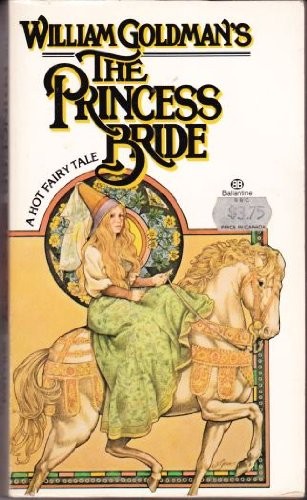
The Princess Bride
S. Morgenstern’s Classic Tale of True Love and High Adventure, the “Good Parts” Version
William Goldman presents a comic adventure about Buttercup, Westley, and the ruthless Prince Humperdinck—but disguises it as his abridgment of an older novel by the invented S. Morgenstern. The romance unfolds through abduction, swordplay, revenge, deception, torture, and unlikely alliances. Around that tale, a fictionalized Goldman interrupts to explain what he has supposedly removed and why the story mattered to him as a child. The result is both an absorbing fairy-tale adventure and a playful examination of how stories are selected, reshaped, remembered, and passed between generations. Its wit does not cancel its emotional stakes: loyalty, grief, courage, and the difficult survival of love remain central.
Where to buy or borrow
Are you selling this book? Bookstores, publishers, authors and libraries can be listed here for free. Request a listing
About this book
Deep Overview
A mysterious man in black follows the kidnappers through a sequence of escalating trials. He defeats Inigo in fencing, overcomes Fezzik in a contest of strength, and outthinks Vizzini. Goldman gives each confrontation its own tone, but he also interrupts the chase to develop the histories of Inigo and Fezzik. Inigo has devoted his life to finding Count Rugen, the six-fingered man who murdered his father, Domingo Montoya. Fezzik, formidable in size but gentle in temperament, has been exploited for his strength. These histories turn apparent stock figures into emotionally intelligible characters.
The rescue of Buttercup does not end the danger. Prince Humperdinck, an obsessive hunter more interested in power and pursuit than marriage, is engineering conflict with Guilder. Count Rugen assists him through cruelty disguised as inquiry, using Westley as the subject of experiments in suffering. Inigo and Fezzik eventually change sides, and their separate needs—for purpose, friendship, and revenge—converge with Buttercup and Westley’s struggle to escape.
The second level is Goldman's elaborate framing device. A fictional version of William Goldman claims that The Princess Bride was written by S. Morgenstern and read aloud to him by his father. When he later encounters the supposed original, he discovers that his father skipped long passages and preserved only the exciting material. He therefore offers a “good parts” edition, interrupting it with explanations, memories, publishing disputes, and comments about storytelling.
This premise is itself fictional: Morgenstern, the original book, and Goldman's editorial labor are inventions. The deception is not merely a joke. It asks who controls a story—the supposed author, the editor, the reader, or the person who first gives it emotional meaning. Goldman simultaneously celebrates narrative pleasure and warns that cherished stories are always shaped by omission, interpretation, and memory. That double movement gives the novel its unusual character: it can believe deeply in courage, love, and loyalty while refusing to treat fairy-tale conventions as innocent or simple.
Key Themes
- **Idealism tested by reality:** True love, heroic revenge, and noble courage matter, yet none guarantees an orderly or painless outcome.
- **Performance and identity:** Westley, Inigo, Fezzik, Buttercup, and even “William Goldman” occupy roles whose apparent simplicity conceals more complicated selves.
- **Friendship as rescue:** Cooperation among damaged or isolated people becomes as important as romantic devotion.
- **Revenge and its limits:** Inigo’s mission gives his life direction, but the book also asks what identity remains when a defining purpose is fulfilled.
- **Power, cruelty, and control:** Humperdinck and Rugen represent different forms of domination—political calculation, physical force, and detached experimentation.
- **Memory and inheritance:** The frame treats stories as emotional legacies passed through families, altered by the conditions in which they are heard.
Historical Context
Its imaginary European setting draws on older traditions rather than a single historical period: courtly romance, succession politics, pirate lore, revenge tragedy, and the fencing adventures associated with writers such as Alexandre Dumas. Goldman filters these traditions through twentieth-century comic skepticism. His professional experience as both novelist and screenwriter also matters: the action is built from sharply staged encounters, reversals, and verbal contests, while the narrative commentary questions what counts as an entertaining story.
The novel predates Rob Reiner’s 1987 film, whose screenplay Goldman wrote. Readers familiar with the adaptation should remember that this 1981 edition belongs to the book’s earlier publishing life and is not a film tie-in retelling.
Intended Audience
It can work for mature teenage readers and adults, although its torture, violence, sexual references, cynical family material, and deliberate blurring of fact and fiction may require context for younger readers. Those seeking immersive world-building without authorial interruption, or an entirely earnest romance, may find its frame disruptive.
Reading Difficulty
Vocabulary is moderate, while the fencing references and mock-historical details occasionally introduce specialized terms. Pacing varies intentionally: exciting sequences alternate with backstories, digressions, and commentary. The violence is often stylized, but torture and revenge carry genuine emotional weight. Readers who accept interruption as part of the design will usually find the structure more rewarding than those expecting a seamless adventure.
Helpful Background Knowledge
Familiarity with fairy tales, courtly romance, pirate stories, and swashbuckling fiction will make the parody easier to recognize. Readers coming from the film may also benefit from treating the novel as a related but distinct work rather than searching only for scenes and lines preserved on screen.
Why Read This Book?
The novel also gives substantially more interior history to Inigo, Fezzik, and the frame narrator than an action-centered summary can convey. It is therefore valuable both as comic fantasy and as an approachable introduction to metafiction—one in which formal experimentation remains tied to suspense, character, and emotion.
Reader Takeaways
Readers may also reconsider the difference between love as an ideal and love as a sustained practice; the ways revenge can organize a life; and the role friendship plays in restoring purpose. Finally, the novel encourages healthy suspicion toward confident narrators, authoritative introductions, and publishing lore. Emotional truth and factual truth are not treated as interchangeable, even when an invented story powerfully shapes a life.
Strengths
- Distinctive voices and forms of competence make the major characters immediately recognizable.
- Action scenes are clearly structured around contrasting skills: fencing, strength, strategy, endurance, and deception.
- Inigo and Fezzik receive histories that complicate their initial roles as hired criminals.
- Comedy and danger reinforce each other rather than occupying separate parts of the novel.
- Goldman's invented scholarly and publishing history extends the satire beyond fairy tales to authorship and literary authority.
- The book remains accessible despite its formal experimentation because its central conflicts are concrete and urgent.
Limitations and Cautions
Buttercup is central to the action but receives less psychological complexity and practical agency than several male characters. The romance often depends upon archetype, exaggeration, and verbal certainty rather than a detailed account of mutual growth. Violence includes murder, poisoning, threats of mutilation, prolonged torture, and suicide-related material. Lastly, this early paperback does not contain the anniversary material and later supplemental features found in some subsequent editions.
Important Concepts, People, and Places
- **Westley:** Buttercup’s farm boy and beloved, defined by adaptability, endurance, and his ability to inhabit strategic identities.
- **Inigo Montoya:** A master swordsman searching for the six-fingered man who murdered his father; his revenge plot supplies the novel’s clearest study of purpose and grief.
- **Fezzik:** A giant trained and exploited as a fighter whose kindness, loneliness, and loyalty challenge assumptions based on physical power.
- **Prince Humperdinck:** Florin’s calculating heir, an expert hunter who treats people and nations as pieces in a political scheme.
- **Count Rugen:** Humperdinck’s six-fingered associate, responsible for Domingo Montoya’s death and for systematic experiments in pain.
- **Vizzini:** The Sicilian planner who abducts Buttercup and embodies intelligence corrupted by vanity and overconfidence.
- **Miracle Max and Valerie:** A combative but effective couple whose intervention turns resurrection into comic bargaining and practical craft.
- **S. Morgenstern:** The fictitious author of the fictitious original text; Goldman's use of him creates the book’s central illusion of editorial authenticity.
- **The Goldman persona:** A partly autobiographical but fundamentally fictional narrator who claims to abridge Morgenstern and directs readers’ responses.
- **Florin:** The principal imaginary kingdom, ruled through monarchy and threatened by Humperdinck’s ambitions.
- **Guilder:** Florin’s neighboring rival and the intended target of Humperdinck’s manufactured conflict.
- **The Dread Pirate Roberts:** A feared identity whose history complicates conventional notions of individual fame and authorship.
- **The “good parts” principle:** The narrator’s claim that he removes dull material; it becomes a metaphor for how memory, reading, and adaptation construct meaning.
- **Metafiction:** Fiction that draws attention to its own artificial nature; here it operates through false authorship, editorial interruptions, and fabricated publication history.
Questions the Book Explores
- Can a work ridicule fairy-tale ideals while continuing to believe in love, courage, and heroism?
- How does an editor or adapter change a work by deciding which passages are essential?
- What happens when revenge becomes a person’s primary source of identity?
- Is intelligence valuable without humility, loyalty, or moral judgment?
- How do names, titles, masks, and reputations acquire power?
- Are stories inherited from family remembered as they were told, or rebuilt around later needs?
- What separates a trustworthy narrator from a persuasive one?
- Can friendship provide a more durable form of rescue than romantic destiny?
Reading Group Guide
Groups familiar with the film can compare one sequence, focusing not on which version is “better” but on what changes when Goldman's interruptions and character histories are removed or transformed. Another productive exercise is to list the kinds of passages the narrator claims to cut and discuss whether his “good parts” theory is defensible. Conclude by considering the ending’s balance of escape, uncertainty, romance, and realism. First-time readers should decide together whether to disclose the Morgenstern conceit before discussion; knowing it is fictional prevents bibliographic confusion but changes the experience of discovery.
Discussion Questions
2. When do the narrator’s interruptions deepen the adventure, and when do they weaken its momentum?
3. Does the novel ultimately defend true love, question it, or do both at once?
4. How does Inigo’s pursuit of Count Rugen shape his understanding of himself?
5. What does Fezzik’s history reveal about the difference between strength and power?
6. How are Vizzini’s intelligence and Humperdinck’s competence limited by their assumptions about other people?
7. In what ways is Buttercup an active participant in her fate, and where does the genre restrict her?
8. What parallels exist between the Dread Pirate Roberts identity and the supposed transmission of Morgenstern’s book?
9. How would the novel change if its framing narrative were removed?
10. Which “good parts” would each group member preserve in an abridgment, and what would those choices reveal?
11. Does the book’s comedy soften its cruelty, or make that cruelty more noticeable?
12. What kind of ending does the novel offer: fairy-tale fulfillment, realistic uncertainty, or a deliberate collision of both?
Sources and Verification
Comments
No published comments yet.
Available editions
Paperback
1981 mass-market paperback edition
- Publisher
- Ballantine Books
- ISBN-13
- 9780345301147
- Pages
- 283