
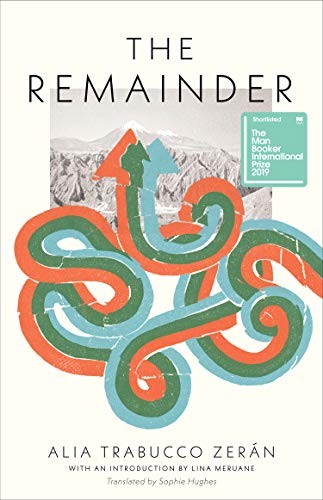
The Remainder
The Remainder is the debut novel by Chilean writer Alia Trabucco Zerán, first published in Spanish as La Resta in 2015 and rendered into English by translator Sophie Hughes. Set in Santiago against the long shadow of Pinochet's dictatorship, the book follows three young adults—childhood friends whose parents were anti-regime militants—on a hearse-driven journey across the Andes to recover the lost body of one friend's mother. Told in alternating first-person chapters, the novel examines how political violence and inherited loss persist in the generation that never chose them. Shortlisted for the 2019 Man Booker International Prize, it stands as a striking example of translated fiction from Latin America that treats intergenerational trauma with formal originality and emotional precision.
Where to buy or borrow
Are you selling this book? Bookstores, publishers, authors and libraries can be listed here for free. Request a listing
About this book
Deep Overview
The structural alternation between Felipe and Iquela is not merely a stylistic choice but a philosophical one. Felipe's chapters descend in number—11, 10, 9—toward a mythical zero where the account of the dead is finally settled. Iquela's chapters carry empty parentheses, suggesting containment, omission, a refusal to resolve. Between them, Paloma's story is told indirectly, through their perceptions and memories. Her parents fled to Germany during the dictatorship; her mother Ingrid has died, and her body is lost in transit, rerouted to Argentina. The three rent a hearse and drive across the cordillera to find it, and the road trip provides the novel's physical momentum.
Zerán's central argument is that political violence does not end with the generation that experienced it. It adapts, metastasizes, and reappears in the forms its children can manage: Iquela's compulsive scratching, Felipe's obsessive body-counting, Paloma's ritualistic rearrangement of food photographs. The parents' militant past—cells, betrayals, exiles, the 1973 coup and its aftermath—forms an invisible architecture in every room. Names have been changed (Iquela's mother is both Consuela and Claudia), and the act of renaming itself becomes a small political gesture that the children inherit without fully understanding.
The volcanic ash that rains on Santiago throughout the road trip functions as a persistent symbol: the past settling over the present, uninvited, covering everything in a uniform grey. The novel draws on the Chilean literary tradition while positioning itself at a generational boundary its predecessors did not occupy. Where Bolaño wrote from exile and Zambra from the immediate aftermath, Zerán writes from the third generation's perspective—those for whom the dictatorship is not a memory but a inheritance, a set of inherited silences and unexplained griefs. The title operates on at least three levels: the mathematical leftover, the living descendants, and the residue of a history that refuses clean resolution.
Key Themes
The impossibility of accounting for the disappeared: Felipe's compulsive subtraction of bodies dramatizes a national wound—thousands officially missing, only a handful ever recovered. The "remainder" is both a mathematical term and an emotional state: what is left over, unresolvable.
Political identity as domestic inheritance: the parents' militant past is not a public history but a private one, lived in kitchens, bathrooms, and dinner tables. The political becomes the personal through altered names, unexplained grief, and obsessive routines.
The body as site of memory and violence: whether it is Iquela's scratched hands, Felipe's fascination with what lies inside a body, or Paloma's mother's corpse in transit, the physical form becomes the locus where history is felt most acutely.
Compulsion as a response to unresolvable loss: the characters' repetitive, self-inflicting behaviors—scratching, counting, rearranging, driving—are presented not as pathology but as the only available grammar for grief that has no endpoint.
Language, naming, and translation: the novel is self-conscious about the gap between what is said and what is meant. Paloma's German-inflected Spanish, Iquela's mother's double name, and the act of translation itself all underscore the difficulty of making inherited experience legible.
Historical Context
The novel's characters are in their thirties during the main narrative, meaning they were toddlers or infants during the regime's worst years. Their parents, however, were active anti-government militants: members of cells, participants in the resistance, some executed, some exiled, some simply gone. This generational positioning—too young to remember, old enough to inherit—places The Remainder within a specific wave of Chilean writing that addresses the dictatorship's legacy from the perspective of its children.
The broader literary context includes Roberto Bolaño, who fled Chile after the coup and wrote extensively about exile and transience; Pedro Lemebel and José Donoso, who documented the regime's impact on those who lived through it directly; and the newer generation including Alejandro Zambra and Nona Fernández, whose work similarly reckons with the aftermath of political terror. The concept of the "Generation of 30," articulated by Chilean critic Marco Antonio de la Parra, describes those who came of age in the immediate post-dictatorship years and felt caught between the failures of their parents' revolution and the compromises of the new democracy. Zerán's characters belong to a generation just after this one, inheriting the same unresolved history from a slightly greater distance.
Internationally, the Pinochet regime is often cited as an early example of what Naomi Klein later termed the "shock doctrine," in which a political crisis is exploited to implement sweeping economic and social change. The novel does not engage with the economics directly, but the political architecture it describes—surveillance, disappearance, the silencing of dissent—forms the invisible backdrop against which every domestic scene plays out.
Intended Audience
Book clubs seeking a thematically dense novel with built-in structural discussion points—alternating voices, the road-trip frame, the question of who owns the past—will find rich material here. Readers who have enjoyed the work of Alejandro Zambra, Nona Fernández, or Cristina Rivera Garza are likely to connect with its sensibility.
The novel may be less suitable for readers who prefer straightforward, plot-driven narratives with clear resolution. The stream-of-consciousness passages, particularly in Felipe's chapters, demand patience. The political backstory is deliberately left opaque, which may frustrate readers who want a more explicit historical account. It is not a page-turner; it is a book that rewards slow, re-reading attention.
Reading Difficulty
The non-linear structure means the reader encounters the 1988 plebiscite night, the present-day road trip, and various childhood memories in an intercut sequence. The political backstory is revealed gradually and often indirectly; Pinochet is never named, and the specific events of the parents' militant past remain largely allusive. Readers must be comfortable with a narrative that withholds explicit explanation.
Vocabulary is generally accessible in the English translation, though Sophie Hughes's rendering preserves the original's syntactic complexity and occasional neologistic play. The 240-page length is moderate, but the density means the book reads as though it is considerably longer. No specialized academic knowledge is required, though a basic familiarity with the broad outlines of Chilean political history will help the reader situate the characters' unspoken grief.
The dual-voice structure rewards readers who enjoy tracking perspective and whose reading habit accommodates books that shift register mid-chapter. It is less forgiving to readers who prefer a single, steady narrative thread.
Helpful Background Knowledge
Readers with some exposure to Latin American literary traditions—particularly the magical-realist and metafictional modes associated with Bolaño, or the intimate political realism of Zambra—will recognize the novel's place in a broader conversation. However, The Remainder does not require knowledge of those specific authors. It stands as a self-contained work of translated fiction that draws on its own internal logic.
A general interest in questions of intergenerational trauma, whether from psychology, history, or personal experience, will help the reader recognize the novel's larger argument without needing to identify it as such. The book does not explain its own themes in didactic terms; it trusts the reader to feel the weight of what is inherited and to sit with the absence of clean answers.
Why Read This Book?
For readers looking for a book that treats the past not as backdrop but as a living, breathing presence in the present tense of the characters' bodies, this is a singular choice. The novel does not ask you to feel sorry for Chile; it asks you to feel the specific, idiosyncratic way grief adapts when it has no owner. Iquela's scratched hands, Felipe's irrational math, Paloma's rearranged plates—these are not symbols in the abstract sense. They are the only language the characters have for a history they did not make.
The road-trip frame gives the book a narrative engine that prevents it from becoming a static meditation. The hearse, the pisco, the volcanic ash, the dark humor of three traumatized adults playing word games in the back of a coffin—all of it keeps the novel moving even as it lingers. It is a book that earns its intensity without ever losing its sense of the strange, the absurd, the almost funny in the middle of grief.
Reader Takeaways
The book also reframes the concept of "the disappeared" away from its purely political or legal register and toward the personal, emotional absence that a missing body creates for a family. Paloma's quest to find her mother's corpse is as much about her own need to complete a story as it is about a civic duty. The remainder is not just the dead who cannot be counted. It is the living who cannot stop counting.
Readers may also gain an appreciation for how narrative form—chapter structure, voice, the choice between one long sentence and a series of short ones—can embody a theme rather than merely illustrate it. The alternation between Felipe and Iquela is not a gimmick. It is the novel's argument made visible: that there is no single way to carry a history, and that the forms we use to tell it are part of the wound itself.
Finally, the novel invites readers to notice their own compulsions—the small, repetitive behaviors they use to manage unresolvable feeling—and to recognize them as a kind of language, however incomplete.
Strengths
The characterization of three distinct responses to inherited trauma—Felipe's obsessive quantification, Iquela's domestic containment, Paloma's performative freedom—is specific and psychologically credible without being reductive. Each character's compulsion is rooted in a particular relationship to the past, and the novel honors the difference between them rather than collapsing them into a single archetype.
Sophie Hughes's translation is widely praised for preserving the original's rhythmic intensity and lyricism while making the syntax work in English. The book reads as though it were written in English, which is a genuine achievement given the novel's reliance on long, unbroken sentences and its play with register.
The road-trip frame provides narrative momentum that prevents the book from becoming a purely interior meditation. The hearse, the pisco-soaked stops, the dark humor of three adults squeezing into the back of a coffin—these elements give the novel a physical, almost comic energy that balances its heavier themes.
As a work of translated fiction, the novel demonstrates that Latin American literary tradition is not a single mode. The Remainder is oblique, formally adventurous, and deeply personal in a way that distinguishes it from both the magical-realist canon and the more explicit political novels of the previous generation.
Limitations and Cautions
The political backstory of the parents' generation is deliberately left opaque. This is a conscious authorial choice that serves the novel's argument about inherited silence, but it can feel like a limitation for readers who want a more complete picture of the parents' militant lives. The specific events, the cells, the betrayals are alluded to rather than dramatized, and the result is a book that asks you to accept a great deal of backstory as given.
The plot—finding the lost body, the road trip across the Andes—is serviceable but underdeveloped relative to the thematic weight the book carries. The hearse journey provides structure, but the stakes of the search are never fully dramatized. The novel is more interested in the emotional landscape than in the logistics of the quest, and readers who want a tighter plot engine may find the middle sections meandering.
The stream-of-consciousness style, while central to the book's identity, is not for every reader. The long, unbroken sentences, the temporal jumps, and the shifting perspectives require sustained concentration. This is a book that rewards patience and rereading more than it rewards speed.
The novel's treatment of gender is complex but uneven. Iquela and Paloma's relationship is richly drawn, but the novel's exploration of how the inherited trauma differs by gender remains suggestive rather than fully developed. Felipe's voice, while compelling, occasionally veers into a territory of violence that can feel gratuitous rather than purposeful.
Important Concepts, People, and Places
The 1988 Chilean plebiscite: The single most important historical event referenced in the novel. The night of October 5, 1988, when Pinochet was voted out, is the formative evening of Iquela's and Paloma's childhood. It anchors the novel's temporal structure and marks the boundary between the parents' world and the children's.
The disappeared (los desaparecidos): The category of people killed by the regime and whose bodies were never recovered. Felipe's obsessive counting is an attempt to resolve the arithmetic of this category. The remainder in the title is, at its most literal, the gap between the number of the dead and the number of bodies accounted for.
Santiago, Chile: The city where the novel is set. The streets, the houses, the traffic, the rain of volcanic ash—Santiago is both a physical location and a palimpsest of the regime's violence. The city is where the bodies appear and where the hearse eventually leaves.
The Andes / the cordillera: The mountain range the three characters cross in the hearse. The journey across the cordillera is the novel's physical spine, a literal traversal of the country's geography that mirrors the emotional distance between the characters and their past.
Alia Trabucco Zerán: The novel's author, born in Santiago in 1983. She holds an MFA from New York University and a PhD from University College London. The Remainder is her debut novel, and the book places her within the lineage of Chilean writers who address the dictatorship's legacy.
Sophie Hughes: The English translator, an award-winning specialist in Spanish-language literature. Her translation preserves the novel's rhythmic intensity and is central to the book's reception in English-speaking readership.
And Other Stories and Coffee House Press: The two publishers that brought the novel to English-language readers. And Other Stories published the first English edition in 2018; Coffee House Press published the US edition in 2019.
The 2019 Man Booker International Prize: The shortlisting of The Remainder for this prize brought the novel to a wider international audience and affirmed its significance within the broader field of translated fiction.
Roberto Bolaño and Alejandro Zambra: Fellow Chilean writers whose work forms the literary context for The Remainder. Bolaño wrote from exile about the regime's aftermath; Zambra wrote from the immediate post-dictatorship period. Zerán's novel extends this conversation to the next generation.
Questions the Book Explores
Who owns the past? The characters are haunted by a history they did not make, a violence they did not perpetrate and did not prevent. The novel asks whether the children of militants have a right to grieve a loss they did not live, or whether that grief belongs, somehow, to a different set of claims.
Is it possible to account for the dead? Felipe's arithmetic—subtracting, tallying, trying to reach zero—poses a question that the novel never resolves. The number of the disappeared will never match the number of bodies found. What does it mean to live in a country where the sum is never balanced?
How does identity form under the weight of inherited silence? The characters' relationships to their parents, to their names, to their country are all shaped by what was not said, not remembered, or deliberately forgotten. The novel suggests that identity in the shadow of dictatorship is partly a performance, a way of managing an inheritance that was never fully explained.
What is the function of compulsion in the face of unresolvable grief? Iquela's scratching, Felipe's counting, Paloma's rearranging—these behaviors are presented not as symptoms to be cured but as the only available response to a loss that has no endpoint. The novel asks whether the compulsion is the wound or the healing.
Can narrative resolve what history has left unresolved? The novel's formal structure—its alternation, its omissions, its single-sentence chapters—enacts the very impossibility it describes. The story cannot close. The remainder persists. The question is whether the act of telling, of driving the hearse, of writing the sentence, is enough.
Reading Group Guide
Divide the novel into three sections for discussion: the opening (Felipe's first chapters and the 1988 plebiscite memory), the middle (the road trip begins, the hearse, the ash), and the final stretch (the climax and the book's ambiguous resolution). Each section can generate its own conversation about structure, character, and theme.
Ask the group to identify the specific compulsions each character exhibits—scratching, counting, rearranging, driving—and discuss whether these feel like pathology, adaptation, or something else. Is the novel asking us to judge these behaviors or simply to witness them?
The parents are largely absent. Discuss what it means that their story is told through the children's fragmented, unreliable memories rather than through their own voices. Is this a limitation or a deliberate choice that serves the novel's argument? What do we gain and lose by not hearing the parents speak?
The hearse is the novel's most sustained image. Discuss its function: is it a vehicle, a coffin, a womb, a stage? What does it mean that three living people drive a vehicle designed for one dead one?
Finally, ask the group: what is the remainder? Let the discussion sit with the question without forcing a single answer. The novel insists on multiplicity, and the group's response should honor that.
Discussion Questions
Iquela and Paloma first meet on the night of the 1988 plebiscite. The novel returns to this evening repeatedly, but each retelling shifts the details. What does this instability suggest about memory, about the relationship between a child's experience and the adult narrative that later claims it?
Felipe's obsession with subtracting dead bodies is the novel's most extreme image. At what point, if any, does it become less compelling? Does the repetition serve the novel's argument, or does it work against the reader's engagement?
The parents' militant past is never fully explained. Their names are changed, their stories are half-told, their motivations are opaque. Do you find this opacity frustrating, or does it feel true to the way inherited history actually works? Would a more explicit account have strengthened or weakened the novel?
Paloma's mother Ingrid dies in Germany, and her body is lost in transit. The search for the body drives the plot, but the novel seems more interested in the emotional significance of the search than in its resolution. What does the lost body represent for Paloma, and for the novel as a whole?
The road trip includes moments of dark humor—word games in the back of the hearse, the pisco, the absurdity of the situation. How does comedy function in a novel about grief and political violence? Does the humor undermine the seriousness, or does it make the seriousness more bearable?
The novel is set in a specific place and time, but its themes—inherited trauma, the impossibility of accounting for loss, the gap between generations—are universal. To what extent does The Remainder depend on its Chilean specificity, and to what extent could its emotional logic be transplanted to another context?
The title operates on multiple levels: the mathematical remainder, the living descendants, the residue of an unresolved history. Which meaning felt most central to you as you read, and did that shift as the novel progressed?
Sources and Verification
Comments
No published comments yet.
Available editions
Paperback
- Publisher
- Coffee House Press
- ISBN-13
- 9781566895507
- Pages
- 240