
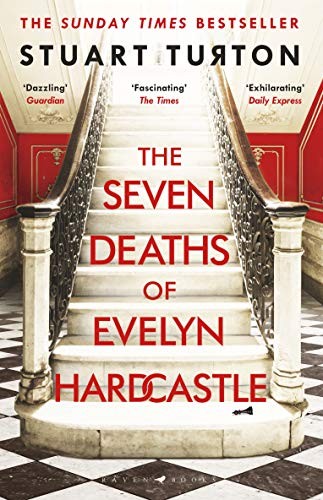
The Seven Deaths of Evelyn Hardcastle
At Blackheath, a decaying English country estate, a house party is approaching the moment when Evelyn Hardcastle will die. Aiden Bishop must identify her killer if he hopes to escape—but he is trapped in a repeating day and awakens each time inside a different guest. Every host gives him new access, abilities, weaknesses, and prejudices, turning detection into a struggle over perspective as well as evidence. Meanwhile, rival investigators pursue their own freedom, a murderous footman stalks the estate, and Aiden’s missing memories conceal another mystery. Stuart Turton combines the clue-driven architecture of a country-house whodunit with a speculative time loop and body-swapping narrative. The result is an intricate puzzle about identity, observation, guilt, punishment, and whether people can become more than the worst things they have done.
Where to buy or borrow
Are you selling this book? Bookstores, publishers, authors and libraries can be listed here for free. Request a listing
About this book
Deep Overview
That investigator is Aiden Bishop. He is required to solve the death of Evelyn Hardcastle, whose family has summoned guests to its deteriorating estate for a masked ball. The day repeats, but not through a simple return to the same starting point. Aiden inhabits eight different guests—his “hosts”—and experiences the day through their bodies. Their schedules overlap, allowing earlier actions to produce later consequences and enabling Aiden to encounter versions of himself operating at other points in the cycle. Detection becomes an exercise in temporal coordination: a clue may be created in one host, recovered in another, and understood only after an apparently unrelated scene has been revisited.
The hosts are not neutral vessels. Their bodies and personalities affect Aiden’s conduct. Social privilege opens some doors, physical strength makes certain interventions possible, and intelligence or professional skill changes the kinds of evidence he can interpret. Other hosts bring illness, fear, appetite, or ingrained habits that restrict his agency. Turton consequently turns multiple viewpoint into a question about identity: if Aiden’s thoughts and decisions are shaped by the person he inhabits, where does Aiden end and the host begin?
Blackheath itself functions as both crime scene and maze. Its neglected rooms, grounds, servants’ passages, and formal rituals preserve the appearance of an old social order while exposing the damage beneath it. The Hardcastle family’s history—especially an earlier tragedy involving Evelyn’s brother Thomas—binds the present gathering to unresolved violence. Guests arrive carrying debts, grudges, compromised loyalties, and incomplete versions of the past.
Aiden is not the only person who understands that the day repeats. Anna and Daniel Coleridge are also caught within the contest, while the Plague Doctor explains its rules without offering complete trust or transparency. The violent footman introduces a more immediate threat by hunting Aiden through his succession of hosts. These competing pressures prevent the novel from becoming a purely contemplative puzzle: Aiden must gather evidence while deciding whom to trust and whether cooperation is possible in a system designed to reward only one escape.
As the investigation deepens, solving Evelyn’s death becomes inseparable from questions about memory, culpability, and rehabilitation. The governing system treats identity as something that can be punished over immense stretches of time. Aiden’s developing commitments challenge that logic. The book ultimately asks whether justice should preserve a person’s worst act forever or acknowledge the possibility that punishment, remorse, and changed choices can produce someone morally different.
Key Themes
**Knowledge as reconstruction:** No witness possesses a complete account of the day. Truth must be assembled from partial observations, repeated scenes, mistaken assumptions, and actions separated across the timeline.
**Justice, punishment, and rehabilitation:** Blackheath is governed by a punitive logic that assumes wrongdoing can permanently define a person. The story tests that assumption by contrasting retribution with evidence of remorse and change.
**Privilege and social decay:** The country-house setting initially offers elegance and order, but the estate’s deterioration mirrors the moral failures of its inhabitants. Wealth protects secrets without repairing the harm behind them.
**Trust under competition:** Aiden’s rivals may also be potential allies. The imposed contest encourages suspicion, making cooperation a moral choice rather than merely a useful tactic.
**Memory and moral continuity:** Aiden begins without his past but remains responsible for decisions made before the opening scene. The novel asks whether personal identity depends on remembered history, present conduct, or some combination of both.
Historical and Literary Context
The estate also evokes the unstable position of Britain’s great houses after the First World War. The war is part of the characters’ recent past, while the property’s neglect conveys a social order losing both material strength and moral authority. Turton has described the period as decaying rather than nostalgic, and the novel’s treatment of hierarchy supports that view: class determines access and behavior, but status does not indicate virtue.
The repeating day belongs to a later narrative tradition familiar from speculative fiction and screen storytelling. By combining that device with body exchange and classical detection, Turton makes chronology itself part of the clue system. The result is less a historically realistic portrait of the 1920s than a deliberate collision between period-mystery conventions and modern high-concept narrative design.
Intended Audience
It may be less suitable for readers seeking a brisk, straightforward detective story, sustained realism, or intimate character development uncomplicated by plot machinery. The violence, threats, coercive punishment, body-image material, and morally disturbing revelations create a darker experience than the stately-house setting may initially suggest.
Reading Difficulty
Readers may find a simple list of hosts, major guests, and approximate times helpful, although the mystery is designed to preserve uncertainty. Short reading breaks can make the chronology harder to retain. The early chapters intentionally withhold basic information, so initial confusion is part of the experience rather than a sign that the reader has missed an explanation.
Helpful Background Knowledge
Readers should also approach the apparent period setting cautiously. Blackheath resembles an English estate of the interwar era, but the book uses that environment as a stylized mystery space rather than as a comprehensive work of social history.
Why Read It?
The novel also rewards rereading. Scenes that initially register as atmospheric incidents can acquire structural importance once the reader understands who was present and which version of Aiden was acting. Beneath that construction lies a serious ethical conflict over whether justice should remain purely punitive. Readers interested in mysteries that test both observation and moral judgment will find more here than a sequence of twists.
Reader Takeaways
The book further complicates familiar ideas about culpability. Remembering a wrong, regretting it, being punished for it, and becoming someone different are not presented as identical processes. Its final moral challenge is to decide what evidence of change should matter—and who has the authority to decide when punishment has achieved its purpose.
Strengths
Blackheath is an effective narrative environment: isolated enough to limit the suspect pool, large enough to conceal movement, and decayed enough to carry thematic meaning. The hosts provide varied investigative tools and constraints, while the competition among trapped participants adds urgency to an otherwise cerebral design.
The book also maintains a productive tension between puzzle and moral argument. Its later concern with rehabilitation does not erase the mystery mechanics; it changes what solving the mystery ultimately means.
Limitations and Considerations
Characterization is uneven by design. Several people first function as suspects, sources, or components in the timetable, and the host mechanism can make emotional attachment harder because bodies and personalities are partly instrumentalized. The novel’s treatment of one host’s weight is also likely to strike some readers as reductive or insensitive.
The speculative framework eventually expands beyond the apparent country-house problem. Readers who want every metaphysical mechanism explained in scientific detail may find the governing system less developed than the murder plot. The historical setting is atmospheric and thematic rather than rigorously documentary.
Important Concepts, People, and Places
**Evelyn Hardcastle:** The apparent victim whose death concludes the day. Her place within the Hardcastle family and her relationship to its past make the question of what happens to her more complicated than a single shooting.
**Anna:** The woman Aiden searches for from the opening pages. She is both a participant in the repeated day and the focus of the novel’s debate over whether a person can change after grave wrongdoing.
**Daniel Coleridge:** Another knowledgeable player within Blackheath. His charm, competence, and uncertain motives make him both a useful collaborator and a serious rival.
**The Plague Doctor:** A masked authority who explains the contest and controls access to escape. The figure represents an institutional form of justice whose rules appear orderly but are morally contestable.
**The footman:** A violent pursuer who hunts Aiden across his hosts. He turns the abstract danger of failure into an immediate physical threat.
**The hosts:** Eight Blackheath guests whose bodies Aiden inhabits. Each possesses different abilities, vulnerabilities, relationships, and impulses, making embodiment a core investigative variable.
**Blackheath:** The Hardcastle family estate and the novel’s enclosed world. Its deteriorating house, surrounding woods, lake, and hidden routes shape both the clue system and the atmosphere of moral decay.
**Thomas Hardcastle’s death:** An earlier family tragedy that connects the present gathering to Blackheath’s unresolved history and helps explain why the party has been assembled.
**The repeating day:** The book’s organizing mechanism. Unlike an ordinary flashback structure, it permits intervention, overlap, and communication among different stages of Aiden’s investigation.
**Rehabilitation:** The central ethical concept behind the larger framework. The novel asks whether sustained moral change should alter a punishment imposed for an earlier identity.
Questions the Book Explores
Can an observer ever separate personal judgment from physical condition, social standing, and inherited bias?
When does punishment cease to serve justice and become cruelty?
What evidence would justify believing that a person responsible for terrible harm has genuinely changed?
Does competition reveal character, or does it manufacture betrayal by making trust irrational?
How does revisiting the same event alter the meaning of apparently settled facts?
Can a mystery be solved without first understanding why its investigator was chosen to solve it?
Reading Group Guide
Compare Blackheath’s elegant social rituals with the estate’s physical decline. Discuss whether the house primarily operates as a setting, a clue system, a symbol of class decay, or all three.
Trace the moments when Aiden chooses cooperation despite the contest’s incentives. Groups can debate whether these choices are strategically sensible, morally necessary, or both.
Examine how the novel distributes sympathy. Notice which characters first appear monstrous, ridiculous, weak, or trustworthy, and identify the later information that revises those impressions.
For a spoiler-inclusive meeting, devote time to the distinction between solving Evelyn’s death and understanding Blackheath’s purpose. Ask whether the larger revelation strengthens the murder mystery or changes the genre too abruptly.
Discussion Questions
2. How do the hosts’ personalities and bodies affect Aiden’s freedom to act?
3. At what point did Blackheath begin to seem like more than an ordinary country estate?
4. Which apparent clue or assumption most successfully misdirected you?
5. Does the repeating day make death seem less consequential, or does repetition intensify its horror?
6. How does social class influence who receives information, trust, protection, or blame?
7. Is Aiden morally the same person without access to his past?
8. What does Anna’s story suggest about remorse and rehabilitation?
9. Are the Plague Doctor’s rules just, effective, both, or neither?
10. How would the story change if Aiden remained in a single host?
11. Did the speculative explanation deepen the book’s ethical questions or distract from the whodunit?
12. After the ending, which earlier scene would you most want to reread?
Sources and Verification
Comments
No published comments yet.
Available editions
Hardcover
First UK edition; hardcover
- ISBN-13
- 9781408889565
- Publication date
- Pages
- 528