
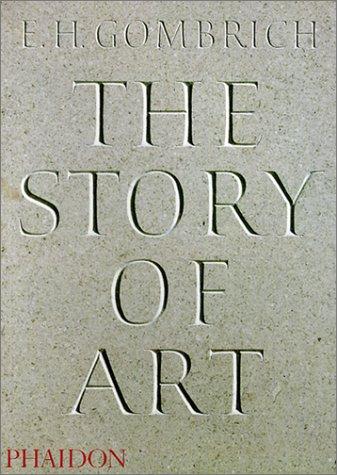
The Story of Art
E. H. Gombrich’s The Story of Art is an illustrated introduction to the development of visual art, especially the Western tradition, from prehistoric image-making and the ancient Mediterranean world to modernism and late twentieth-century debates. Rather than treating art history as a procession of isolated masterpieces, Gombrich asks what problems artists faced, what purposes their works served, and how inherited conventions changed through experiment. His narrative gives particular attention to representation: the long effort to render bodies, space, light, movement, and emotion convincingly, followed by modern artists’ challenges to naturalism. Architecture, sculpture, and painting appear within religious, civic, courtly, and commercial settings. The book’s clarity and close attention to individual works make it a durable entry point into art history. Its account is not a balanced global survey, however; Europe dominates, while women artists and many non-Western traditions receive…
Where to buy or borrow
Are you selling this book? Bookstores, publishers, authors and libraries can be listed here for free. Request a listing
About this book
Gombrich writes as a guide rather than as a compiler of dates and labels. He moves between formal observation—how a picture organizes color, line, space, and gesture—and historical explanation of patrons, beliefs, materials, and artistic conventions. The result is a connected argument about artists solving practical and expressive problems. This gives the book unusual narrative momentum for a large survey. It also reveals the limits of its mid-twentieth-century framework: the main line remains centered on European art, naturalistic representation, and a canon dominated by men.
Deep Overview
From Greece and Rome, the narrative follows the transformation of classical forms within Jewish, Christian, Byzantine, and medieval settings. Gombrich repeatedly warns against judging stylized works by Renaissance standards. Medieval artists often simplified physical appearance to communicate sacred meaning clearly. Romanesque and Gothic churches are presented as coordinated achievements in architecture, sculpture, stained glass, and worship rather than merely as steps toward later realism.
The Renaissance occupies the structural center of the book. Filippo Brunelleschi’s architectural recovery of classical principles and experiments associated with perspective help establish a new understanding of pictorial space. Masaccio, Donatello, Jan van Eyck, Leonardo da Vinci, Michelangelo, Raphael, Albrecht Dürer, and Titian exemplify different solutions to problems of anatomy, volume, texture, light, composition, and expression. Gombrich does not describe progress as automatic. Each solution creates new expectations and new difficulties: technical mastery can harden into convention, and younger artists must decide whether to perfect, redirect, or reject it.
Later chapters show these tensions unfolding through Mannerism, the Baroque, Dutch painting, eighteenth-century art, Romanticism, Realism, Impressionism, and Post-Impressionism. Caravaggio’s dramatic immediacy, Peter Paul Rubens’s movement, Rembrandt van Rijn’s psychological depth, and Johannes Vermeer’s controlled light represent different uses of the visible world. In the nineteenth century, photography, changing patronage, urban life, and rebellion against academic standards weaken the old consensus about what art should accomplish. Claude Monet investigates changing perception; Paul Cézanne seeks structural order; Vincent van Gogh intensifies expressive color; and later artists question representation itself.
Modernism is thus presented not as an arbitrary rupture but as the consequence of accumulated experiments. Yet the book’s continuity comes at a cost. Traditions from China, Islam, India, ancient America, and other regions enter selectively and seldom shape the main narrative on equal terms. The Story of Art is most illuminating when read as Gombrich’s highly skilled account of a predominantly European canon, not as a comprehensive history of world art.
Key Themes
• **Convention and observation work together.** Artists do not simply copy nature; they learn visual formulas and modify them when those formulas no longer meet their aims.
• **Function shapes form.** Tombs, temples, churches, portraits, altarpieces, palaces, and private pictures look different because they answer different social and religious needs.
• **Naturalism is historically constructed.** Convincing space, anatomy, light, and movement are treated as achievements built across generations, not as neutral defaults.
• **Tradition enables innovation.** Major departures become intelligible only against the conventions they alter or reject.
• **Modern art changes the terms of judgment.** When imitation ceases to be the dominant measure, structure, expression, material, and artistic intention gain greater prominence.
Historical and Intellectual Context
Gombrich resisted deterministic accounts in which impersonal historical laws produce styles. His emphasis falls instead on individual makers, inherited conventions, practical problems, and the psychology of seeing. That method helped make formal analysis understandable to nonspecialists. Later art history broadened its focus toward gender, colonialism, race, global exchange, material culture, institutions, and spectatorship. Those developments do not erase the book’s achievements, but they make its exclusions and hierarchy more visible.
Intended Audience
Readers looking for equal coverage of global traditions, women artists, Indigenous art, decorative arts, or contemporary practice should treat it as one foundation among several rather than a complete curriculum. Those wanting a quick reference book may also find its continuous narrative less convenient than an encyclopedia or period-specific guide.
Reading Difficulty
Because the argument depends heavily on looking, the illustrations are integral rather than decorative. Readers should pause to compare details, poses, spatial arrangements, and techniques. The book can be read straight through, but shorter chapter sessions with frequent reference to the images are more productive.
Helpful Background Knowledge
Readers may also want a simple map of Europe and the Mediterranean. Florence, Rome, Venice, the Low Countries, Paris, and London repeatedly function as centers of patronage and artistic exchange. Knowing the basic differences among fresco, tempera, oil painting, engraving, and sculpture will clarify why technical innovations mattered.
Why Read It?
The book also demonstrates how to compare works fairly across periods. Instead of asking why medieval art does not resemble Renaissance painting, it asks what each work was designed to do. That habit of historically informed attention remains valuable even when readers challenge the boundaries of Gombrich’s canon.
Reader Takeaways
Readers may also become more attentive to the institutional conditions behind art: religious practice, courtly display, civic identity, markets, workshops, academies, and museums. Finally, the book provides a case study in canon formation. What it includes establishes a persuasive story; what it omits demonstrates why every survey must be read critically.
Strengths
Another strength is his refusal to equate resemblance with artistic quality. He helps readers appreciate stylization, symbolism, and convention on their own terms. The illustrated format, charts, maps, and glossary-index make the 16th edition useful for sustained study as well as browsing.
Limitations and Cautions
The canon is also overwhelmingly male; women’s artistic production, training, patronage, and exclusion from institutions receive almost no sustained analysis. Social history is present but secondary to questions of style, representation, and individual achievement. Readers interested in colonial exchange, race, gender, labor, material culture, or the politics of collecting will need complementary studies.
The account of recent and contemporary art ends within a twentieth-century horizon and cannot address subsequent developments. Some older terminology and judgments also reflect the period in which the book was written and revised.
Important Concepts, People, Places, and Movements
• **Egyptian art:** A foundational example of art governed by durable conventions and religious purposes rather than momentary optical appearance.
• **Classical Greece:** Central to the account of artists moving from inherited formulas toward increasingly persuasive bodies, movement, and spatial relationships.
• **Christian Church:** The principal patron and institutional setting for much medieval European architecture and imagery; doctrine and worship strongly influence artistic form.
• **Florence:** A crucial Renaissance center associated with Filippo Brunelleschi, Donatello, Masaccio, Leonardo da Vinci, and Michelangelo, among others.
• **Linear perspective:** A systematic means of organizing pictorial space, important to the Renaissance redefinition of the image as a convincing view onto a scene.
• **Jan van Eyck:** A leading figure in Northern European painting whose meticulous surfaces and handling of oil demonstrate a path to visual precision distinct from Italian methods.
• **Leonardo da Vinci, Michelangelo, and Raphael:** Artists through whom Gombrich examines the Renaissance pursuit of naturalism, monumentality, harmony, and expressive design.
• **Reformation and Counter-Reformation:** Religious upheavals that changed patronage and the functions of images, helping produce divergent artistic conditions across Europe.
• **Caravaggio and the Baroque:** Caravaggio’s forceful realism and dramatic light exemplify a wider seventeenth-century search for immediacy, movement, and emotional involvement.
• **Dutch Republic:** A commercial setting in which portraits, landscapes, interiors, and scenes of everyday life became major forms of artistic production.
• **Impressionism:** A movement associated with the study of changing light, color, and immediate perception, and with resistance to established academic expectations.
• **Paul Cézanne and Vincent van Gogh:** Post-Impressionist artists whose different responses to structure and expression help prepare Gombrich’s account of modernism.
• **Modernism:** A broad field of experimentation in which artists rethink naturalistic representation and give new emphasis to form, expression, medium, and invention.
• **Warburg Institute:** The London research institution central to Gombrich’s career and to the study of how images and classical traditions survive and change across history.
Questions the Book Explores
• How should viewers judge works that were never intended to imitate visible reality?
• What roles do religion, patronage, technology, and social use play in the appearance of art?
• How did European artists learn to represent volume, movement, space, light, and atmosphere?
• Does technical mastery solve artistic problems, or does every solution create new constraints?
• Why did the shared standards of European academic art weaken during the nineteenth century?
• How can modern art be understood as a historical development rather than as an unexplained rejection of tradition?
• What happens to any history of art when one tradition is made the principal line of development?
Reading Group Guide
For the Renaissance, compare the Italian and Northern European routes toward convincing representation. Notice how materials, workshop traditions, and intellectual ambitions produce different results. In the modern chapters, identify moments when innovation appears as a response to an older success rather than a clean break.
Keep a parallel record of absences. Which regions, media, communities, and artists remain peripheral? A productive group can distinguish between the explanatory power of Gombrich’s chosen narrative and the larger claim implied by the title. Conclude by asking what a global story of art would have to change: not merely which names it added, but how it organized relationships among artistic traditions.
Discussion Questions
2. Where does his emphasis on individual artists illuminate history, and where might it understate institutions or collective labor?
3. Which chapter most successfully changed how you viewed an unfamiliar style or period?
4. Does the book avoid treating naturalism as the only measure of artistic achievement, or does naturalism still organize its central narrative?
5. How do religious and political functions alter the standards by which a work should be judged?
6. Compare Gombrich’s treatment of Italian Renaissance art with his treatment of Chinese or Islamic art. What differences in depth and narrative importance appear?
7. How does the physical presence of illustrations affect the persuasiveness of his interpretations?
8. What assumptions about artistic greatness or influence are built into the selection of works?
9. How should present-day readers respond to the scarcity of women artists in the book?
10. Is a single connected story the best form for introducing art history, or would several intersecting histories be more accurate?
11. Which modern development seems most convincingly connected to earlier traditions?
12. What companion book or perspective would most effectively expand or challenge this account?
Sources and Verification
Comments
No published comments yet.
Available editions
Paperback
16th edition; paperback
- Publisher
- Phaidon Press
- ISBN-13
- 9780714832470