
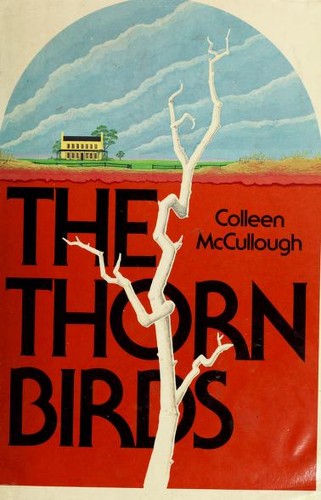
The Thorn Birds
Spanning much of the twentieth century, The Thorn Birds follows the Irish-Australian Cleary family after they move from New Zealand to Drogheda, an immense sheep station in New South Wales. Its emotional center is Meggie Cleary’s lifelong bond with Ralph de Bricassart, a Catholic priest divided between love, vocation, and ambition. Around them, births, deaths, inheritances, marriages, disasters, and departures shape several generations. Colleen McCullough combines a family saga, historical fiction, and tragic romance while treating the Australian landscape as a force that tests every human plan. Readers seeking classic romance novels with broad social scope will find a story concerned not only with forbidden love, but also with faith, power, sacrifice, gender, and the consequences of choosing one consuming desire over every competing claim.
Where to buy or borrow
Are you selling this book? Bookstores, publishers, authors and libraries can be listed here for free. Request a listing
About this book
McCullough organizes the book around consequential choices whose effects may not become visible until years later. Agricultural labor, inheritance, Catholic hierarchy, motherhood, social status, and personal ambition all influence the characters’ options. Her scientific training may help explain the novel’s firm large-scale construction: McCullough herself described her fiction as being built on a strong factual framework, and she stated that several male deaths in the novel drew on deaths in her own family. Among historical fiction novels with a major romantic plot, this one is distinguished by its immense temporal reach and by the way Drogheda functions simultaneously as workplace, inheritance, refuge, and trap.
Deep Overview
At Drogheda, Meggie forms a profound attachment to Ralph de Bricassart, an intelligent and charismatic priest. Ralph cares for her, yet he also wants advancement within the Catholic Church. His conflict is therefore more complicated than a simple contest between desire and religious duty: spiritual aspiration, institutional ambition, self-image, and class mobility become entangled. Mary recognizes both his attachment and his hunger for influence. Through her wealth and estate, she creates conditions that bind Ralph’s future to choices that wound Meggie and compromise his claims to self-denial.
The Meggie–Ralph relationship anchors the novel, but McCullough places it within a broader pattern of frustrated attachment. Fiona Cleary’s reserve conceals an earlier history that affects her marriage and children. Frank’s anger grows from family secrecy, wounded identity, and confinement within roles he resents. Later, Meggie’s marriage to Luke O’Neill shows how an attempt to build an ordinary life can reproduce neglect in a new form. The younger generation—especially Justine and Dane—both inherits and resists the emotional arrangements of the family.
Drogheda gives these relationships physical scale. Sheep work, isolation, fire, drought, rain, distance, and the rhythms of rural labor remind readers that private feeling unfolds within material conditions. The property offers continuity, but continuity has a price: it can preserve loyalty and memory while keeping people attached to old losses. By contrast, Ralph’s movement through the Church carries him toward Rome and institutional prominence, yet geographical ascent does not resolve his divided loyalties.
The title’s thorn-bird image supplies the novel’s governing metaphor: a life may be organized around the pursuit of one supreme fulfillment, even when attaining it brings suffering. McCullough applies this pattern to more than romantic love. Ralph pursues ecclesiastical importance; Meggie seeks a love and family she can claim as her own; other characters choose duty, autonomy, revenge, or escape. The book repeatedly asks whether their pain is imposed by social structures and circumstance, or whether they help create it by treating one desire as worth every sacrifice.
Across its long chronology, the novel shifts from one generation’s endurance to the next generation’s possibility. It does not offer a simple moral that renunciation is noble or that desire should always prevail. Instead, it traces how secrecy, possessiveness, ambition, and withheld tenderness become family inheritances—and whether later lives can break that pattern.
Key Themes
- **The cost of consuming desire:** Major characters organize their lives around a single overriding want, often overlooking the harm produced along the way.
- **Women, labor, and restricted choice:** Fiona, Meggie, and Justine face different versions of a social order that expects female endurance while limiting female authority.
- **Inheritance beyond property:** Money and land pass between generations, but so do silence, resentment, emotional deprivation, and patterns of sacrifice.
- **Faith and institutional power:** Catholicism appears as belief, culture, moral discipline, hierarchy, and a route to influence; these dimensions do not always agree.
- **Landscape and human vulnerability:** Drogheda’s isolation and environmental extremes reduce the illusion that people control their futures.
- **Motherhood and substitution:** Mothers and children repeatedly struggle with unequal affection, displaced longing, and the burden of fulfilling another person’s unmet needs.
- **Belonging and escape:** Characters must decide whether home is an inheritance to preserve, an identity they cannot evade, or a structure they must leave.
Historical Context
Drogheda belongs to Australia’s pastoral world. A “station” is a large livestock property, and Australian sheep stations could be enormous and geographically isolated. Their operation depended on recurring tasks such as mustering, shearing, animal care, and water management. That background explains why the land is both an economic foundation and an exhausting daily obligation.
The Clearys’ Irish identity and Catholic faith also matter. In the early twentieth century, Catholic family culture could strongly shape education, marriage, sexuality, fertility, and attitudes toward clergy. Ralph’s career reflects a hierarchical, international Church whose center of authority lies far from rural Australia. Readers should nevertheless distinguish the novel’s dramatic representation of Catholicism from a neutral history of the Church.
The book was published simultaneously in the United States and Australia–New Zealand in 1977. Its international success made it a major example of Australian popular fiction reaching a global audience, and the 1983 television adaptation further expanded its cultural presence.
Intended Audience
It may be less suitable for readers who prefer fast plots, concise contemporary prose, consistently sympathetic protagonists, or romance narratives promising emotional reassurance. The book contains death, family violence, sexual material, reproductive coercion, grief, clerical conflict, and relationships marked by serious power imbalances. Mature teen readers may manage the language, but the themes and length generally make it a better adult selection.
Reading Difficulty
Some agricultural and Catholic vocabulary may be unfamiliar, though meaning is usually clear from context. The greater challenge is interpretive rather than linguistic: the narration sometimes presents troubling behavior in the conventions of mid-twentieth-century popular romance, requiring readers to separate emotional intensity from ethical approval. A family tree or short character list may be useful, particularly after breaks in reading.
Helpful Background Knowledge
A basic understanding of Roman Catholic clerical celibacy and hierarchy will clarify Ralph’s conflict. A priest is committed to celibacy, while advancement within the Church can lead through offices of increasing authority toward Rome and the Vatican. Familiarity with Irish Catholic migration to Australia and New Zealand can also illuminate the Clearys’ communal identity.
Readers should approach Drogheda as a fictional property, not a documentary portrait of every Australian station. It is also useful to remember that the novel was written in the 1970s and portrays earlier decades through the conventions and assumptions of that era.
Why Read This Book?
For readers seeking historical fiction that is easy to enter yet substantial enough for discussion, the book offers clear storytelling alongside difficult questions about faith, ambition, gender, and self-deception. It is also culturally significant as the novel that transformed McCullough’s career and became one of the most internationally recognized works of Australian popular fiction.
Reader Takeaways
Readers may also reconsider the distinction between loving someone and making that person carry one’s unfulfilled desires. Across several generations, silence often protects social order while deepening harm. The younger characters suggest that change requires more than physical escape; inherited expectations must first be recognized.
Finally, the book encourages attention to institutions and environments. Church hierarchy, wealth, gender roles, and the pastoral economy do not merely surround the characters. They shape which desires appear possible, respectable, or forbidden.
Strengths
- **Memorable setting:** Drogheda combines practical detail, isolation, beauty, danger, and symbolic weight.
- **Moral complexity:** Ralph, Meggie, Fiona, Mary, and Frank are driven by mixed motives rather than single virtues or faults.
- **Integration of the domestic and institutional:** Family feeling is connected convincingly to inheritance, labor, religion, class, and career.
- **Strong narrative accessibility:** McCullough handles a broad chronology in prose designed for sustained popular reading rather than academic display.
- **Discussion value:** The book invites disagreement over whether its central relationship is tragic, selfish, exploitative, spiritually conflicted, or some combination of these.
Limitations and Cautions
Its treatment of gender, sexuality, marriage, motherhood, race, and clerical authority reflects both the periods depicted and the assumptions of popular fiction published in 1977. Certain controlling or coercive behaviors may be framed with more romantic or melodramatic emphasis than contemporary readers find comfortable. The relationship between Meggie and Ralph also begins when he is an adult priest and she is a child, making the later romance inseparable from questions of authority, dependency, and grooming that reading groups should not minimize.
The book offers a selective vision of Australia centered on a white settler family and a wealthy pastoral estate. Indigenous histories and the colonial foundations of landholding remain peripheral. Likewise, its Catholic setting supports character conflict and symbolism but should not be taken as a balanced institutional history. Readers should also be cautious about claims that the thorn-bird story is an authentic ancient Celtic legend; its independent folkloric basis is uncertain.
Important Concepts, People, and Places
- **Ralph de Bricassart:** A Catholic priest torn among affection, religious identity, and advancement. His choices connect private betrayal with institutional ambition.
- **Drogheda:** The fictional New South Wales sheep station where the Clearys settle. It is home, livelihood, inheritance, and a mechanism of dependence.
- **The Cleary family:** An Irish Catholic family whose movement from New Zealand to Australia begins the novel’s central generational history.
- **Fiona “Fee” Cleary:** Meggie’s emotionally guarded mother. Her past establishes important patterns of secrecy, unequal love, and endurance.
- **Paddy Cleary:** Fee’s husband and head of the working Cleary household, whose relationship with his family embodies affection constrained by hardship and convention.
- **Frank Cleary:** Meggie’s eldest brother, whose anger and alienation expose the destructive effects of hidden parentage and imposed identity.
- **Mary Carson:** Paddy’s wealthy sister and Drogheda’s owner. Her will and manipulation turn property into power over both the Clearys and Ralph.
- **Luke O’Neill:** Meggie’s husband, associated with her attempt to escape Ralph and construct a conventional married life on her own terms.
- **Justine O’Neill:** Meggie’s daughter, whose independence and theatrical career test whether a younger generation can live beyond Drogheda’s emotional pattern.
- **Dane O’Neill:** Meggie’s son, whose vocation binds family secrecy to Ralph’s religious world.
- **Catholic priesthood and celibacy:** The institutional and spiritual commitments that make Ralph’s relationship with Meggie ethically and practically impossible.
- **Pastoral station life:** The labor system of sheep raising, shearing, mustering, and maintaining an isolated property; it grounds the family drama economically.
- **Rome and the Vatican:** The center of Ralph’s ecclesiastical ambition and a geographical counterpoint to remote Drogheda.
- **The thorn-bird metaphor:** The idea that a being may pursue one perfect achievement at fatal cost; the novel uses it to frame desire, sacrifice, and self-created suffering.
Questions the Book Explores
- Where does religious vocation end and worldly ambition begin?
- How do wealth and inheritance alter apparently personal relationships?
- Why do families preserve secrets even when secrecy repeatedly damages them?
- Can love be genuine while also being possessive, unequal, or destructive?
- How does emotional neglect pass from parents to children?
- Is home a source of identity, a form of captivity, or both?
- What allows one generation to interrupt patterns established by another?
- How do landscape, distance, and labor restrict choices that appear purely emotional?
- Does suffering create meaning, or do people sometimes use meaning to justify avoidable suffering?
Reading Group Guide
For a second session, compare the book’s major structures of power: Mary’s wealth, Ralph’s clerical authority, patriarchal family roles, and Drogheda’s economic demands. Ask when characters exercise free choice and when their circumstances substantially narrow it.
A third approach is to assign each participant one major character and ask what that person believes they are sacrificing, what they actually gain, and who bears the cost. Include Fiona, Mary, Frank, Luke, Justine, and Dane alongside Meggie and Ralph.
If members know the 1983 miniseries, discuss adaptation only after evaluating the novel on its own. Compare what television emphasizes or omits rather than treating the screen version as a substitute. Content-sensitive groups may wish to announce in advance that the discussion will address age and authority differences, reproductive control, family violence, bereavement, and religious power.
Discussion Questions
2. Which matters more in Ralph’s decisions: faith, ambition, fear, or concern for Meggie?
3. In what ways does Mary Carson use money as a substitute for intimacy or as an instrument of revenge?
4. Does Drogheda sustain the Clearys, confine them, or perform both functions at different moments?
5. How does Fiona’s history alter your interpretation of her emotional distance?
6. Which family secret causes the greatest damage, and why does it remain concealed?
7. How should readers evaluate the age and authority imbalance at the foundation of Meggie and Ralph’s bond?
8. Does the novel challenge restrictive gender roles, reproduce them, or do both at once?
9. How do Justine and Dane respond differently to the emotional inheritance they receive?
10. Is the thorn-bird metaphor insightful, dangerously romantic, or both?
11. Which tragedies appear unavoidable, and which result from choices that could have been made differently?
12. By the ending, has the Cleary family escaped its central pattern or merely changed its form?
Sources and Verification
Context about the author and composition was drawn from Australia’s National Portrait Gallery, including McCullough’s recorded explanation of her structural approach and the family basis for several fictional deaths. State Library resources supplied context for the book’s first publication and for Australian station life. Established newspaper accounts were consulted for the novel’s reception and cultural reach.
No exact publication date was entered because the reliable records consulted securely establish only 1977, while less authoritative listings disagree about the month or day. The novel’s “thorn bird” should be treated as its governing literary legend rather than as verified Celtic folklore.
Comments
No published comments yet.
Available editions
Hardcover
1977 English-language hardcover edition
- Publisher
- Harper & Row
- ISBN-13
- 9780060129569
- Pages
- 533