Deep Overview
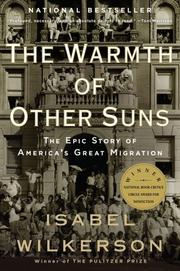
Isabel Wilkerson reconstructs the Great Migration, the decades-long movement of roughly six million Black Americans from the South to Northern, Midwestern, and Western cities. Rather than treating migration primarily as a demographic trend, she builds the history around three people whose journeys represent different routes, decades, social positions, and destinations: Ida Mae Brandon Gladney leaves Mississippi sharecropping for Chicago; George Swanson Starling escapes dangerous labor conflict in Florida and settles in New York; and Robert Joseph Pershing Foster leaves Louisiana to pursue a medical career in Los Angeles. Their stories are interwoven with census findings, archival evidence, historical explanation, and accounts gathered through extensive interviews. The result is both a collective history and a study of individual decision-making under racial constraint. The narrative follows the migrants before departure, through the practical and emotional ordeal of leaving, and across their long lives in cities that offered greater freedom without offering racial equality. It also examines consequences beyond the three biographies: labor changes in the South, urban segregation, housing discrimination, family separation, political transformation, and the circulation of Southern Black culture throughout the country. ([penguinrandomhouse.com](https://www.penguinrandomhouse.com/books/190696/the-warmth-of-other-suns-by-isabel-wilkerson/))
Key Themes
The central themes are migration as self-emancipation, the search for full citizenship, and the difference between formal freedom and freedom that can be exercised in daily life. The book repeatedly considers what people are willing to leave behind—family, familiarity, status, land, and memory—to escape a system that restricts their safety and prospects. It explores Jim Crow not only as legislation but as an encompassing social order enforced through humiliation, economic dependence, disfranchisement, and violence. Other major themes include the power of personal agency within structural oppression; the persistence of Southern identity after relocation; the creation of migrant networks; generational conflict; ambition and reinvention; the psychological cost of departure; and the collision between hope and the discriminatory housing and labor systems of Northern and Western cities.
Historical Context
The Great Migration developed in successive waves from the 1910s through about 1970. Racial violence, Jim Crow restrictions, agricultural exploitation, and political exclusion pushed Black Southerners to leave. Industrial labor demand, especially during the two world wars, created powerful incentives to move, while railroads, Black newspapers, churches, family connections, and community organizations helped migrants find routes and destinations. The movement reshaped cities including Chicago, Detroit, New York, Philadelphia, Cleveland, Oakland, and Los Angeles. Leaving the South did not end racial discrimination: migrants encountered restrictive housing covenants, redlining, employment barriers, segregated neighborhoods, and episodes of organized white violence. At the same time, they built churches, businesses, political constituencies, cultural institutions, and support networks that transformed American urban life. ([archives.gov](https://www.archives.gov/research/african-americans/migrations/great-migration?utm_source=openai))
Intended Audience
The book is especially well suited to readers of American history, African American history, biography, oral history, migration studies, civil-rights history, sociology, and long-form narrative journalism. Its character-centered structure may appeal to readers who find conventional survey histories too abstract. It is also valuable for educators and groups examining how national developments become visible in family histories and individual lives. Readers seeking a short introduction or a narrowly argued academic monograph may find its length and biographical detail demanding. The book includes disturbing accounts of racist violence, threats, humiliation, labor exploitation, and family hardship.
Reading Difficulty
The prose is accessible to a general adult audience, but the book is long and emotionally demanding. It alternates among three life stories, historical interludes, statistical context, and shorter accounts of other migrants, so readers must keep track of several timelines and geographic routes. Specialized academic knowledge is not required. The greater challenge is cumulative: repeated encounters with racial terror, constrained choices, separation, disappointment, and aging give the narrative substantial emotional weight. Groups may benefit from dividing the book according to its major parts rather than assigning equal page increments.
Helpful Background Knowledge
Readers will benefit from a basic understanding of Reconstruction’s collapse, the rise of Jim Crow, sharecropping and tenant farming, Black disfranchisement, lynching and racial terror, industrial labor during the world wars, and twentieth-century housing discrimination. Familiarity with the geography of the three major migration streams is also useful: the eastern route toward cities such as New York, the central route toward Chicago and other Midwestern centers, and the western route from Louisiana and Texas toward California. None of this knowledge is essential because Wilkerson supplies extensive context, but it can help readers distinguish the broader historical forces from the particular circumstances of each protagonist.
Why Read This Book?
The book makes a vast demographic transformation comprehensible without reducing migrants to numbers or symbols. Its three central biographies demonstrate that people participating in the same historical movement could have sharply different motives, temperaments, resources, destinations, and outcomes. It also connects Southern racial rule to the subsequent development of Northern and Western cities, helping readers understand why the Great Migration belongs at the center of national rather than regional history. Readers interested in their own family migrations may find its attention to departure, adaptation, memory, and inherited identity especially useful. The book also offers a strong model of how oral testimony, archival research, demographic evidence, and narrative craft can work together.
Reader Takeaways
A careful reader may come away seeing migration as both a response to oppression and a creative act of remaking one’s life. The book complicates any simple contrast between a racist South and a welcoming North: relocation altered the range of available choices, but discrimination followed migrants into employment, housing, education, and public life. It also shows how millions of individual decisions accumulated into national change. Black Southerners did not merely enter existing cities; they transformed urban politics, religion, music, food, language, labor, and neighborhood life. Finally, the protagonists’ later years emphasize that historical outcomes cannot be judged only through income or status. Safety, dignity, belonging, family continuity, personal regret, and the experience of having chosen one’s own path also matter.
Strengths
The book’s principal editorial strength is its ability to move between intimate biography and national history. Wilkerson selected three central figures after interviewing more than 1,200 people, choosing lives that could represent the three major migration streams and different periods of departure. ([niemanstoryboard.org](https://niemanstoryboard.org/2011/04/04/isabel-wilkerson-warmth-of-other-suns-interview-2/)) The parallel narratives give the migration human scale while the historical chapters prevent the individual stories from being mistaken for complete statistical representations. The long time span also allows the book to examine consequences after arrival rather than presenting departure as a complete resolution. Its attention to work, travel, marriage, housing, family networks, health, aging, and memory broadens the meaning of political history. The structure encourages comparison without forcing the protagonists into identical narratives.
Limitations and Cautions
The three protagonists illuminate the Great Migration but cannot represent every migrant experience. The book emphasizes movement out of the South to prominent Northern and Western destinations; intraregional migration, migration to smaller cities, and the experiences of those who remained in the South receive less sustained attention. Its narrative method privileges depth and emotional understanding over exhaustive comparison among competing historical interpretations. Readers seeking detailed quantitative analysis of wages, housing markets, demographic selection, or city-by-city variation will need supplementary scholarship. The domestic-immigration analogy is illuminating because it emphasizes rupture, adaptation, and the search for freedom, but it should not erase the distinctive legal fact that these migrants were citizens moving within their own country. The book was first published in 2010, so research released afterward is necessarily absent.
Important Concepts and People
Key concepts include the Great Migration; Jim Crow; sharecropping; disfranchisement; racial terror; chain migration; internal migration; migrant networks; industrial labor recruitment; restrictive covenants; redlining; residential segregation; white flight; and cultural transplantation. The three central people are Ida Mae Brandon Gladney, George Swanson Starling, and Robert Joseph Pershing Foster. Readers should also note the importance of Black newspapers, rail lines, churches, clubs, relatives, and earlier migrants in transmitting information and making later journeys possible. The title comes from Wilkerson’s engagement with a passage associated with Richard Wright’s account of leaving the South, giving the image of another sun both geographic and emotional meaning. ([penguinrandomhouse.com](https://www.penguinrandomhouse.com/books/190696/the-warmth-of-other-suns-by-isabel-wilkerson/))
Questions the Book Explores
What makes leaving become more bearable than staying? How do people exercise agency when nearly every available choice is constrained? What is gained and lost when migration separates people from family, landscape, customs, and social identity? How did Black Southerners alter the cities to which they moved? Why did greater legal and economic opportunity fail to eliminate racial hierarchy? Can a mass historical event be understood adequately through individual lives? What responsibilities do destination communities bear when newcomers encounter exclusion? How should success be measured when migrants seek not only prosperity but safety, dignity, autonomy, and a future for their children?
Reading Group Guide
A group can divide the discussion into four stages: conditions before departure, the journeys themselves, adaptation in the destination cities, and the protagonists’ later assessments of their choices. Keep a simple chart for Ida Mae, George, and Robert recording origin, departure date, destination, occupation, motive, support network, major obstacle, and changing definition of success. A map of the three migration streams will help participants connect biography to transportation routes and regional patterns. Groups should distinguish between what the individual stories establish and what Wilkerson supports through broader historical evidence. Because the book contains painful material, facilitators should allow discussion of emotional responses while returning to specific scenes, institutions, and historical mechanisms. Supplementary primary sources—migration letters, newspaper advertisements, photographs, railroad maps, and housing records—can deepen the discussion.
Discussion Questions
1. How does following three individuals change your understanding of a migration involving millions of people?
2. In what ways do Ida Mae, George, and Robert define freedom differently?
3. Which pressures appear decisive in each departure: violence, labor conditions, ambition, family responsibility, or something else?
4. Does the book portray migration primarily as escape, resistance, self-invention, or a combination of these?
5. How do the three destination cities fulfill and betray the migrants’ expectations?
6. What do the protagonists carry from the South into their new lives, intentionally or otherwise?
7. How does housing discrimination shape the opportunities available after migration?
8. What is gained by comparing the Great Migration to immigration across national borders, and where does that comparison become incomplete?
9. How does Wilkerson balance affection for her subjects with the need to portray their weaknesses and mistakes?
10. Which consequences of the Great Migration remain most visible in contemporary American life?
11. How might the history look different if narrated by someone who chose to remain in the South?
12. By the end of the book, which measures of success seem most meaningful: income, professional status, family stability, dignity, autonomy, or peace?
Sources and Verification
Bibliographic details were checked against Penguin Random House’s official Vintage edition page and corroborated with library and bibliographic records. The book’s scope, protagonists, research method, and organization were checked against the publisher’s reading guide and Wilkerson’s interview with Nieman Storyboard. Historical framing was cross-checked with the National Archives, Library of Congress, and Smithsonian National Museum of African American History and Culture. Descriptions of themes, strengths, limitations, audience, and difficulty are original editorial assessments rather than publisher claims. Page numbering may appear differently in catalogs because some records count the numbered main text and preliminary pages while the publisher lists a 640-page product length.