
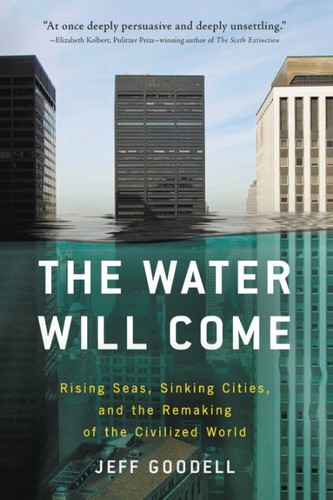
The Water Will Come
Rising Seas, Sinking Cities, and the Remaking of the Civilized World
In The Water Will Come, environmental journalist Jeff Goodell investigates how rising seas will alter coastlines, cities, economies, and patterns of human settlement. Traveling from Miami and New York to Venice, Lagos, the Netherlands, the Marshall Islands, and vulnerable military installations, he connects climate science with the decisions being made by engineers, politicians, property owners, and residents. The book explains how warming water and melting land ice raise sea levels, but its principal concern is social: what happens when roads, homes, drinking-water systems, cultural landmarks, and entire communities can no longer be defended at an acceptable cost? Goodell presents adaptation as an unavoidable process involving engineering, finance, migration, and political conflict. Published in 2017, the book is both a report from places already confronting recurrent flooding and an examination of the difficult choices that coastal societies face as the boundary between land and sea…
Where to buy or borrow
Are you selling this book? Bookstores, publishers, authors and libraries can be listed here for free. Request a listing
About this book
Deep Overview
The physical explanation is presented accessibly. Heat-trapping emissions warm the ocean, causing seawater to expand, while glaciers and the great ice sheets of Greenland and Antarctica lose mass. Local outcomes vary because land may also rise or sink, currents and winds redistribute water, and storms temporarily drive the sea far above its ordinary level. These interacting processes mean that communities experience sea-level rise through events such as tidal flooding, saltwater intrusion, damaged drainage systems, eroding shores, and increasingly destructive storm surges—not simply as a smooth, uniform increase on a measuring stick.
Miami and Miami Beach form a central case study. The region’s low elevation, porous limestone, dependence on engineered drainage, and powerful real-estate economy complicate conventional defenses. Walls alone cannot fully solve a problem when water can move through the ground, while public acknowledgment of long-term danger can threaten current property values and development. Goodell uses this tension to show that climate adaptation is also a problem of political timing: elected officials, investors, insurers, and homeowners operate on shorter horizons than seas and ice sheets.
Other locations widen the argument. New York after Hurricane Sandy demonstrates how a single disaster can expose the fragility of tunnels, power systems, housing, and waterfront infrastructure. Venice represents a centuries-old city whose cultural heritage depends on costly protection from recurrent flooding. Dutch water management shows what sustained public commitment, engineering expertise, and long-term planning can accomplish, but also makes clear that protection requires continuous investment. Lagos reveals the unequal distribution of safety, with wealthy development and informal communities facing water from radically different positions. The Marshall Islands raise questions of sovereignty, cultural continuity, contamination, and the possible disappearance of habitable national territory.
Across these cases, the book distinguishes protection from permanence. Pumps, barriers, elevated streets, restored wetlands, and revised building practices can reduce risk and gain time, but each intervention has limits. Eventually, some places may confront managed retreat, whether planned openly or produced chaotically through repeated losses, unaffordable insurance, declining public services, and falling confidence.
Goodell’s broadest argument is that sea-level rise forces societies to decide what they will defend, who will receive protection, who will pay, and where displaced people can go. The advancing ocean is physical; the distribution of loss is political. The book asks readers to see coastal adaptation as a test of foresight, public institutions, and social justice rather than a challenge that engineering alone can settle.
Key Themes
**Adaptation versus permanent control:** Protective infrastructure can reduce damage and extend the useful life of threatened places, but it does not abolish risk. Goodell repeatedly examines the difference between buying time and solving the underlying problem.
**Short-term incentives:** Political cycles, mortgages, development profits, and municipal budgets reward near-term decisions. Sea-level rise unfolds over decades and centuries, creating a persistent mismatch between the danger and the systems expected to address it.
**Unequal vulnerability:** Wealthier districts can often secure pumps, barriers, elevated infrastructure, and insurance for longer. Poorer communities and low-income nations face displacement sooner despite generally having contributed less to the accumulation of greenhouse gases.
**Migration and retreat:** Leaving the coast is not presented as a single future event. Retreat can begin gradually through repetitive flooding, rising costs, reduced services, and the departure of residents and investment.
**The politics of acknowledgment:** Publicly recognizing risk can support preparation, yet it may also alarm property markets and taxpayers. Silence and delay therefore become economically tempting even when they deepen later losses.
Historical Context
Goodell places modern coastal exposure within a longer history. Sea levels have changed dramatically over geological time, and people have repeatedly moved as shorelines shifted. What distinguishes the present problem is the density and value of fixed infrastructure along the world’s coasts: airports, ports, roads, railways, military bases, power facilities, sewage systems, historic districts, and large real-estate markets.
Several case studies also carry their own histories. Venice has fought water and subsidence for centuries; the Netherlands has developed extensive institutions around flood control; South Florida was transformed through drainage, dredging, air-conditioning, and speculative development; and the Marshall Islands bear the legacy of United States nuclear testing. These histories explain why exposure is not merely natural. It has been produced by earlier political, technological, and economic choices.
Intended Audience
It can also support undergraduate discussion because its place-based reporting makes abstract climate processes concrete without requiring advanced scientific training. Readers looking for a neutral technical reference, a detailed mathematical treatment of climate models, or a step-by-step household preparedness manual will need other sources. Its tone is urgent and often unsettling, so readers seeking an optimistic catalogue of solutions may find the emphasis on unavoidable tradeoffs demanding.
Reading Difficulty
The pace is faster than that of an academic monograph, although passages on infrastructure, projections, and public policy benefit from careful reading. Maps or independent geographic references may help readers unfamiliar with the locations discussed. Because the book was published in 2017, readers should also distinguish its durable conceptual arguments from project schedules, projections, and policy details that may have changed.
Helpful Background Knowledge
Readers may also benefit from knowing that relative sea level differs by location. Land subsidence, uplift, ocean circulation, tides, and regional weather affect how a global trend is experienced locally. It is useful to distinguish chronic sea-level rise from storm surge, even though a higher baseline allows storm-driven water to reach farther inland.
For the policy sections, familiarity with zoning, municipal infrastructure, flood insurance, and the role of property taxes will clarify why adaptation decisions are politically difficult. Brief background on Hurricane Sandy, the 2015 Paris agreement, Venice’s lagoon, and the nuclear-testing history of the Marshall Islands can add context.
Why Read It?
The comparative reporting is especially valuable. Placing Miami beside Venice, Lagos, New York, the Netherlands, and Pacific islands prevents any single city’s strategy from looking universal. The book also clarifies why technological confidence can be misleading: a seawall or pump may work within defined conditions while transferring costs, encouraging further development, or becoming inadequate as the baseline changes.
Most importantly, it gives readers a vocabulary for recognizing retreat before abandonment becomes visible. Insurance withdrawal, repeated repairs, declining infrastructure, and widening inequality can all mark the early stages of a coastline’s social transformation.
Reader Takeaways
The book encourages readers to evaluate adaptation proposals by asking how long they are designed to work, what level of risk they assume, who pays for them, and whose property receives protection. It also demonstrates that engineering, land-use policy, insurance, public finance, and migration planning are inseparable parts of climate response.
Another major takeaway is that uncertainty is not the same as safety. The precise pace and local magnitude of future rise may remain uncertain, yet the direction of change and the vulnerability of low-lying infrastructure can still justify action. Finally, readers may reconsider the moral geography of climate change: communities with the fewest resources can face the earliest and most irreversible losses.
Strengths
The book is also effective at revealing hidden systems. Drainage networks, groundwater, insurance, municipal revenue, military preparedness, and coastal geology become central to understanding whether a place can remain functional. Its explanations are approachable, and the travel-reporting structure gives momentum to a subject that could otherwise become abstract.
A further strength is its refusal to treat sea-level rise as only a scientific forecasting problem. By examining property, power, cultural heritage, inequality, and national identity, it conveys the scale of social reorganization that a moving coastline can demand.
Limitations and Cautions
Its emphasis is heavily urban and coastal, with substantial attention to the United States. Inland destinations for displaced populations, rural coastal livelihoods, legal mechanisms for organized retreat, and the full ecological effects of shoreline defense receive less sustained treatment than the threatened cities themselves.
Time is another limitation. Published in 2017, the book predates later observations, assessments, disasters, construction milestones, and policy changes. Named projects and numerical projections should therefore be checked against current authoritative sources. Its urgent framing is purposeful, but readers may want to pair it with newer work on adaptation practice, climate finance, community-led relocation, and emissions mitigation.
Important Concepts, People, Places, and Institutions
**Miami and Miami Beach:** Central examples of a low-lying property market confronting porous limestone, tidal flooding, drainage problems, and strong incentives to continue development.
**New York City and Hurricane Sandy:** Sandy’s 2012 storm surge provides a demonstration of how coastal water can disable dense urban infrastructure and reshape adaptation debates.
**Venice and the MOSE barriers:** Venice embodies the challenge of preserving an irreplaceable historic city. MOSE, a system of movable lagoon barriers, represents both the ambition and the limits of large-scale protection.
**The Netherlands and Rotterdam:** Dutch water governance and Rotterdam’s adaptive design illustrate long-term planning that combines engineering with making room for water.
**Lagos and Eko Atlantic:** Lagos highlights extreme inequality in coastal protection. The Eko Atlantic development and nearby informal communities reveal how security from water can be divided by wealth and political influence.
**The Marshall Islands:** These low-lying Pacific islands connect sea-level rise with sovereignty, forced migration, freshwater security, cultural survival, and the legacy of nuclear testing.
**Norfolk and Naval Station Norfolk:** The Virginia military complex illustrates sea-level rise as a national-security and operational problem, not solely an environmental issue.
**Greenland and Antarctica:** Their land-based ice sheets are crucial to long-term sea-level outcomes; their behavior shapes the upper range of future risk.
**Thermal expansion:** The increase in seawater volume as the ocean warms, one of the principal physical causes of sea-level rise.
**Subsidence:** The sinking of land due to geological processes, groundwater withdrawal, sediment compaction, or development, which can intensify relative sea-level rise.
**Storm surge:** Water driven ashore by a storm. A higher underlying sea level allows comparable storms to flood farther inland.
**Managed retreat:** The planned relocation of people and infrastructure away from places that can no longer be defended safely or affordably.
**Climate justice:** The question of why communities that contributed least to greenhouse-gas accumulation often have fewer resources for protection and face disproportionate displacement.
Questions the Book Explores
Why do cities continue approving expensive coastal development after the danger is recognized?
Can pumps, barriers, elevated roads, restored wetlands, and redesigned buildings keep coastal cities viable—and for how long?
Who decides which neighborhoods, landmarks, and infrastructure deserve protection?
When does continued defense become less responsible than organized retreat?
How will insurance, mortgages, public revenue, and property values respond before land is permanently submerged?
What obligations do wealthy, high-emitting societies have toward island nations and low-income communities facing displacement?
Can a nation preserve political sovereignty and cultural identity if its habitable territory is severely diminished?
How should planners act when the range of possible outcomes is wide but the cost of waiting may be irreversible?
Reading Group Guide
Track the book’s different meanings of adaptation. Mark examples of resistance, accommodation, elevation, protection, and retreat, and discuss whether the author treats them as complementary or competing strategies. Give particular attention to moments when a technical proposal conceals a political choice about who receives safety.
The group can also examine time horizons. Compare the lifespan of a mortgage, mayoral administration, seawall, transit system, and ice sheet. Discuss how these mismatched clocks influence decisions.
Finally, separate the book’s 2017-specific details from its lasting analytical framework. Members might consult a recent local flood-risk or adaptation plan and evaluate it using questions raised by the book: What assumptions does it make? Who benefits? What happens if projections are exceeded?
Discussion Questions
2. Does the book ultimately place more faith in engineering, governance, migration, or changes in development patterns?
3. How does the treatment of Miami connect climate risk with the psychology and economics of real estate?
4. When does infrastructure adaptation protect a community, and when might it encourage further exposure?
5. What moral principles should guide decisions about which places receive public protection?
6. How do wealth and political power determine who can remain near the coast and who must leave?
7. What would a fair managed-retreat policy need to provide beyond financial compensation?
8. How do Venice and the Marshall Islands complicate the idea that relocation is simply a practical matter?
9. Does uncertainty about the speed of future sea-level rise strengthen or weaken the case for immediate action?
10. Which institutions discussed in the book appear capable of planning across generations, and which remain trapped in short-term incentives?
11. How might residents respond differently if climate risk were reflected fully in insurance and property prices?
12. Which elements of the book require the most updating, and which arguments remain durable?
Sources and Verification
Comments
No published comments yet.
Available editions
Hardcover
First edition; hardcover
- Publisher
- Little, Brown and Company
- ISBN-13
- 9780316260244
- Publication date
- Pages
- 340