
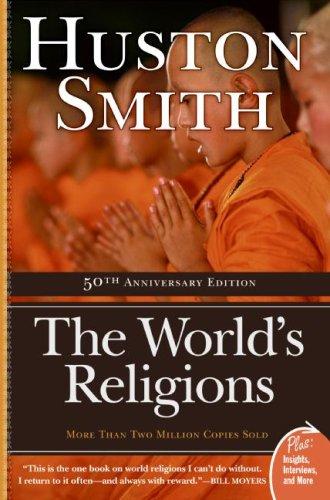
The World's Religions
Huston Smith introduces several of the world’s most influential religious traditions by asking what makes each one compelling to its adherents. Separate chapters consider Hinduism, Buddhism, Confucianism, Taoism, Islam, Judaism, Christianity, and traditions Smith groups under the historically common but now contested label “primal religions.” Rather than attempting an exhaustive institutional history, he concentrates on formative teachings, spiritual ideals, conceptions of reality, and paths of human transformation. The result is a sympathetic work of comparative religion that treats faiths as living responses to enduring questions about suffering, purpose, morality, community, and transcendence. Smith’s approach helped make the book an enduring introduction to religious diversity, but it also reflects the assumptions of an earlier generation of religious studies: it favors coherent spiritual essences over internal disputes, political conditions, and everyday variations. Readers can t…
Where to buy or borrow
Are you selling this book? Bookstores, publishers, authors and libraries can be listed here for free. Request a listing
About this book
Deep Overview
The chapter on Hinduism presents human desire as developing through levels, from pleasure and worldly success toward duty, liberation, and realization of the deepest self. Concepts such as Brahman, atman, karma, samsara, moksha, and the principal yogic paths allow Smith to show Hindu traditions as offering several temperaments a route toward spiritual freedom. Buddhism then addresses suffering through the life and teaching of Siddhartha Gautama, the Four Noble Truths, the Noble Eightfold Path, and differing Buddhist vehicles. Smith gives particular attention to forms of practice and insight associated with Zen and Tibetan Buddhism.
Confucianism and Taoism are treated as contrasting yet complementary responses within Chinese civilization. Confucianism stresses cultivated character, humane relationships, ritual propriety, education, and social harmony. Taoism turns toward naturalness, receptivity, spontaneity, and alignment with the Tao. Smith’s presentation asks readers to see one tradition as refining social life and the other as loosening the artificial constraints that prevent life from moving freely.
The chapters on Islam, Judaism, and Christianity examine monotheistic traditions through their foundational revelations, central figures, moral commitments, communities, and understandings of history. Muhammad and the Qur’an are central to the account of Islam, along with submission to God and the practices that structure Muslim life. Judaism is presented through covenant, revelation, moral meaning, collective identity, and the interpretation of historical experience. Christianity centers on Jesus Christ, the meaning of his life and teachings, love, incarnation, crucifixion, resurrection, and the formation of a community shaped by the gospel.
Smith concludes his principal survey with Indigenous traditions from several regions, emphasizing sacred relationship, oral transmission, ritual, ancestry, place, and participation in a living cosmos. The treatment resists the old assumption that such traditions are merely undeveloped versions of later religions, although its broad grouping compresses very different peoples into one category.
Across the book, Smith does not argue that all religions are identical. He instead presents them as distinct wisdom traditions whose deepest forms disclose different dimensions of human spiritual possibility. His comparative method depends on generous interpretation, but that generosity also creates the book’s central tension: ideal forms receive more attention than conflict, hierarchy, historical change, dissent, and diversity within traditions.
Key Themes
• **Human transformation:** Religion is repeatedly presented as a path that changes perception, desire, conduct, and the relationship between the individual and ultimate reality.
• **Many forms of spiritual discipline:** Meditation, ritual, ethical cultivation, devotion, self-knowledge, social responsibility, and submission to divine will appear as different ways of shaping a religious life.
• **Unity without simple sameness:** Smith looks for recurring spiritual concerns across traditions while preserving substantial differences in doctrine, symbolism, and practice.
• **The tension between inward and institutional religion:** The book privileges spiritual insight and exemplary teaching over bureaucracy, political power, sectarian conflict, and institutional failure.
• **Religion as a response to enduring questions:** Suffering, mortality, moral obligation, freedom, community, transcendence, and the nature of reality connect otherwise different chapters.
Historical and Intellectual Context
Its origins in lectures and public educational television help explain its clarity and its reliance on vivid, representative formulations. The work predates many later developments in religious studies, including stronger attention to colonialism, gender, race, migration, material culture, political power, and the differences between official teaching and everyday practice. Its title change from The Religions of Man to The World’s Religions also reflects changing language and a broader awareness of gendered terminology.
The book is associated with a comparative and partly perennialist approach: religions are treated as culturally distinct traditions that may preserve profound wisdom about a transcendent or sacred order. More recent scholarship frequently questions whether religions have stable, discoverable essences or can be arranged neatly into a set of bounded “world religions.”
Intended Audience
It is less suitable as a stand-alone resource for advanced academic research, detailed religious history, contemporary demographics, denominational differences, or the political role of religion. Readers seeking a consistently skeptical, sociological, or materialist analysis may find Smith’s admiration for religious wisdom too prominent. Those requiring extensive treatment of Sikhism, Jainism, Shinto, new religious movements, secular worldviews, or the diversity within Indigenous traditions will need supplementary works.
Reading Difficulty
The principal challenge is conceptual rather than stylistic. Readers must shift among different understandings of selfhood, divinity, liberation, revelation, ethics, and reality without forcing them into a single framework. Some generalized terminology and older conventions of religious studies may also require contextual explanation. The book is substantial in length, but its clear chapter structure makes it more approachable than a technical academic survey.
Helpful Background Knowledge
Familiarity with terms such as monotheism, polytheism, mysticism, ritual, scripture, ethics, and oral tradition may ease the reading. A map of South Asia, East Asia, the Middle East, and the Mediterranean world can help situate major developments. It is also useful to understand that the category “world religions” is itself debated because it can make fluid, internally diverse traditions appear more uniform than they are.
Why Read This Book?
The book is also valuable as an object of intellectual reflection. Its strengths and limitations reveal how the modern comparative study of religion developed: through a desire for cross-cultural understanding, but also through broad categories and selective portraits. Reading it critically can therefore illuminate both the traditions discussed and the assumptions involved whenever someone attempts to summarize religion on a global scale.
Reader Takeaways
Readers may also recognize that comparison always involves selection. Smith’s chosen teachings do not exhaust the traditions, and ideal religious claims do not automatically describe institutions or individual behavior. The book can therefore cultivate two complementary habits: interpretive generosity toward unfamiliar beliefs and critical awareness of any account that presents a religion as a single unified system.
Strengths
The tradition-by-tradition organization is clear, memorable, and useful for introductory study. Smith also treats Asian religions as substantive intellectual and spiritual traditions rather than curiosities peripheral to a Western story. His attention to Zen, Tibetan Buddhism, Sufism, and other experiential dimensions gives the survey an immediacy absent from purely institutional accounts.
Limitations and Cautions
The survey is selective rather than globally comprehensive. Several important traditions receive little or no independent treatment, while highly diverse Indigenous religions are grouped together. The term “primal religions,” though historically used in comparative scholarship, is now often avoided because it can imply a misleading evolutionary hierarchy.
Smith’s broad categories also reflect the contested “world religions” model, which may treat traditions as more bounded and internally consistent than lived history supports. Because the book’s framework took shape in the mid-twentieth century, it should be supplemented with newer scholarship and voices from the communities discussed.
Important Concepts, People, and Traditions
• **Siddhartha Gautama, the Buddha:** The formative teacher of Buddhism; his analysis of suffering, its causes, and the path beyond it structures Smith’s account of Buddhist life.
• **Confucius:** The Chinese teacher associated with moral cultivation, education, ritual propriety, humane relationships, and responsible participation in society.
• **Laozi and the Tao:** Laozi is traditionally associated with the Tao Te Ching. The Tao names the elusive way or underlying course with which Taoist life seeks alignment.
• **Muhammad and the Qur’an:** Muhammad is understood in Islam as God’s messenger, while the Qur’an is the central revelation around which Smith explains Islamic faith and submission.
• **Jesus Christ:** The central figure of Christianity, interpreted through his teachings, life, death, resurrection, and significance for Christian understandings of divine love and redemption.
• **Brahman and atman:** Major terms in Smith’s presentation of Hindu thought, concerning ultimate reality and the deepest identity of the self.
• **Karma, samsara, and moksha:** Interrelated concepts of morally consequential action, repeated existence, and liberation that help orient the Hinduism chapter and also inform discussion of Indian religious thought more broadly.
• **The Four Noble Truths and Noble Eightfold Path:** The core framework Smith uses to explain the Buddhist diagnosis of suffering and the disciplined path toward its cessation.
• **Covenant:** A central principle in the Judaism chapter, expressing the binding relationship among God, the Jewish people, revelation, communal responsibility, and history.
• **Sufism:** A diverse range of Islamic mystical traditions that Smith highlights when discussing inward realization, devotion, and direct awareness of God.
• **Zen and Tibetan Buddhism:** Buddhist traditions receiving particular attention because they exemplify distinct forms of meditation, insight, discipline, symbolism, and spiritual training.
• **Indigenous and traditional religions:** Traditions connected to particular peoples, lands, ancestors, rituals, and oral inheritances. Smith’s collective treatment introduces recurring relationships but cannot represent their full diversity.
• **Perennialism:** An interpretive outlook associated with the idea that enduring religions may disclose complementary aspects of a transcendent truth. It helps explain Smith’s appreciation of multiple traditions, though the label does not settle all questions about his method.
Questions the Book Explores
• What do different religions identify as the deepest human problem?
• How do liberation, salvation, enlightenment, harmony, and submission differ?
• What relationships do traditions establish among the self, society, nature, and ultimate reality?
• How do ethical discipline, ritual, contemplation, devotion, and knowledge shape religious life?
• Can traditions be compared sympathetically without collapsing their differences?
• What is gained—and what may be obscured—when a religion is presented through its exemplary teachings?
• Do the world’s religions disclose shared spiritual concerns, or does that claim impose unity on fundamentally different systems?
Reading Group Guide
Groups can compare paired chapters productively: Hindu and Buddhist treatments of self and liberation; Confucian and Taoist approaches to social order and naturalness; or Jewish, Christian, and Islamic understandings of revelation, community, and history. Another useful exercise is to distinguish similarity from equivalence. When two traditions address suffering or moral conduct, do they mean the same thing or merely begin from a related human concern?
Readers with direct knowledge of a tradition can discuss where Smith’s portrait is illuminating and where it feels incomplete, while avoiding the assumption that any one participant represents an entire religion. Conclude by considering whether sympathetic understanding requires agreement and whether a more critical account could preserve Smith’s openness while attending more fully to power and diversity.
Discussion Questions
2. When does sympathetic interpretation become idealization?
3. Which tradition most challenges the book’s general assumptions about religion?
4. How does Smith connect religious beliefs with practices of personal transformation?
5. What important differences remain among salvation, liberation, enlightenment, harmony, and submission?
6. How do Confucianism and Taoism offer contrasting visions of a well-lived life?
7. Does the book preserve the distinctiveness of Judaism, Christianity, and Islam while comparing them?
8. What problems arise from placing many Indigenous traditions in one chapter?
9. Which voices within the traditions are least visible in Smith’s presentation?
10. How might attention to gender, politics, colonialism, class, or migration change one chapter?
11. Can a nonbelieving reader adopt Smith’s inside-oriented method without accepting religious claims?
12. What should a contemporary revision retain, remove, or substantially expand?
Sources and Verification
Comments
No published comments yet.
Available editions
Paperback
50th anniversary edition; paperback
- Publisher
- HarperOne
- ISBN-13
- 9780061660184