
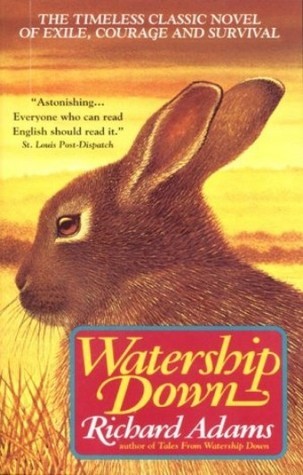
Watership Down
After the visionary Fiver foresees the destruction of Sandleford Warren, his brother Hazel leads a small band of rabbits into the dangerous English countryside. Their search for a secure home becomes an epic of migration, improvisation, and political conflict. The travelers encounter communities that have answered fear in radically different ways, from passive accommodation to rigid authoritarian control. To survive, they must combine courage, specialized talents, storytelling, and cooperation. Richard Adams grounds the adventure in recognizable animal behavior while giving the rabbits a language, mythology, and social memory of their own. The result is both a suspenseful survival narrative and an inquiry into leadership, freedom, community, and the stories through which vulnerable creatures make sense of danger.
Where to buy or borrow
Are you selling this book? Bookstores, publishers, authors and libraries can be listed here for free. Request a listing
About this book
Deep Overview
The journey tests more than endurance. Each rabbit contributes a different form of intelligence. Bigwig supplies strength and battlefield courage; Blackberry solves practical problems; Dandelion offers speed and storytelling; Pipkin inspires protective loyalty; Fiver perceives dangers that others cannot yet articulate. Hazel’s achievement is not mastery of all these abilities but the capacity to recognize, coordinate, and sometimes restrain them. Leadership therefore emerges as attention to others rather than mere dominance.
Adams places this mobile group beside several contrasting societies. Sandleford represents complacent hierarchy: its leaders cannot imagine that familiar arrangements may suddenly vanish. Cowslip’s warren possesses comfort, food, and cultivated manners, but its inhabitants survive by refusing to name the deadly bargain beneath their prosperity. Efrafa, ruled by General Woundwort, answers danger through surveillance, restricted movement, military discipline, and the suppression of individual choice. Watership Down must become a fourth possibility—a community capable of defense without making coercion its governing principle.
The rabbits’ mythology deepens that political structure. Tales of El-ahrairah, the legendary trickster and ancestor, appear at moments when the travelers need entertainment, courage, precedent, or strategic imagination. These stories are not detachable ornaments. They show culture functioning as a survival resource: the weak cannot always defeat power directly, but inherited narratives teach them to value speed, wit, daring, and reversals of fortune. The tales also connect immediate suffering to a larger communal identity.
Material survival remains inseparable from the novel’s moral concerns. The rabbits need shelter, food, mates, territorial knowledge, and warning systems. Their initial group is composed mainly of bucks, so establishing a lasting warren requires rescuing does from captivity and negotiating the future of reproduction and social continuity. This part of the plot produces some of the book’s sharpest suspense, while also exposing its most dated assumptions about gender.
The final conflict between Watership Down and Efrafa turns the adventure into a contest between models of order. Woundwort treats fear as justification for permanent domination. Hazel accepts risk, consultation, and dependence on unlikely allies, including the gull Kehaar and even human-associated forces the rabbits barely understand. Victory comes through collective ingenuity rather than invulnerability. Adams ultimately presents civilization as fragile and repeatedly chosen: a home survives not because danger disappears, but because its members learn how freedom, responsibility, memory, and mutual reliance can reinforce one another.
Key Themes
- **Freedom and security:** The warrens illustrate different bargains between safety and autonomy, asking when protection becomes submission.
- **Exile and home-making:** Home is reconstructed through shared labor, memory, relationships, and institutions—not merely discovered as a favorable location.
- **Prophecy and neglected knowledge:** Fiver’s visions dramatize how communities respond to warnings that cannot be proved by conventional means.
- **Storytelling as survival:** El-ahrairah’s adventures preserve values, inspire strategy, and bind individuals into a people with a remembered past.
- **Power and political organization:** Sandleford, Cowslip’s warren, Efrafa, and Watership Down embody sharply different responses to danger and authority.
- **Ecology and vulnerability:** Weather, terrain, predators, farming, roads, and human development shape every decision; no society exists apart from its environment.
- **Courage and fear:** Bravery appears not as fearlessness but as useful action taken despite uncertainty, physical weakness, or likely loss.
Historical Context
The book also belongs to a long British tradition of animal literature, yet it differs from stories in which animals simply behave like people in costume. Adams gives the rabbits speech, religion, and heroic personalities while retaining biological constraints and a prey animal’s view of the countryside. Ronald Lockley’s The Private Life of the Rabbit informed this naturalistic dimension.
Its publication history is part of its significance. The manuscript was rejected repeatedly before the small publisher Rex Collings accepted it. The novel then won major children’s-literature honors even though its length, violence, vocabulary, and political concerns attracted a substantial adult readership. That crossover identity remains central to how the work is read.
Intended Audience
It is less suitable for readers expecting a gentle pastoral story simply because its protagonists are rabbits. Predation, suffocation, trapping, injury, forced confinement, displacement, and warfare are important to the plot. Readers who prefer very rapid pacing may also find the landscape descriptions, embedded legends, and extended planning sequences demanding. The novel’s limited handling of female agency may frustrate those seeking an evenly balanced ensemble.
Reading Difficulty
Lapine—the rabbits’ invented vocabulary—creates a modest initial barrier. Most terms become intelligible through context, and they eventually sharpen the reader’s sense of a nonhuman worldview. The embedded El-ahrairah stories interrupt the immediate action but usually echo or prepare the dilemmas surrounding them. Emotional difficulty may be greater than linguistic difficulty: the novel includes sustained threat, violent confrontations, and descriptions of communal destruction.
Helpful Background Knowledge
Readers may also benefit from recognizing the pattern of a classical migration epic: a threatened people leave home, undergo trials, encounter alternative societies, and seek to found a lasting settlement. The El-ahrairah episodes draw on trickster-story traditions in which physically vulnerable figures survive by language and ingenuity. Consulting a map of the rabbits’ route can make the practical importance of rivers, roads, hills, farms, and cover easier to follow.
Why Read This Book?
The novel is also distinctive in scale. A field, culvert, road, or barn becomes immense when perceived by small prey animals, allowing a familiar English landscape to feel newly dangerous and wondrous. The invented folklore adds another layer, showing how myths can carry practical wisdom without becoming simple instruction manuals.
Most importantly, the book offers a nuanced portrait of leadership. Hazel is not the strongest fighter, the prophet, or the cleverest problem-solver. His gift is making those different capacities work together. Readers interested in cooperation, institution-building, or the ethics of power will find as much to consider as readers seeking pursuit, escape, and battle.
Reader Takeaways
It may also change how readers perceive ordinary landscapes. Human construction and land use appear radically different when roads, machinery, wire, and development are experienced by animals with little control over them. The contrasting warrens provide a useful vocabulary for thinking about complacency, denial, authoritarian security, and participatory leadership. Finally, the book demonstrates how shared stories do practical work: they preserve identity, create hope, and offer imaginative models for action when direct strength is insufficient.
Strengths
- **Memorable ensemble characterization:** The rabbits possess recognizable temperaments and complementary abilities without becoming interchangeable representatives of ideas.
- **Concrete political imagination:** Different systems of rule are experienced through daily consequences, making institutional questions vivid and dramatically consequential.
- **Sustained suspense:** Reconnaissance, escape, pursuit, deception, and defense are carefully prepared, so solutions usually arise from information established earlier.
- **Landscape writing:** Adams makes distances, weather, vegetation, and terrain central to both atmosphere and strategy.
- **Myth within narrative:** The El-ahrairah cycle enlarges the fictional culture while commenting indirectly on the main action.
- **Cross-generational range:** The surface adventure remains accessible while the ethical, ecological, and political patterns reward rereading.
Limitations and Cautions
The depiction of rabbit behavior is naturalistically informed, not a current scientific account. Adams transforms selected observations into fiction and combines them with speech, prophecy, religion, strategy, and humanlike political organization. Readers should not treat every social claim as zoological fact.
Some readers may find the long middle sections, inset legends, formal narration, and detailed operational planning slow. Others may be disturbed by animal suffering, mass death, snares, predation, authoritarian punishment, and combat. Political interpretations are illuminating but should remain interpretations: no single one-to-one allegorical key adequately explains every warren or character.
Important Concepts, People, and Places
- **Fiver:** Hazel’s smaller brother, whose prophetic perceptions initiate the migration and repeatedly challenge the group’s reliance on visible evidence.
- **Bigwig:** A powerful former member of Sandleford’s Owsla; his courage and ability to endure pressure become decisive, especially inside Efrafa.
- **Blackberry:** An inventive problem-solver who demonstrates the survival value of intelligence that is practical rather than hierarchical.
- **Dandelion:** A swift runner and accomplished teller of traditional stories, linking physical skill to cultural memory.
- **General Woundwort:** Efrafa’s formidable leader, embodying the conversion of legitimate fears about survival into permanent authoritarian control.
- **Hyzenthlay:** An Efrafan doe whose intelligence and willingness to resist reveal opposition within Woundwort’s system.
- **Kehaar:** An injured black-headed gull who forms an alliance with the rabbits and expands their strategic reach through aerial observation.
- **El-ahrairah:** The legendary rabbit trickster and folk hero whose tales model cunning, audacity, loss, and survival.
- **Frith:** The sun and creator figure in rabbit mythology, associated with the gifts and burdens of rabbit existence.
- **Sandleford Warren:** The threatened homeland whose leaders reject Fiver’s warning; it represents both belonging and institutional blindness.
- **Cowslip’s warren:** An outwardly prosperous community maintained through denial and accommodation with hidden violence.
- **Watership Down:** The elevated Hampshire landscape where Hazel’s group attempts to establish a freer and more durable society.
- **Efrafa:** A crowded, militarized warren in which movement and identity are tightly regulated in the name of security.
- **The Owsla:** A warren’s elite body of officers or fighters; its character varies according to the political order it serves.
- **Lapine:** The invented rabbit vocabulary that expresses distinctions important within the animals’ world.
- **Ronald Lockley:** The naturalist whose The Private Life of the Rabbit helped inform Adams’s representation of rabbit behavior.
Questions the Book Explores
- How should a community respond to warnings that are urgent but difficult to verify?
- When does the pursuit of security destroy the freedom it claims to protect?
- Can a displaced group preserve its identity while creating institutions different from those it left behind?
- Why do some societies deny an obvious danger when acknowledging it would threaten their comfort?
- How do stories, myths, and humor help vulnerable beings survive fear and loss?
- What obligations does a leader have toward the weakest members of a group?
- Can violence defend a free community without becoming its organizing principle?
- How does viewing human activity from an animal perspective alter ideas about progress, property, and habitat?
- What must a temporary alliance become before it can be called a lasting society?
Reading Group Guide
Set aside one discussion segment for the El-ahrairah stories. Rather than summarizing them, examine when Adams inserts each tale and what emotional or strategic need it answers. Another useful exercise is to trace knowledge: who notices a problem, who believes the observer, how information travels, and what happens when authorities suppress or ignore it.
For a final comparison, place Hazel and Woundwort side by side as leaders responding to the same basic fact—the rabbit world is dangerous. Discuss how each converts fear into institutions and what each demands from followers. Groups sensitive to animal harm may wish to flag chapters involving snares, the destruction of Sandleford, Efrafa’s punishments, and the concluding conflict before meeting.
Discussion Questions
2. Which member of the traveling group contributes the least visible but most essential form of leadership?
3. How does Cowslip’s warren maintain its collective denial, and what makes that denial attractive?
4. Is Efrafa presented only as tyranny, or does the novel allow readers to understand why such a system might arise?
5. How do the stories of El-ahrairah alter the rabbits’ choices in the main narrative?
6. What is gained—and what is distorted—by combining realistic rabbit behavior with humanlike speech and politics?
7. At what point does Hazel’s band become a community rather than a collection of refugees?
8. How does Bigwig’s time inside Efrafa change the meaning of courage in the novel?
9. What does Hyzenthlay reveal about the internal weaknesses of authoritarian rule?
10. How does the rabbits’ perspective transform familiar human objects and activities?
11. Does the novel successfully distinguish necessary defense from militarism?
12. How would the story change if the does’ experiences and decisions occupied equal narrative space?
13. Which interpretation of “home” matters most in the book: territory, safety, memory, kinship, or self-government?
14. Why is humor repeatedly present in scenes of danger?
15. What does the ending suggest about mortality, succession, and the relationship between history and legend?
Sources and Verification
Context concerning Adams’s life, the novel’s origin, awards, crossover readership, and publication history was checked through official publisher biographies and established journalism. Information about the selected Avon edition is bibliographic rather than interpretive. The profile’s discussion of themes, characters, structure, and limitations is independent editorial analysis. Categories: Classics; Fantasy; Animal Fiction; Adventure. Tags: rabbits, survival, leadership, exile, authoritarianism, invented mythology, ecological fiction, English countryside.
Comments
No published comments yet.
Available editions
Paperback
Avon Books mass-market paperback
- Publisher
- Avon Books
- ISBN-13
- 9780380395866
- Pages
- 478