
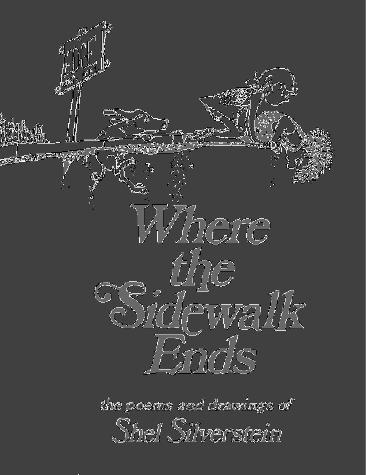
Where the Sidewalk Ends
The Poems & Drawings of Shel Silverstein
Shel Silverstein’s landmark children’s collection joins brief, highly performable poems with loose black-and-white drawings. Its speakers encounter impossible creatures, stubborn children, runaway shadows, peculiar machines, exaggerated disasters, and ordinary frustrations pushed into absurdity. Beneath the jokes, the poems repeatedly test adult rules, childhood fears, responsibility, difference, and the freedom to imagine alternatives. Rhymes, refrains, comic timing, and visual punch lines make the volume especially inviting for reading aloud, while moments of tenderness and unease keep it from becoming merely silly. For families or teachers seeking poetry books that welcome hesitant readers, it offers an accessible entrance into sound, rhythm, figurative language, and the pleasure of verbal surprise.
Where to buy or borrow
Are you selling this book? Bookstores, publishers, authors and libraries can be listed here for free. Request a listing
About this book
Deep Overview
This method makes exaggeration more than a source of punch lines. A neglected task may expand until it consumes the speaker’s world, while a casual wish can produce consequences no one anticipated. The poems therefore explore cause and effect without settling into straightforward moral instruction. Some resemble cautionary tales, but their excess keeps the lesson unstable: readers can recognize a warning while also enjoying the offender’s nerve, ingenuity, or spectacular failure.
Voice is central to the collection. Many poems sound spoken rather than formally recited. Their clipped phrases, emphatic repetitions, quick rhymes, and conversational turns invite readers to perform them aloud. Silverstein often lets a speaker reveal more than intended. A boast becomes self-exposure; a complaint uncovers selfishness; a confident explanation collapses under its own absurdity. Children can enjoy the immediate joke, while older readers may notice satire directed at vanity, conformity, greed, avoidance, and the mechanical use of authority.
The drawings are not ornamental additions. Silverstein’s sparse lines isolate the crucial action or expression, leaving generous blank space around figures. That visual simplicity helps emerging readers connect language with gesture and consequence. At times, a picture clarifies the impossible premise; elsewhere it delays or completes the joke. The page consequently works as a unit of timing, with pauses, spacing, line breaks, and images controlling when the reader understands what has happened.
The title provides the collection’s broadest metaphor. The sidewalk represents the mapped, regulated world—the route already laid down—while its ending suggests a threshold into invention. Yet Silverstein’s imagined territory is not a gentle refuge. It contains monsters, failures, embarrassment, selfishness, and loss alongside delight. Imagination matters here because it permits readers to inspect difficult feelings and social rules from an oblique angle. The collection’s enduring achievement is its demonstration that poetry can be playful without being trivial, accessible without being simple-minded, and child-centered without idealizing childhood.
Key Themes
• Consequences and excess: Wishes, appetites, excuses, and neglected duties frequently grow beyond control.
• Resistance to authority: Young speakers question commands and conventions, sometimes perceptively and sometimes for selfish reasons.
• Language as play: Rhyme, repetition, invented words, sound effects, and abrupt reversals make expression itself part of the entertainment.
• Difference and belonging: Unusual bodies, habits, creatures, and viewpoints challenge easy definitions of normality.
• Fear made manageable: Monsters, illness, disappearance, punishment, and embarrassment are approached through comic distortion.
• Perspective: Many jokes depend on the gap between what a speaker believes and what readers can infer.
Historical Context
Intended Audience
Reading Difficulty
Helpful Background Knowledge
Why Read This Book?
Reader Takeaways
Strengths
• A productive union of poetry and illustration, with images frequently completing rather than merely decorating the text.
• Short, self-contained pieces that accommodate browsing, rereading, performance, and mixed reading levels.
• Humor broad enough to reach young listeners while leaving irony and social satire for older readers.
• Memorable transformations of ordinary childhood concerns into imaginative situations.
• A broad tonal range that includes nonsense, mock horror, tenderness, rebellion, and reflective quiet.
Limitations and Cautions
Important Concepts, People, and Places
• The sidewalk’s end: A metaphorical boundary between prescribed routes and imaginative possibility, giving the collection its organizing invitation.
• Nonsense verse: Poetry that applies pattern and verbal precision to impossible situations; much of the book draws power from this tradition.
• Comic cautionary tale: A storylike poem in which misconduct or excess produces outlandish consequences, often complicating rather than simply delivering a moral.
• Speaker: The voice presenting a poem. Silverstein frequently uses unreliable, boastful, evasive, or naïve speakers whose words reveal unintended meanings.
• Hyperbole: Extreme exaggeration turns common annoyances and desires into surreal events throughout the collection.
• Wordplay: Rhyme, double meaning, invented language, repetition, and sound patterns make words objects of play as well as vehicles for stories.
• Black-and-white line drawing: Silverstein’s economical illustrative style supplies expression, action, scale, and comic timing with minimal detail.
• American children’s poetry: The literary context in which the book helped popularize an informal, irreverent, performance-friendly approach to verse for young readers.
Questions the Book Explores
Reading Group Guide
Discussion Questions
2. Which poem depends most strongly on its illustration, and how would its meaning change without the picture?
3. When does a child speaker appear wiser than the adults, and when does the reverse occur?
4. How does Silverstein make an impossible situation feel internally consistent?
5. Which poems resemble cautionary tales, and how seriously should their lessons be taken?
6. Where does humor make a frightening subject easier to approach, and where might it make the subject more unsettling?
7. How do rhythm and rhyme guide a reader toward a surprise?
8. Which speakers misunderstand themselves, and how can the reader tell?
9. What kinds of authority does the collection mock or question?
10. Which dated element would generate the most useful contemporary discussion?
11. How do blank space and simple lines affect the pace of reading?
12. If the collection were assembled today, what ordinary modern frustrations might Silverstein transform into poems?
Sources and Verification
Comments
No published comments yet.
Available editions
Hardcover
Library binding
- Publisher
- Harper & Row
- ISBN-13
- 9780060256685