
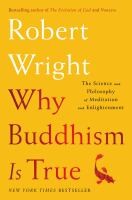
Why Buddhism Is True
The Science and Philosophy of Meditation and Enlightenment
Robert Wright argues that selected Buddhist teachings offer an unusually accurate diagnosis of ordinary human experience. Natural selection, he explains, shaped minds to pursue rewards, avoid threats, defend status, and divide the social world into allies and enemies—not necessarily to perceive reality impartially or remain content. This evolutionary framework helps him interpret Buddhist ideas about suffering, impermanence, attachment, not-self, and the deceptive character of perception. Drawing on psychology, evolutionary theory, philosophy, personal experience, and mindfulness practice, Wright presents meditation as a way to observe feelings without automatically obeying them. His claim is deliberately narrower than the title suggests: he does not defend every Buddhist doctrine or supernatural belief. Instead, he makes a secular case that central Buddhist insights into craving, cognition, and identity illuminate why people suffer and how greater awareness might produce clarity, equ…
Where to buy or borrow
Are you selling this book? Bookstores, publishers, authors and libraries can be listed here for free. Request a listing
About this book
Deep Overview
This account becomes Wright’s bridge to the Buddhist analysis of dukkha, a term encompassing suffering, unsatisfactoriness, and the instability of conditioned experience. Craving promises more durable fulfillment than it usually supplies. Aversion magnifies unpleasant experiences. Feelings quietly attach positive or negative evaluations to people, objects, memories, and ideas, then present those evaluations as properties of the world itself. Mindfulness matters because it can expose this process. A meditator learns to experience a feeling as a changing event rather than as an unquestionable command.
The book then turns to anatta, or not-self. Wright does not simply claim that a person does not exist. He questions the familiar picture of a single inner executive that authors thoughts, controls behavior, and remains identical through time. Drawing on models of a modular mind, he portrays mental life as competition among partly independent systems whose influence changes with circumstances. Meditation can make this fragmented quality visible: thoughts appear without being consciously summoned, moods alter what seems true, and impulses gain or lose authority as attention changes.
Wright also considers the Buddhist suggestion that ordinary perception is delusive. His argument is not that the external world is imaginary. Rather, perception is an interested construction. Organisms notice, categorize, and emotionally color reality in ways that supported survival. The perceived essence of an enemy, temptation, insult, or possession may therefore owe much to the observer’s mental conditioning. Insight practice can weaken these seemingly solid essences by revealing the sensations, feelings, and judgments from which they are assembled.
The inquiry expands from personal distress to moral and political life. If feelings help construct our certainties, then hostility toward opponents and loyalty to groups may feel more objective than they are. Wright proposes that observing these reactions can create room for less defensive judgment and wider compassion. He does not present meditation as effortless or guarantee enlightenment; his accounts include distraction, doubt, and limited progress. The book’s central proposition is more modest: understanding how evolution shaped the mind, then observing that mind through disciplined attention, can lend empirical plausibility to important Buddhist claims and reduce the power of the biases that govern both private suffering and collective conflict.
Key Themes
• **Feelings as judgments:** Pleasant and unpleasant feelings do more than accompany thought; they guide attention, valuation, and behavior while making their evaluations seem objectively warranted.
• **Mindfulness and freedom:** Freedom is presented not as absolute control over the mind but as an increased ability to notice an impulse without immediately identifying with or acting on it.
• **Not-self:** The book explores the possibility that the unified, commanding self is less substantial than intuition suggests. Mental life may be better understood as shifting coalitions of motives, perceptions, and cognitive systems.
• **Constructed perception:** Humans encounter a world already filtered by inherited tendencies, learned associations, and emotional interests. Meditation may disclose some of that filtering.
• **Clarity and compassion:** Seeing the contingency of one’s own reactions may reduce egocentrism, hostility, and tribal certainty, giving Buddhist insight an ethical and social dimension.
Historical and Intellectual Context
Wright’s approach reflects this Buddhist-modernist and secular-Buddhist environment. He focuses on meditation and philosophical claims that can be discussed alongside psychology and evolutionary theory. The evolutionary component also continues the inquiry of his earlier work, particularly his interest in how natural selection shaped human motivation. Readers should therefore distinguish the book’s carefully selected, naturalistic Buddhism from the full historical diversity of Theravada, Mahayana, and Vajrayana traditions. Traditional Buddhism encompasses ethical precepts, institutions, rituals, devotional practices, cosmologies, and doctrines that this book does not attempt to validate.
Intended Audience
Readers wanting a comprehensive history of Buddhism, instruction within a specific lineage, close study of canonical texts, or a balanced survey of Asian Buddhist traditions will need other books. Those expecting decisive scientific proof of enlightenment or every Buddhist doctrine may also find the title broader than the actual argument.
Reading Difficulty
The book is argumentative rather than a step-by-step meditation manual. Readers can follow it without practicing, but even brief familiarity with observing breath, sensation, or emotion may make its experiential claims easier to assess. Technical research is explained for a general audience rather than presented at specialist depth.
Helpful Background Knowledge
Familiarity with the Four Noble Truths, mindfulness, impermanence, dependent arising, and anatta can provide orientation, but the book introduces the concepts it needs. Readers may also keep in mind the distinction between scientific findings, broader psychological theories, Wright’s philosophical inferences, and reports from his own meditation. Those forms of evidence do not all carry the same weight.
Why Read This Book?
The book also offers a useful meeting point for readers who distrust both uncritical spirituality and dismissive reductionism. It treats Buddhist claims as propositions to examine through experience, philosophy, and science rather than as doctrines that must be accepted in advance.
Reader Takeaways
Readers may also reconsider the self as a changing process rather than a fixed controller, understand why fulfilled desires so often produce only temporary satisfaction, and see meditation as training in metacognitive observation rather than simple relaxation. At the social level, Wright’s analysis invites greater suspicion of outrage, status defense, and tribal certainty—especially when those reactions feel most righteous.
Strengths
Another strength is the distinction between having a thought or feeling and granting it authority. This gives the discussion practical force without turning the book into a list of wellness tips. Its movement from individual craving to political and social tribalism also demonstrates why attention training might carry ethical consequences beyond private calm.
Limitations and Cautions
The scientific evidence and the philosophical conclusions also need to be distinguished. Psychological research may show that perception is biased or that mental processes are distributed without conclusively proving Buddhist not-self, emptiness, or liberation. Some analogies between modern cognitive models and ancient teachings remain interpretations rather than demonstrations.
Finally, evolutionary psychology provides illuminating hypotheses but can tempt writers into plausible stories that are difficult to test directly. The book’s personal meditation reports make the argument vivid, yet they are illustrative experiences, not universal outcomes or clinical evidence. It should not be used as a substitute for mental-health care or as a complete meditation-safety guide.
Important Concepts and People
• **Siddhartha Gautama, the Buddha:** The historical teacher associated with the origins of Buddhism. Wright engages teachings attributed to this tradition rather than offering a biography of the Buddha.
• **Natural selection:** The explanatory foundation of Wright’s case. Evolution shaped perception and motivation for reproductive fitness, which need not align with contentment or impartial truth.
• **Dukkha:** Commonly translated as suffering or unsatisfactoriness. In the book, it includes the instability, frustration, and recurring discontent generated by craving and attachment.
• **Tanha, or craving:** The drive to grasp pleasant experiences, reject unpleasant ones, and seek renewed gratification. Wright connects it to evolved reward systems.
• **Anicca, or impermanence:** The instability of sensations, emotions, pleasures, relationships, and identities. Failure to appreciate change helps turn attachment into distress.
• **Anatta, or not-self:** The Buddhist challenge to belief in a permanent, unified inner controller. Wright relates it to evidence that thought and behavior emerge from multiple interacting processes.
• **Mindfulness meditation:** Training in sustained, nonautomatic observation of sensations, feelings, and thoughts. It is the book’s chief practical method for loosening identification with mental events.
• **Vipassana, or insight meditation:** A family of practices aimed at directly seeing characteristics of experience, including change, unsatisfactoriness, and the absence of a fixed self.
• **Modular mind:** A psychological model in which partly specialized systems compete or cooperate to shape attention and action. Wright uses it to question the intuition of a single mental executive.
• **Emptiness and essence:** Wright explores how objects and people appear to possess fixed qualities even though those qualities partly reflect context, association, and the observer’s emotional response.
• **The Matrix:** The film supplies Wright with an opening metaphor for living inside a persuasive but distorted representation of reality and for choosing to investigate that distortion.
Questions the Book Explores
• Why does satisfaction fade so quickly after a desire has been fulfilled?
• Are feelings responses to objective value, or do they help create the value we think we perceive?
• Is there a unified self directing mental life, or does control move among competing psychological systems?
• Can meditation provide knowledge about the mind, and how should first-person insight be related to scientific evidence?
• What does it mean to call perception “delusive” without denying the existence of an external world?
• Can greater awareness of mental conditioning reduce hatred, tribalism, and moral self-righteousness?
• Which Buddhist claims can be defended naturalistically, and what is lost when Buddhism is separated from its religious settings?
Reading Group Guide
A second productive angle is the selection of Buddhism itself. Identify which doctrines and practices receive sustained attention and which are set aside. Consider whether this focus makes the tradition more accessible, changes it fundamentally, or does both at once.
Groups can also compare the treatment of private and public suffering. Notice the point at which an account of craving and attention becomes an argument about compassion and political tribalism. Ask what additional ethical institutions or social practices would be needed if meditation alone is insufficient.
Finally, invite members to observe one ordinary episode of craving, irritation, or status anxiety before the meeting. The aim is not to judge anyone’s meditation ability but to test the book’s descriptive vocabulary against lived experience.
Discussion Questions
2. Does an evolutionary explanation of craving make the Buddhist diagnosis of suffering more persuasive? Why or why not?
3. When does a useful evolutionary account become an untestable adaptation story?
4. Which of the book’s arguments for not-self is strongest, and what kind of self, if any, survives it?
5. Does observing a feeling without acting on it constitute freedom, or only another kind of conditioning?
6. How convincingly does Wright distinguish reality itself from the emotional and conceptual filters through which it appears?
7. Can a first-person meditative experience count as evidence? What are its proper limits?
8. Does secularizing Buddhism clarify its insights or remove features necessary to understand them?
9. What connects mindfulness to compassion in Wright’s account? Is that connection guaranteed?
10. Can individual meditation meaningfully reduce political tribalism without changes to institutions and incentives?
11. Which claim in the book would be hardest to accept without undertaking meditation practice?
12. How might a traditional Buddhist practitioner, cognitive scientist, and philosopher of mind evaluate the book differently?
Sources and Verification
Comments
No published comments yet.
Available editions
Hardcover
hardcover
- Publisher
- Simon & Schuster
- ISBN-13
- 9781439195451
- Publication date