
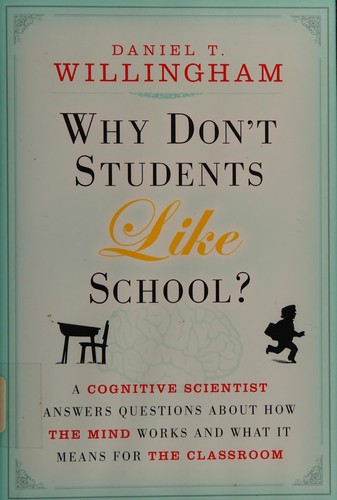
Why Don’t Students Like School?
A Cognitive Scientist Answers Questions About How the Mind Works and What It Means for the Classroom
Why Don’t Students Like School? explains classroom learning through cognitive psychology. Daniel T. Willingham begins with an apparent contradiction: people are curious, yet sustained thinking is slow, demanding, and often avoided. Students are most likely to engage when a problem is challenging enough to be satisfying but not so difficult that success seems remote. From that foundation, the book examines how prior knowledge supports reasoning and reading comprehension, why memory depends on what learners think about, why abstract ideas require concrete examples, and when practice helps. It also considers expertise, differences among learners, beliefs about intelligence, educational technology, and the mental demands placed on teachers. Rather than offering a single teaching method, Willingham presents cognitive principles and asks educators to adapt them to particular subjects and classrooms. The result is an accessible bridge between research on memory and thought and the daily work…
Where to buy or borrow
Are you selling this book? Bookstores, publishers, authors and libraries can be listed here for free. Request a listing
About this book
Deep Overview
The book then turns to the relationship between knowledge and thought. Willingham challenges the idea that schools must choose between teaching facts and teaching higher-order skills. Reasoning, comprehension, analysis, and problem-solving all depend on information already stored in long-term memory. Background knowledge helps readers interpret language, recognize patterns, and keep working memory from becoming overloaded. Facts are not presented as the final aim of education; they are part of the cognitive equipment that makes more sophisticated thinking possible.
Memory receives similarly practical treatment. The crucial question is not only what a teacher presents but what students mentally do with it. Learners tend to remember the meaning or feature on which their attention and thought were focused. This makes lesson design partly an exercise in anticipating student cognition: an entertaining activity can fail if students remember its spectacle but not the intended idea. Willingham also discusses the memorable structure of stories, while cautioning that engaging presentation should serve the material rather than distract from it.
Later chapters examine why abstract knowledge is difficult to acquire and transfer. New concepts are usually first understood through familiar, concrete instances, but students may cling to surface features and miss the deeper structure connecting examples. Varied examples, comparisons, and carefully sequenced practice can help learners perceive that structure. Practice is defended not as purposeless repetition but as a way to make foundational procedures more automatic, preserve learning, and create mental capacity for advanced work.
The book distinguishes novice learning from expert performance. Students cannot simply imitate professional historians, mathematicians, or scientists because experts possess extensive organized knowledge and years of specialized practice. It also questions the instructional usefulness of popular learning-style classifications and treats intelligence as responsive to sustained effort and environment rather than as a fixed classroom destiny. The second edition extends this reasoning to educational technology: a tool should be evaluated by the cognitive work it changes, not by novelty alone. The concluding focus on the teacher’s mind makes professional improvement itself a problem of learning, feedback, and practice.
Key Themes
• **Knowledge as a foundation for thinking:** Critical thinking is not a content-free procedure. What a learner can infer, evaluate, or understand depends partly on what that learner already knows about the subject.
• **Memory follows thought:** Exposure and repetition alone do not guarantee durable learning. Students are more likely to remember the aspect of an experience they considered meaningfully.
• **Concrete beginnings, abstract goals:** Familiar examples make ideas accessible, but instruction must help students move beyond surface details and recognize transferable relationships.
• **Purposeful practice:** Practice can support fluency, long-term retention, and advanced reasoning when it is directed toward important knowledge or procedures rather than assigned mechanically.
• **Novices and experts think differently:** Expert performance rests on large, organized bodies of knowledge. Beginning students need instruction appropriate to novice cognition rather than premature imitation of professional inquiry.
• **Skepticism toward educational shortcuts:** Learning styles, technological novelty, and generalized thinking skills are examined through the question of whether they reliably alter learning.
Educational and Intellectual Context
The second edition appeared in 2021, after digital platforms and devices had become routine features of many classrooms. Its added technology chapter reflects a shift from asking whether schools should use technology to asking which cognitive task a particular tool improves, changes, or complicates. Readers should also recognize that the book concentrates primarily on cognitive conditions for academic learning. Social belonging, institutional trust, material inequality, disability, culture, and school organization may also shape students’ experiences, but they are not its principal explanatory framework.
Intended Audience
Readers wanting a comprehensive theory of student motivation, educational inequality, classroom relationships, or school reform will find only part of what they need here. The book is best approached as a focused account of cognitive constraints and opportunities, not as a complete explanation of why any particular student dislikes school.
Reading Difficulty
The chapter-by-question structure makes the book suitable for selective reading, although its principles are most useful when considered together. The main challenge is conceptual rather than stylistic: apparently simple recommendations depend on distinctions between remembering and understanding, surface features and deep structure, or novice and expert performance. Readers may benefit from pausing after each chapter to test the principle against an actual lesson.
Helpful Background Knowledge
Before reading, it may help to recall a learning experience that felt satisfyingly difficult, one that felt impossible, and one activity remembered vividly even though its intended lesson was forgotten. These examples provide useful reference points for the book’s discussions of challenge, prior knowledge, and the relationship between thought and memory.
Why Read This Book?
The book is particularly useful when confronting plausible educational claims. Its treatment of learning styles, expert thinking, intelligence, and classroom technology encourages readers to ask what evidence supports a claim and what cognitive mechanism would make a proposed intervention work.
Reader Takeaways
The book may also change how readers interpret difficulty. Struggle is not automatically evidence of laziness or low ability; it may indicate insufficient background knowledge, overloaded working memory, weakly organized practice, or a task set at the wrong level. At the same time, successful learning still requires sustained effort. The practical goal is not to eliminate effort but to make it productive.
Strengths
It is also valuable for resisting false dichotomies. Knowledge and thinking, understanding and practice, or engagement and academic content are not treated as mutually exclusive. The second edition’s chapter on technology extends this measured approach into an area often dominated by novelty and broad promises. Finally, the book usually presents principles as constraints and possibilities rather than claiming that cognitive science supplies a complete script for teaching.
Limitations and Scope Boundaries
General cognitive principles also require contextual judgment. A laboratory finding does not dictate one classroom procedure, and different subjects may demand different forms of representation and practice. Readers may additionally dispute how far the knowledge-centered account should guide inquiry-based, arts-based, or culturally responsive instruction. The book is most reliable as one important lens among several, not as a comprehensive philosophy of education.
Important Concepts and People
• **Cognitive psychology:** The research field supplying the book’s framework for attention, memory, reasoning, and learning.
• **Working memory:** The limited mental space in which information is actively held and combined. Overloading it makes unfamiliar reasoning difficult.
• **Long-term memory:** The store of knowledge and procedures that supports comprehension and reduces demands on working memory.
• **Prior or background knowledge:** Information already known by the learner. It shapes what can be understood, inferred, and remembered.
• **Memory as the residue of thought:** The principle that learners tend to retain what they meaningfully considered, not necessarily everything a teacher displayed or said.
• **Story structure:** Causal, goal-directed organization that can make material easier to follow and remember when it fits the subject.
• **Automaticity:** Fluency produced through practice, allowing a foundational procedure to consume less conscious attention.
• **Transfer:** The ability to apply learning in a new setting. It is difficult when students notice surface differences instead of a shared underlying structure.
• **Deep structure and surface structure:** Surface features are immediately visible details; deep structure is the underlying relationship or principle that experts more readily recognize.
• **Novice–expert distinction:** Experts reason with extensive, organized subject knowledge, so methods effective for experts may not suit beginners.
• **Learning styles:** Popular classifications of learners by preferred mode. The book questions whether matching instruction to such labels reliably improves learning.
• **Malleable intelligence:** The view that cognitive ability is not a fixed classroom verdict and can develop through learning, effective strategy, and sustained effort.
• **Educational technology:** In the second edition, technology is treated as a means whose value depends on how it changes a specific learning task.
Questions the Book Explores
• How does the level of challenge affect whether schoolwork feels rewarding or frustrating?
• Why is subject knowledge necessary for comprehension and critical thinking?
• What determines which parts of a lesson enter long-term memory?
• Why do concrete examples help initially, yet sometimes obstruct transfer?
• Under what conditions does practice create fluency rather than boredom?
• Why can novices not simply be asked to think exactly like disciplinary experts?
• Should teaching be matched to alleged learning styles?
• How can educators respond constructively to differences in students’ rates of learning?
• What questions should be asked before adopting a new classroom technology?
• How can teachers improve complex professional skills that are difficult to evaluate in the moment?
Reading Group Guide
A productive discussion can compare cognitive engagement with emotional and social engagement. Where does the book illuminate student experience, and where are additional perspectives required? Groups can also examine the difference between using stories to organize meaning and adding entertaining details that divert attention.
For the technology chapter, choose one tool already used by the group. Avoid discussing whether it is modern or appealing; instead, specify the learning process it is meant to improve and what evidence would indicate success. Conclude by having each participant redesign one small feature of a lesson and explain the cognitive principle behind the change.
Discussion Questions
2. How can a teacher judge whether a task is at a productively difficult level for students with different prior knowledge?
3. When does an emphasis on factual knowledge support deeper thinking, and when might it become an excuse for shallow instruction?
4. Think of a memorable lesson or presentation. Did you remember the intended idea or only an attention-grabbing detail?
5. How can teachers use story structure in subjects that are not ordinarily taught as narratives?
6. What distinguishes purposeful practice from repetitive work that students experience as meaningless?
7. Which classroom activities ask novices to behave like experts before they possess the necessary knowledge?
8. Why are learning-style claims appealing even when matching instruction to style labels lacks strong support?
9. How should schools discuss intelligence and effort without ignoring disability, unequal opportunity, or differences in prior preparation?
10. What would count as convincing evidence that a classroom technology improves learning rather than convenience or enjoyment alone?
11. Which parts of teaching can be improved through structured practice and feedback, and which resist such decomposition?
12. How should the book’s cognitive account be combined with social, cultural, emotional, and institutional explanations of school experience?
Sources and Verification
Comments
No published comments yet.
Available editions
Paperback
2nd edition, paperback
- Publisher
- Jossey-Bass
- ISBN-13
- 9781119715665
- Publication date