
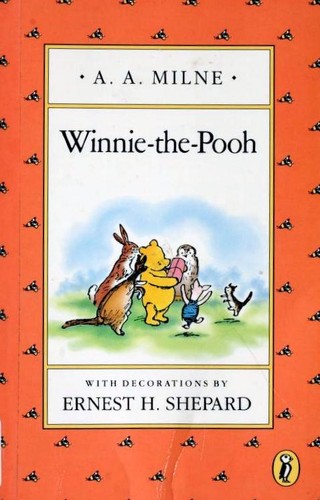
Winnie-the-Pooh
Winnie-the-Pooh gathers ten linked stories about a bear of modest intellect, his friend Christopher Robin, and the animals who share a forest in southern England. Pooh hunts for honey, Piglet confronts imagined monsters, Eeyore endures his gloom, and a small party sets off to find the North Pole. A. A. Milne wrote the tales in the 1920s for his young son, and E. H. Shepard's drawings gave the characters their lasting look. Everyday worries, friendship and muddled logic become gentle comedy. It is among the most durable books for kids ever published, and adults often notice a second layer of wordplay and affectionate observation of human nature. This profile covers the 1992 Puffin paperback.
Where to buy or borrow
Are you selling this book? Bookstores, publishers, authors and libraries can be listed here for free. Request a listing
About this book
The book opens with an introduction and then runs through ten chapters. Each chapter title begins with the formula "In which...", which lets the narrator announce the plot with a wink. The storyteller is present throughout. He talks with Christopher Robin about the tales, so the book feels like an oral performance at bedtime that has been written down. Each chapter works as a self-contained anecdote, but the cast and the geography build up from one to the next.
The book is distinctive for its comic precision. Milne's jokes depend on the rhythm of speech, on capital letters and invented spellings, and on characters who reason confidently towards the wrong conclusion. Shepard's line drawings carry equal weight. The edition profiled here is the Puffin paperback, with Shepard credited as illustrator.
Deep Overview
The early chapters establish Pooh's temperament. He is hungry, hopeful and sincere, and he thinks of himself as having very little brain. His first scheme, to reach a beehive by floating up under a balloon while disguised as a small black cloud, shows the pattern the book repeats. A plan that sounds sensible inside the character's logic fails in the practical world, and the failure is treated with warmth. Pooh then visits Rabbit and eats so much that he gets stuck in the doorway, and the next chapter has Pooh and Piglet tracking footprints in the snow, only to discover they have been circling and following their own trail.
The middle of the book widens the community. Eeyore, who has lost his tail, is the first fully drawn gloomy personality in the forest, and Pooh's search for the tail leads to an ingenious but comic resolution. Piglet and Pooh then trap a Heffalump with a honey jar, and nobody involved knows what a Heffalump is. Kanga and Roo arrive as newcomers. Piglet is treated with suspicion by Rabbit's scheming, and he ends up bathed and dosed in a pointed domestic scene. The comedy here comes from how groups handle strangers and unknown dangers.
The later chapters are larger set pieces. Christopher Robin leads an "expotition" to the North Pole, and Pooh happens to find a pole while rescuing Roo from a stream. A flood isolates Piglet in his house, and the rescue combines courage, improvisation and pure accident. In the final chapter a party honours Pooh for helping, and the book closes by returning to the relationship between the boy and his bear.
What Milne demonstrates is that childhood logic can be taken seriously without being made solemn. Each character is built around a recognisable human tendency. Rabbit organises, Owl pretends to learning, Piglet is nervous but loyal, and Eeyore finds the worst in everything. Pooh survives all of them through kindness and an ability to say the simple thing others overlook. The book does not preach. Its moral life lies in actions: sharing, rescuing, noticing a friend's sadness, and being loyal when it costs something.
The animals also depend on Shepard's illustrations, which settle their physical personalities and give the forest its recognisable pines, streams and paths. Together the text and drawings create a world that is whimsical but never vague, with named places, reliable routines and a set of relationships that feel stable enough for a child to trust.
Key Themes
The book also explores the gap between knowing and seeming to know. Owl's long words, Rabbit's schemes and the whole Heffalump hunt show characters acting with confidence about things they do not understand. Pooh's frank admission of ignorance is often what rescues a situation.
A third strand concerns childhood imagination and play. Christopher Robin is the authority figure in a world that exists because a child supplies the rules. Expeditions, traps and rescues are all games taken at full seriousness.
Finally, the stories treat small fears and moods with respect. Piglet's nerves, Eeyore's gloom and Pooh's hunger are not cured but accommodated, which gives the book a quiet model of how a community can hold different temperaments together.
Historical Context
The setting has a real counterpart as well. The Milnes bought Cotchford Farm in Sussex in 1925, on the edge of Ashdown Forest, and its heath and pine clumps became the model for the forest of the stories, rendered in the books as the Hundred Aker Wood. The first Pooh story appeared in London's Evening News on Christmas Eve 1925, and the book was published by Methuen in London on 14 October 1926, with E. P. Dutton issuing it in the United States.
Milne belonged to the circle of writers and artists around Punch magazine, and E. H. Shepard, also a Punch contributor, supplied the illustrations after visiting the forest to sketch it. Shepard's Pooh is reported to have been modelled on his own son's bear rather than Christopher Robin's.
The success of the books later became complicated. Milne reportedly resented that children's writing overshadowed his work for adults, and Christopher Robin Milne wrote in his 1974 memoir, The Enchanted Places, about the strain of being identified with the fictional boy. That memoir is the best-known account of the real people behind the stories.
Intended Audience
Teachers, librarians and anyone interested in the history of children's literature will find it a useful reference point, because many later talking-animal stories borrow its tone. Adult readers who enjoy British humour, nonsense and light philosophical comedy are also a natural audience.
Readers expecting a fast, plot-driven adventure may be less satisfied. The pleasure here is in voice and character, and the stories are deliberately small. Those who know only the animated versions should also expect a different, drier and more verbal experience.
Reading Difficulty
The publisher gives this edition a Lexile measure of 790L, which suggests an upper-elementary reading level, but the humour often works on two levels and benefits from an adult reader's pacing. Chapters are self-contained, so the book is easy to start and stop. The jokes depend on tone, which means reading aloud tends to make them clearer than silent reading.
This is a paperback with illustrations by Shepard. Page counts differ between catalogue records for this edition, so the physical length is best checked on the copy in hand.
Helpful Background Knowledge
Readers who have only met Pooh through animated adaptations should know that the original characters are slightly different in manner, and that the stories rely on a narrator speaking directly to Christopher Robin. It is also helpful to know that the book is the first of two. Tigger does not appear in this volume, and he arrives in the sequel, The House at Pooh Corner.
A light acquaintance with English nursery verse and nonsense writing makes Milne's wordplay easier to enjoy, though it is not required.
Why Read This Book?
It is also an unusually good choice for shared reading. A parent and child can enjoy the same chapter for different reasons, one for the adventure, the other for the irony. Among books for kids that are still widely read a century after publication, it offers an uncommon mix of comfort and intellectual play.
Finally, this edition gives access to the book as published, with Shepard's drawings, rather than to a retelling. Anyone curious about where a global cultural figure began will find the source here.
Reader Takeaways
Readers may also reconsider the value of simplicity. Pooh is not a model of intelligence, yet he repeatedly sees what matters, and the book invites readers to ask when cleverness helps and when it gets in the way.
Others may notice how a children's book can hold emotion lightly. Eeyore's birthday, for example, treats loneliness and the pleasure of being remembered without turning into a lecture.
Adults reading aloud might also notice what the narrator does: he never talks down to Christopher Robin, and he lets a child interrupt and correct the story.
Strengths
Character design is economical and memorable. Each animal is distinct from its first appearance, and relationships develop across the chapters without elaborate plotting.
The partnership between text and image is another strength. Shepard's drawings anchor the setting and the characters' expressions, and they remain closely tied to Milne's phrasing.
The episodic structure also makes the book flexible. It can be read in one sitting, one chapter at a time, or revisited in any order, and it has real interest for both children and adults.
Limitations and Cautions
Some readers coming from film adaptations will notice that familiar elements are missing. Tigger, for instance, appears only in the sequel, so this volume does not contain every character associated with the franchise.
The book's backstory is also more complicated than its cheerful surface. Christopher Robin Milne later wrote about discomfort with his public identity as the boy in the stories, and some readers may prefer to approach the text with that in mind. Accounts of the real toys and places come from family memoir and institutional displays, and details vary between sources.
The catalogue data for this particular edition shows inconsistent page counts, so readers comparing editions should check the physical copy.
Important Concepts, People, and Places
Christopher Robin: the boy who leads expeditions, solves problems and stands in for the real Christopher Robin Milne, A. A. Milne's son, for whom the stories were first told.
Piglet, Eeyore, Owl, Rabbit, Kanga and Roo: the other animals of the forest, each exemplifying a temperament such as nervousness, gloom, pretended learning or bossiness. They were modelled on, or invented alongside, the child's toys.
The Hundred Acre (Aker) Wood and Ashdown Forest: the fictional forest and its real model in southern England, near the Milne family's country home at Cotchford Farm.
E. H. Shepard: the illustrator whose drawings set the visual identity of the characters and landscape.
A. A. Milne and Punch: Milne was a humorist and playwright associated with Punch, and the magazine connects him to Shepard and to the comic tradition behind the stories.
Woozles and Heffalumps: invented creatures that Pooh and Piglet fear and hunt. They show how fear grows from misunderstanding.
The Enchanted Places: Christopher Milne's 1974 memoir about the real childhood and toys behind the books.
The House at Pooh Corner: the 1928 sequel, which introduces Tigger.
Harry Colebourn and Winnipeg the bear: the Canadian veterinarian and London Zoo bear who gave the character half of his name.
Questions the Book Explores
How do communities treat members who are anxious, gloomy or inconvenient?
What does it mean to believe in a game so thoroughly that it becomes real, and who has the authority to decide the rules?
How do fear and ignorance feed each other, as in the pursuit of imaginary creatures?
What is the relationship between a storyteller and a child listener, and who really controls the story?
How does comfort in a story relate to the passing of childhood, which the final chapter quietly acknowledges?
Reading Group Guide
Groups of parents and children could compare the written text with a film or animated version they know and note which characters and scenes are missing or altered. Adult groups might pair the book with extracts from Christopher Milne's memoir to discuss the gap between a beloved story and the experience of its real-life model.
It is helpful to set aside time to look at Shepard's drawings, since many jokes are visual. A final activity could be to map the forest from the text and see how much of the geography can be reconstructed.
Discussion Questions
2. Pooh calls himself a bear of little brain, yet he often solves problems. What does the book suggest about different kinds of intelligence?
3. Which character do you find most convincing as a portrait of a human temperament, and why?
4. How do the Woozle and Heffalump chapters portray the way groups create and then fear their own mistakes?
5. What is the role of Eeyore in the community of the forest? How do the others respond to his gloom?
6. How do Shepard's illustrations shape your idea of the characters, and where do they add jokes the text does not make?
7. The final chapter has a quiet, almost wistful tone. What is it saying about childhood and growing up?
8. How does knowing about the real toys, the real forest, and Christopher Robin Milne's later reflections change the way you read the stories?
Sources and Verification
Page counts for this edition differ between sources (161 and 176 pages), so no page count is given. Accounts of the real toys, the naming of the bear and Shepard's models are drawn from secondary sources and may vary in minor detail.
Comments
No published comments yet.
Available editions
Paperback
Puffin Modern Classics paperback
- Publisher
- Puffin Books
- ISBN-13
- 9780140361216
- Publication date