
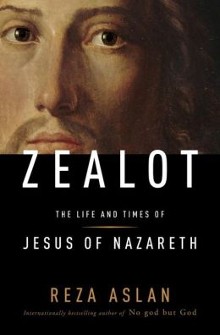
Zealot
The Life and Times of Jesus of Nazareth
Reza Aslan’s Zealot reconstructs Jesus of Nazareth as a first-century Jewish preacher whose message cannot be separated from Roman occupation, economic inequality, messianic expectation, and conflict over the Jerusalem Temple. Rather than beginning with Christian doctrines about Jesus, Aslan asks what can plausibly be said about the historical person behind the Gospels. He presents Jesus’s proclamation of the Kingdom of God as politically charged and interprets the crucifixion under Pontius Pilate as evidence that Rome regarded him as a threat to public order. The book then follows the transformation of a Jewish movement after Jesus’s death, emphasizing tensions among James, Peter, and Paul and the gradual emergence of Christianity beyond Judaism. Written as accessible narrative history, Zealot offers a vivid, forcefully argued portrait. Its central reconstruction is disputed, however, and readers should approach it as one provocative interpretation within historical-Jesus scholarship…
Where to buy or borrow
Are you selling this book? Bookstores, publishers, authors and libraries can be listed here for free. Request a listing
About this book
Deep Overview
Within that setting, Jesus appears as a Galilean Jew who announces the Kingdom of God, performs healings and exorcisms, gathers disciples, and challenges accepted boundaries of authority. Aslan interprets “Kingdom of God” in concrete as well as spiritual terms: if God is king, the legitimacy of Caesar, Rome’s client rulers, and collaborating elites becomes questionable. The journey to Jerusalem and the disturbance associated with the Temple therefore become decisive. Jesus’s execution by crucifixion—Rome’s degrading punishment for rebels, enslaved people, and perceived enemies of order—is central to Aslan’s case that his public mission had political consequences.
The book repeatedly distinguishes the historical Jesus from the Christ described by later Christian proclamation. The canonical Gospels remain indispensable, but Aslan reads them as theological narratives written after Jesus’s death and shaped by the needs of early communities. He places their portrayals beside the broader history of Roman Palestine and the evidence preserved by figures such as the Jewish historian Flavius Josephus. This method produces a Jesus defined less by later creeds than by Jewish apocalyptic hope, prophetic action, and opposition to entrenched power.
The final movement concerns what happened after the crucifixion. James, the brother of Jesus, represents the Jerusalem community and the movement’s continuing Jewish character. Paul of Tarsus becomes the major agent of expansion among non-Jews and, in Aslan’s interpretation, gives the movement a theological direction that eventually overshadows its original political and Jewish setting. Peter stands within the disputed memory of leadership and mission linking these communities.
The destruction of Jerusalem and the Second Temple in 70 CE forms a critical turning point. After Rome crushed the revolt, openly anti-imperial interpretations became more dangerous and the Jesus movement increasingly developed outside Judea. Aslan argues that memories of Jesus were consequently framed in ways more compatible with a predominantly gentile church. The resulting book is both a portrait of Jesus and an argument about historical memory: failed movements do not survive unchanged, and later communities reinterpret founders to answer new political, theological, and social needs.
Key Themes
• Empire and resistance: Roman occupation is treated as essential to understanding language about kingship, liberation, and the Kingdom of God.
• Religion and political power: Temple authority, priestly status, taxation, and imperial rule appear as an interconnected order rather than isolated institutions.
• Apocalyptic expectation: Jesus’s mission is placed within Jewish hopes that God would intervene decisively in history and restore justice.
• Memory after defeat: The execution of Jesus and the destruction of Jerusalem create conditions in which followers reinterpret the meaning of his life.
• Jewish and gentile Christianity: The contrast between the Jerusalem community and Paul’s mission highlights disagreements about law, identity, authority, and the movement’s future.
Historical Context
The Jerusalem Temple was the central sanctuary of Jewish religious life and also a major political and economic institution. Jewish society was diverse: priestly elites, Pharisees, Sadducees, apocalyptic groups, rural communities, prophetic leaders, and resistance movements did not share a single response to Roman power. Expectations of a messiah could refer to royal, priestly, prophetic, or other divinely authorized agents; the term did not automatically carry the later Christian meaning.
The First Jewish–Roman War began in 66 CE, decades after Jesus’s death, and culminated in the destruction of Jerusalem and the Second Temple in 70 CE. Because the canonical Gospels were written in the decades surrounding or following that catastrophe, historians ask how war, displacement, and increasingly gentile audiences affected their presentations of Jesus and responsibility for his death.
Intended Audience
It is less suitable as a sole academic guide to New Testament history. Readers wanting a neutral survey of competing scholarly positions, sustained engagement with Greek texts, or a systematic explanation of historical method should pair it with specialist work. Those looking for spiritual instruction, defense of traditional doctrine, or a harmonized Gospel biography should expect substantial disagreement with the book’s premises.
Reading Difficulty
The notes and bibliographical discussions add scholarly depth but require slower reading. Readers will benefit from tracking chronology, especially the gap between Jesus’s lifetime, Paul’s letters, the composition of the Gospels, and the destruction of Jerusalem. No knowledge of biblical languages is required.
Helpful Background Knowledge
Readers should also recognize three methodological points. Jesus and his earliest followers were Jews; “messiah” had multiple Jewish meanings before later Christian doctrine; and the surviving narrative sources about Jesus were written from positions of belief rather than as modern biographies. Finally, the Sicarii, the various forms of religious-political “zeal,” and the organized faction later called the Zealots should not be treated as automatically identical.
Why Read This Book?
Its value does not depend on accepting every conclusion. Because Aslan advances a clear thesis in memorable prose, the book makes disagreements about Jesus visible and discussable. It is especially productive when read beside a more cautious historical-Jesus study or a work defending a different reconstruction.
Reader Takeaways
Readers may become more alert to the difference between an event, a later written account of that event, and a community’s theological interpretation. They may also reconsider Paul’s role, the importance of James and the Jerusalem community, and the effect of the year 70 CE on Christian memory. Just as importantly, the book illustrates why historical reconstruction remains provisional when evidence is sparse and every major source has an interpretive purpose.
Strengths
Its structure connects three subjects that are often separated: Jesus’s public activity, the consequences of crucifixion, and the later development of the movement. The emphasis on Jesus’s Jewish identity corrects readings that detach him from Jewish scripture, hopes, and disputes. Extensive notes and bibliographical material also provide routes into deeper study, even when readers ultimately disagree with the synthesis built from them.
Limitations and Cautions
The book sometimes turns plausible context into biographical detail even when direct evidence for Jesus is lacking. Its readable, dramatic style can make reconstruction appear more secure than it is. Specialists have also challenged individual historical claims and the handling of Gospel literature. Readers should therefore distinguish the valuable insistence on political context from the stronger claim that this context proves Aslan’s particular account of Jesus’s intentions. The book is best treated as an argumentative popular synthesis and paired with scholarship representing other views.
Important Concepts, People, and Places
• James, brother of Jesus: Leader of the Jerusalem community after Jesus’s death. He matters because his authority demonstrates the movement’s continuing Jewish center before Paul’s influence became dominant.
• Paul of Tarsus: Missionary and letter writer who expanded the movement among gentiles. Aslan assigns him a decisive role in shifting attention from Jesus’s earthly mission toward a universal theology of the crucified and risen Christ.
• Simon Peter: Prominent disciple associated with the earliest movement and later missions. He stands near the intersection of the Jerusalem leadership and the widening gentile church.
• Pontius Pilate: Roman governor of Judea under whom Jesus was crucified. His office is crucial to the book’s argument that the execution was an imperial political act.
• Herod Antipas: Client ruler of Galilee during Jesus’s ministry. His regime illustrates how Rome exercised power through local dynasties.
• John the Baptist: Apocalyptic preacher who baptized Jesus and announced impending divine judgment. He situates Jesus within a wider landscape of prophetic renewal movements.
• Flavius Josephus: First-century Jewish historian whose works provide major evidence for Judean politics, prophetic figures, revolt, and Roman war outside the New Testament.
• Jerusalem and the Second Temple: The city and sanctuary formed the religious and political center of Jewish life. Jesus’s confrontation there becomes a turning point in Aslan’s reconstruction.
• Galilee and Nazareth: The northern region and village associated with Jesus’s origins. Their distance from Jerusalem helps frame social and regional tensions.
• Kingdom of God: Jesus’s central proclamation. Aslan treats it as a claim with consequences for earthly sovereignty, not merely an inward spiritual condition.
• Crucifixion: A Roman form of public execution and humiliation. Its political function anchors the book’s interpretation of why Jesus died.
• Messiah: A Jewish category of divine authorization with several possible meanings. The book traces how expectations attached to Jesus changed after his death.
• Zeal and the Zealots: Religious devotion could authorize resistance or violence, but the organized Zealot movement is chiefly associated with the later revolt. This distinction is central to evaluating Aslan’s title and thesis.
• First Jewish–Roman War and the destruction of Jerusalem: The revolt of 66–73/74 CE and the Temple’s destruction in 70 CE transformed both Judaism and the developing Christian movement.
Questions the Book Explores
• What did the Kingdom of God mean under Roman occupation?
• Why would Roman authorities have crucified Jesus?
• How did Temple power, priestly leadership, taxation, and imperial rule interact?
• Did Jesus understand himself as a messiah, and what might that designation have meant to him?
• How did the Jerusalem community under James differ from Paul’s mission among gentiles?
• Why did the interpretation of Jesus change as the movement spread beyond Judea?
• How did the destruction of Jerusalem affect the writing and reception of the Gospel traditions?
Reading Group Guide
Track the kinds of evidence used in several representative chapters. Mark claims based directly on ancient sources, conclusions inferred from political context, and narrative details that remain speculative. Discuss whether the prose signals those differences clearly.
Give special attention to the Temple episode, the inscription “King of the Jews,” and crucifixion. These form the strongest chain in Aslan’s political interpretation. Then examine the sections on James and Paul, asking whether the relationship is best understood as conflict, adaptation, diversity, or some combination.
Finally, compare the opening reconstruction of occupied Judea with the closing account of Christianity after Jerusalem’s destruction. Consider what changes when a movement survives its founder, crosses cultural boundaries, and explains an apparent defeat to later generations.
Discussion Questions
2. How does Roman occupation alter the meaning of the Kingdom of God?
3. Does crucifixion establish that Rome considered Jesus politically dangerous? What does it not establish?
4. Is “zealot” an illuminating description of Jesus, or does it impose too narrow a category?
5. How persuasive is the book’s interpretation of the Temple action?
6. What roles do class, geography, and access to power play in Aslan’s reconstruction?
7. How does the book characterize James, Peter, and Paul differently?
8. Does Aslan draw too sharp a division between Jesus’s mission and Paul’s theology?
9. How should historians use sources written to inspire belief rather than to satisfy modern historical standards?
10. Where does the book acknowledge uncertainty effectively, and where does it sound more confident than the evidence warrants?
11. How might a Christian, Jewish, or secular reader respond differently to the distinction between Jesus of Nazareth and Jesus Christ?
12. What does Zealot suggest about the way communities reshape a founder’s memory after political catastrophe?
Sources and Verification
The description of the book’s argument was checked against the publisher’s synopsis and excerpt, library subject records, and critical responses from scholars and established religious-history publications. Interpretive claims in this profile are presented as Aslan’s reconstruction, not as universally accepted conclusions about the historical Jesus.
Comments
No published comments yet.
Available editions
Hardcover
First U.S. edition; hardcover
- Publisher
- Random House
- ISBN-13
- 9781400069224
- Publication date