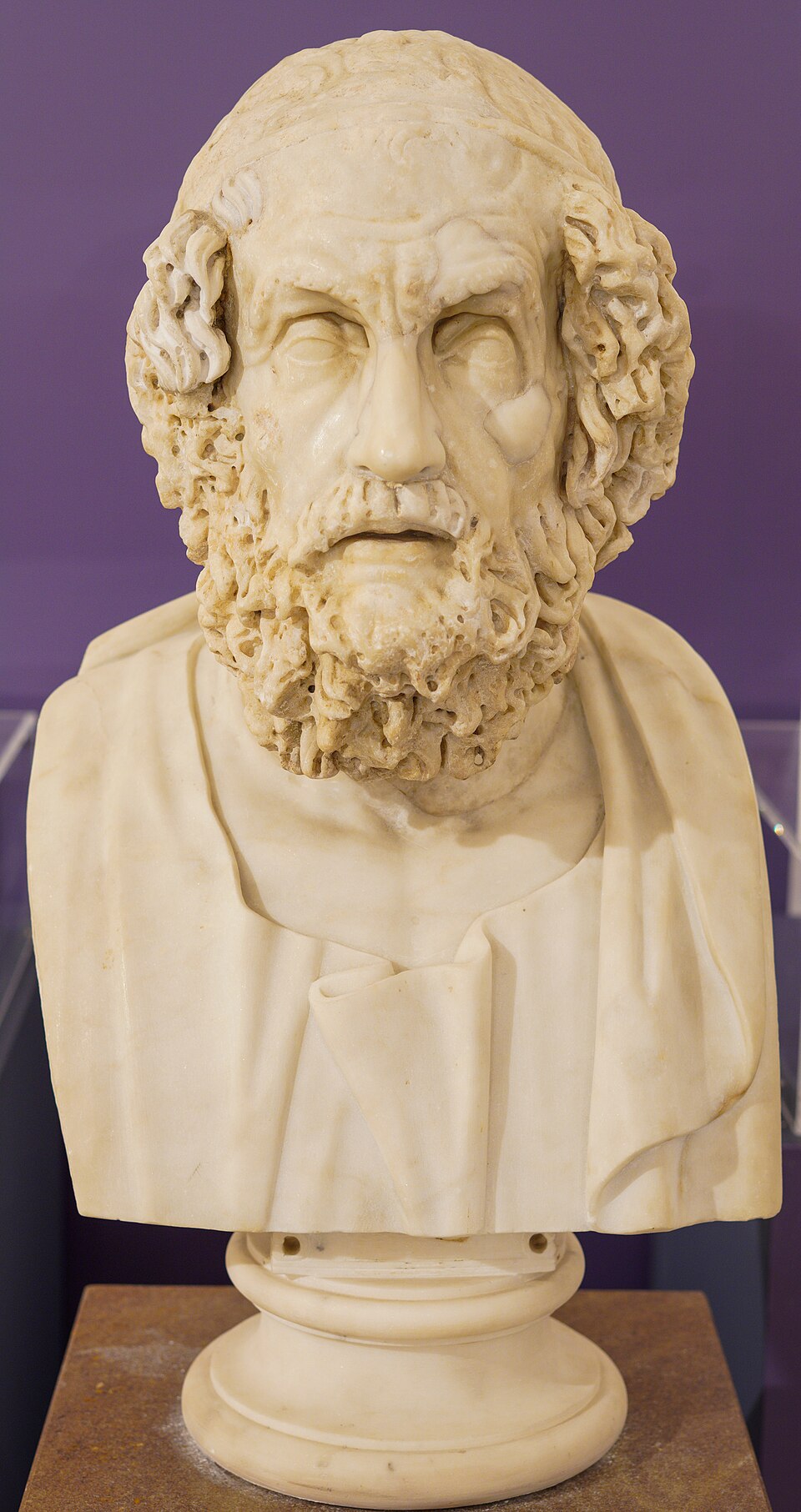
Homer is the name behind the Iliad and the Odyssey, and the man is a ghost. Ancient sources pointed to Ionia, with Chios and Smyrna as the likeliest homes. The familiar image of a blind bard is closer to pious legend than fact. What is concrete is the work itself: two vast narratives in dactylic hexameter, each divided into 24 books. Whether one poet composed them or they hardened from a long oral tradition into fixed form remains one of the oldest open questions in classical scholarship.
The Iliad is narrow and fierce. It takes a short stretch of the Trojan War and turns it around the rage of Achilles, the finest Greek fighter, who has walked off the battlefield and watches his comrades die. The Odyssey is wider, stranger. It opens not with the hero but with his son Telemachus hunting for news, and Odysseus does not tell his own tale of the Cyclops, the Sirens, and the trip to the land of the dead until Books 9 through 12. Gods bicker overhead in both poems, but the human stakes do the real work.
Greek schoolchildren memorized long passages for centuries. Virgil built the Aeneid as a Roman answer to the pair. In modern English, Robert Fagles's translations of the Iliad (1990) and the Odyssey (1996), with introductions and notes by Bernard Knox, brought the poems to a wide new audience.
Start with the Odyssey in Fagles. The opening with Telemachus gives you a clear emotional thread, and Knox's notes make the archaic gods and place-names less intimidating. Once the verse has a feel to it, the Iliad reads as a tighter, more concentrated experience.