
The Odyssey
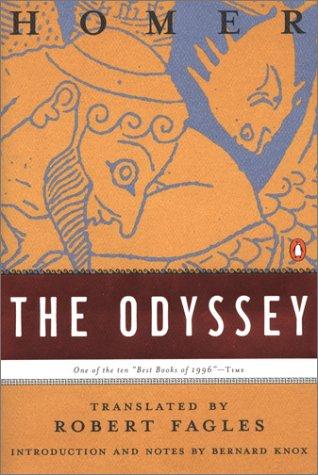
The Odyssey is the ancient Greek epic of Odysseus, the clever king of Ithaca, and his long, dangerous journey home after the Trojan War. At home, his wife Penelope and his son Telemachus struggle to hold the household together against a crowd of suitors. The poem moves between sea monsters, enchantresses, the land of the dead and a tense domestic reckoning. It asks what it takes to survive, to be recognized and to belong somewhere. This Penguin Classics edition presents Robert Fagles's modern verse translation, with an introduction and notes by Bernard Knox. It is one of the classic books that shaped Western storytelling, and it is a natural anchor for any serious reading list.
Where to buy or borrow
Are you selling this book? Bookstores, publishers, authors and libraries can be listed here for free. Request a listing
About this book
This edition is Robert Fagles's translation in contemporary free verse. It adds Bernard Knox's introduction and notes, maps and guidance on the spelling and pronunciation of Greek names, which help readers who are new to the material. Among world literature books, it is one of the most widely taught entry points to ancient Greek poetry in English. The Deluxe Edition is a paperback with French flaps and deckle-edged paper. These are features of the physical object, not of the text.
Deep Overview
Odysseus himself enters in Book 5, leaving Calypso on a raft that Poseidon wrecks. He lands among the Phaeacians, who are hospitable and rather too comfortable. In the central books, at their court, he tells the story of his wanderings. These include the Lotus-Eaters, the Cyclops Polyphemus, Circe, the descent to the dead, the Sirens, Scylla and Charybdis, and the cattle of the Sun. Because Odysseus is narrating, the reader hears the most fantastic episodes in the voice of a man known for crafting persuasive stories. That raises the question of how much any teller shapes his own history.
The second half is quieter and in some ways harder. Odysseus reaches Ithaca disguised as a beggar. He tests the loyalty of those he left behind, including the swineherd Eumaeus, his old nurse Eurycleia, and his son. The household is not a simple restoration. Penelope has her own strategy of delay and testing, and Odysseus has to prove his identity through knowledge only the two of them share. The bow contest and the killing of the suitors bring the plot to its violent climax. The poem then adds a coda of reconciliation that strains at the limits of vengeance.
The poem is a long exercise in how identity is established and recognized. Names can be hidden, as in Odysseus's trick on Polyphemus. Scars, the bed, the bow and shared memory serve as proofs. Odysseus's survival depends less on strength than on mêtis, a practical cunning that includes patience, disguise and self-restraint. The poem repeatedly tests that restraint against his pride, his appetites and his longing for home.
The poem also presents a moral world organized around hospitality. Characters are judged by how they treat strangers, and the suitors' abuse of Odysseus's house is an offence against the gods as well as against the household. The gods intervene, but the poem often lets human choices explain suffering, as the opening divine council makes explicit. This edition's Fagles text turns the Greek into fluent, speakable verse. Bernard Knox's apparatus gives readers a framework for the poem's geography, its names and its place within the epic tradition.
Key Themes
Cunning and endurance: Intelligence, disguise and self-control are valued alongside courage. The poem repeatedly tests whether Odysseus can hold back, as when he stays his hand or hears the Sirens bound to the mast.
Hospitality and its violation: How hosts treat guests, and guests treat hosts, serves as a measure of civilization. Contrast the Phaeacians with Polyphemus and the suitors.
Identity and recognition: Names, scars, stories and objects confirm who a person is. Disguise is a tool but also a danger.
Fidelity and loyalty: Penelope, Telemachus, Eumaeus and Eurycleia show different forms of constancy, and some servants fail the test.
Divine and human responsibility: The gods help and obstruct, but the poem also asks how much suffering humans bring on themselves.
Storytelling itself: Bards, travellers' tales and lies are embedded throughout, so the poem comments on narrative's power to console, deceive and preserve memory.
Historical Context
The Greek tradition remembered the war as lasting ten years. Odysseus then spends a further ten years trying to get home, with Poseidon hostile to him. The poem was already central to Greek education in antiquity and shaped later Roman literature, including Virgil's Aeneid. Its influence runs through medieval, Renaissance and modern writing, including adaptations that retell the story from other points of view.
This edition belongs to a modern translation tradition. Robert Fagles was a classicist and poet-translator who also produced widely read versions of the Iliad and the Aeneid for Penguin. The Penguin edition frames the poem for general readers through Bernard Knox's introduction and notes, and through maps and a note on Greek names.
Intended Audience
It is less suitable for readers who want a line-by-line crib to the Greek, since a free-verse translation necessarily makes choices about rhythm and diction. Those who prefer prose may find verse slower. Anyone looking for a modern novel's psychological realism should adjust expectations, since the poem uses formulaic epithets, set scenes and repeated structures.
Reading Difficulty
The poem is long, at about 560 pages in this edition. A steady rhythm of a book or two per sitting works well. The maps and the pronunciation guide in the front matter are useful to consult early. The notes and introduction by Bernard Knox are helpful if you want guidance, but you can read the poem first and consult them afterwards. The paperback's deckle-edged paper and flaps are matters of presentation and do not affect the text.
Helpful Background Knowledge
It also helps to know the main gods who appear: Athena as Odysseus's patron, Poseidon as his adversary, and Zeus as the final arbiter. A sense of Greek customs around guest-friendship, sacrifice and funeral rites makes many scenes clearer. Reading Knox's introduction before starting will supply much of this, as will a glance at the maps.
Why Read This Book?
This edition is a good choice for those who want to read Homer as a poem, not just as a summary. Fagles's translation is designed to be read aloud and keeps the narrative momentum of the original. The scholarly apparatus is helpful without overwhelming the story. The poem is also a reminder that adventure and domestic drama can share one plot, and that the second half's quieter tests carry as much weight as the first half's spectacles.
Reader Takeaways
Readers may also reconsider the traditional picture of Odysseus as a straightforward hero. His boasting, his lies and his losses of crew invite a more complicated assessment. Penelope, too, can be read as more than a waiting wife: she holds a household and a kingdom in balance through her own intelligence. Finally, the reader may become more alert to how translation shapes an ancient poem.
Strengths
The Fagles translation is fluent and energetic and works well for first-time readers or for reading aloud. The edition adds helpful tools, including Bernard Knox's introduction and notes, maps and a pronunciation guide. The paperback is a convenient size for study and casual reading alike.
Limitations and Cautions
The poem reflects the values of an ancient aristocratic society, including slavery, the treatment of female servants and an ethic of violent retribution. These aspects are disputed and discussed by scholars, and readers may find them uncomfortable. Questions about Homer's identity, the poem's date and its oral composition are unresolved, and this profile reflects common scholarly views, not settled facts. Printings of this edition differ in cover and packaging, and some retailers list different page counts.
Important Concepts, People, and Places
Penelope: Odysseus's wife, who uses delay and testing to hold off the suitors and to confirm her husband's identity.
Telemachus: Their son, whose journey in the first four books marks his transition to adulthood.
Athena: Odysseus's divine patron, who guides father and son.
Poseidon: The sea god whose anger over the blinding of his son Polyphemus prolongs Odysseus's voyage.
Polyphemus: The Cyclops whose cave episode shows both Odysseus's cunning and his arrogance.
Circe and Calypso: Powerful female figures who detain Odysseus and test his desire to return.
The suitors: The men who occupy Odysseus's house and abuse its hospitality; they represent the breakdown of social order.
Eumaeus and Eurycleia: Loyal servants who help show what fidelity looks like.
Ithaca: Odysseus's island home, the goal of the whole journey.
The Trojan War: The conflict whose aftermath frames the poem and whose events are told in the Iliad.
Xenia: The Greek custom of guest-friendship, which structures the moral world of the poem.
Mêtis: Practical cunning, the quality that most marks Odysseus's heroism.
Bernard Knox and Robert Fagles: The classicist who wrote this edition's introduction and notes, and the poet-translator who made the English verse text.
Questions the Book Explores
Reading Group Guide
If the group includes readers of other translations, comparing how a short passage reads in each can be a lively starting point. Reading a passage aloud is also worthwhile, given the poem's oral origins. Groups should allow time at the end to discuss the ending's ethical complexity, since responses vary considerably.
Discussion Questions
2. How does it affect your reading that Odysseus himself narrates the most fantastic adventures?
3. In what ways does Penelope exercise power and intelligence, and how does the poem present her?
4. Which characters keep faith with Odysseus, and which do not? What distinguishes them?
5. How does the poem define a good host and a bad guest, and how do these standards apply to the Cyclops, the Phaeacians and the suitors?
6. Is Odysseus a heroic figure, a flawed one, or both? Which moments shape your view?
7. How does the poem handle the role of the gods in human outcomes?
8. Did the killing of the suitors and the maidservants seem justified within the poem's own framework? How might readers today respond differently?
9. What does the recognition of Odysseus by various characters reveal about memory and identity?
10. If you have read other translations, how does the style of Fagles's verse shape your sense of the poem's voice and pace?
Sources and Verification
Comments
No published comments yet.
Available editions
Paperback
Penguin Classics Deluxe Edition
- Publisher
- Penguin Classics
- ISBN-13
- 9780140268867
- Publication date
- Pages
- 560