
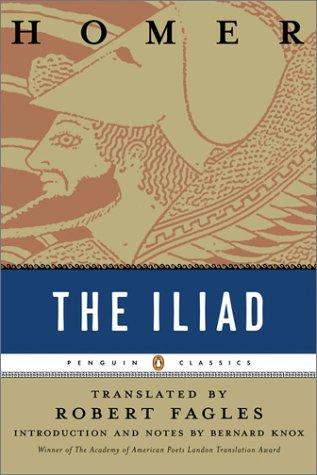
The Iliad
The Iliad is the foundational war epic of the Greek tradition. It is set in the tenth year of the Trojan War and concentrates on a few charged weeks rather than the whole conflict. Its subject is the anger of Achilles, the Greek warrior who withdraws from battle after a humiliating quarrel with Agamemnon, and the cost of that withdrawal for his friends, his enemies and the gods who watch. This edition presents Robert Fagles's modern verse translation with an introduction and notes by Bernard Knox. Among classic books, the poem stands out for refusing to make war simple: it admires courage while showing grief, waste and the shared mortality of Greeks and Trojans. Readers approaching world literature books for the first time will find a text that is violent, formal and often surprisingly humane.
Where to buy or borrow
Are you selling this book? Bookstores, publishers, authors and libraries can be listed here for free. Request a listing
About this book
This particular volume is a translation with scholarly apparatus, not the Greek text. Robert Fagles's version first appeared in 1990 and uses a free, flexible line of roughly five or six beats instead of imitating the Greek metre. Bernard Knox, a classicist, supplies an introduction and notes that orient readers in the poem's world. The Penguin Classics Deluxe format adds French flaps and deckle-edged paper, and it carries the same translation as the earlier hardcover.
What distinguishes the poem is its narrow focus and wide reach. It does not narrate the whole Trojan War, the judgment of Paris or the wooden horse. It dramatizes one crisis inside the war, and through similes, catalogues and scenes of domestic life it draws in a whole civilization. Among world literature books it is unusual for treating both sides of a conflict with real sympathy.
Deep Overview
The middle of the poem shows what that decision costs. Without Achilles, the Greeks are pushed back toward their ships. An embassy offers him gifts and reconciliation, and he refuses. Gods intervene on both sides, Zeus tries to hold the balance, and a long series of battle scenes establishes the human cost of the war. Patroclus, Achilles' closest companion, finally borrows his armour and enters the battle. His death at the hands of Hector, the leading Trojan warrior, turns Achilles' anger away from Agamemnon and toward Hector.
The second half moves toward revenge and then past it. Achilles returns to battle, reaches a state of near-inhuman fury, and kills Hector in front of Troy's walls. He then mistreats the body. The poem could have ended with a victory, but it carries on through the funeral games for Patroclus and one of the most remembered scenes in ancient literature. Priam, the aged king of Troy, crosses into the Greek camp at night and begs Achilles to return his son's body. The two men weep for their different losses, and a truce is agreed so Hector can be buried. The poem ends with Trojan mourning, not with the fall of the city.
The poem's design is more careful than its battlefield pace suggests. Scenes of fighting are broken up by similes drawn from farming, herding, weather and family life, bringing peacetime into the violence. The shield that Hephaestus forges for Achilles shows cities at war and at peace. Hector's farewell to his wife Andromache and baby son makes the Trojans individuals with a future they will not have. The gods are not remote moral guides but powerful, partisan, and often petty figures whose quarrels contrast with the fatal seriousness of human choices.
This edition places the poem in Fagles's English verse, which aims for momentum, a speakable rhythm and the force of Homer's repeated phrases. Knox's introduction and notes help readers follow the Greek background, the heroic code and the poem's shape.
Key Themes
Honour and recognition: Heroes fight for status as well as survival, and the poem examines what happens when gifts, rank and public esteem become matters of life and death.
Mortality and the hero's choice: Warriors know that glory and long life are in tension. The poem returns to this problem in Achilles' reflections on his own short future.
War's cost on both sides: Greek and Trojan casualties are mourned, named and sometimes given brief biographies, which resists any simple division into heroes and villains.
The relationship between gods and humans: Divine favour, interference and indifference shape events, yet people remain responsible for what they choose.
Civilization inside violence: Similes, shield imagery, marriages and funerals keep showing the ordinary life that war interrupts.
Grief, compassion and recognition: The final book turns from killing to mutual understanding between enemies who share the experience of loss.
Historical Context
The Homeric Question concerns how the poems were composed and who Homer was. Little is reliably known about the poet's life. Britannica notes that modern scholars generally agree that the poet composed the Iliad but did not originate the material, probably relying on oral tradition. Milman Parry, and later Albert Lord, argued that the repeated phrases and formulas in Homeric verse are signs of oral composition, a view that shaped later scholarship.
The poems became central to Greek education and cultural identity and have been among the most influential texts of the European tradition. English translators have approached them since the Renaissance, and each generation has made different choices about verse and diction. Fagles's version appeared in 1990 as part of a late twentieth-century revival of popular translations of the classics. He later translated the Odyssey and Virgil's Aeneid.
Intended Audience
Readers of myth retellings and historical or war narratives may find it deepens their sense of where such stories began. Those curious about the Trojan War legend should be aware that the poem covers only a small part of it.
It may be less suitable for readers who want a fast, plot-driven narrative with a conventional ending, or who want a prose retelling. Specialists who need to analyse Homeric diction will want the Greek text or a more literal translation alongside this one.
Reading Difficulty
The battle books can feel repetitive on a first read because injuries and deaths are described in close succession. Many readers find it easier to treat these as a long, deliberate sequence building toward the emotional centre. Reading a book or two at a time, using the maps and glossary, and following Knox's notes are all practical ways to keep your place.
No specialist knowledge is needed. The conceptual difficulty lies in how the poem handles its ideas, mainly honour, fate and divine involvement, not in technical vocabulary. The paperback is a large, heavy volume, so you may prefer to read it at a desk.
Helpful Background Knowledge
It also helps to know the main Olympian gods and their sympathies, including Zeus, Hera, Athena, Apollo, Poseidon and Thetis. A short guide to the heroic code, in which honour is earned through combat and shown through gifts and prizes, will explain many characters' decisions.
Reading Knox's introduction first can help, especially if you are new to Homer. You can also read the cast list or glossary before you start, so that unfamiliar names become easier to recognize.
Why Read This Book?
This edition is a good way to read it. Fagles's translation was written for readers who want pace and clarity, and it is paired with a respected classicist's guidance. The deluxe paperback format is also well suited to a book that readers often return to and annotate.
The poem rewards a slow and curious reading. It shows an ancient world on its own terms, with its violence and hierarchies, and still gives a profoundly moving account of what a person loses when they stop seeing an enemy as human.
Reader Takeaways
They may reconsider assumptions about heroism, honour and revenge, and about how the poem encourages sympathy for Hector, Priam and the Trojans as well as Achilles. They may also understand better why translation choices matter, since the same Greek can be rendered in very different English.
Finally, readers may be better prepared to approach the Odyssey, the Aeneid, Greek tragedy and modern retellings of the Trojan War.
Strengths
Bernard Knox's introduction and notes give context without overwhelming the poem. The edition includes a bibliography and glossary for further study.
The physical design is pleasant for a long book, and the format is part of the Penguin Classics series that many courses and reading groups already use. The text makes the poem approachable while preserving its seriousness.
Limitations and Cautions
The edition is a reissue of a translation first published in 1990. Its introduction reflects scholarship of that period and does not cover later developments in Homeric studies.
The poem's world is hierarchical, and it treats captive women as prizes, so its values can be uncomfortable. It also depicts graphic combat violence. The poem covers only a few weeks of the Trojan War, so readers should not expect the Trojan Horse or the fall of Troy. The poem's authorship and composition remain debated, and no single account is settled.
Important Concepts, People, and Places
Agamemnon: the Greek commander whose seizure of Briseis starts the quarrel.
Briseis: the captive woman whose transfer between the two men shows how honour was measured.
Hector: the leading Trojan warrior, a husband and father, who stands as the poem's counterweight to Achilles.
Patroclus: Achilles' close companion, whose death changes the course of the story.
Priam: the king of Troy, whose visit to Achilles forms the poem's closing movement.
Andromache: Hector's wife, who shows what is at stake for Troy's families.
Thetis, Zeus, Hera, Athena and Apollo: the gods and goddesses who shape or contest events, usually in support of one side.
Troy (Ilium) and the Greek camp: the walled city and the ships on the shore, where nearly all the action takes place.
Kleos and timē: the Greek ideas of glory and honour that motivate heroic action.
Homeric Question and oral-formulaic theory: the scholarly debate over who composed the poem and how, shaped by Milman Parry and Albert Lord.
Robert Fagles and Bernard Knox: the translator and the classicist whose work defines this edition.
Questions the Book Explores
It also investigates how enemies might recognize one another, whether any violence can be answered by something other than more violence, and what mourning and ritual do for the living. A final question is how a poem can honour courage while showing its costs.
Reading Group Guide
Members might keep a shared list of characters, gods and epithets, and compare passages from other translations to see how word choice changes tone. It can be useful to read key scenes aloud, particularly Hector and Andromache in Book 6 and the meeting of Priam and Achilles in Book 24.
Because the poem is violent and treats war captives as prizes, groups may want to agree early on that they will discuss both the work's values and its ancient context.
Discussion Questions
2. How does the poem make Hector a sympathetic figure while still showing Troy as the enemy?
3. What is the effect of placing long similes from peaceful life in the middle of battle scenes?
4. How do the gods change your understanding of human responsibility?
5. Why does the poem end with a funeral and not the fall of Troy?
6. What do Briseis, Andromache and other women reveal about the world of the poem?
7. Which parts of the translation seemed especially effective or unfamiliar, and why?
8. How do you think the poem would change if it were told entirely from the Trojan side?
Sources and Verification
Comments
No published comments yet.
Available editions
Paperback
Penguin Classics Deluxe Edition
- Publisher
- Penguin Classics
- ISBN-13
- 9780140275360
- Publication date
- Pages
- 704