
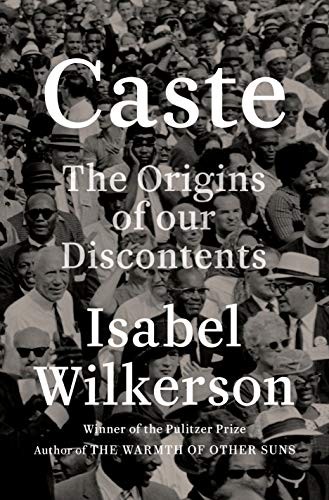
Caste
The Origins of Our Discontents
In Caste, Isabel Wilkerson argues that American racism is sustained by a deeper architecture of inherited social ranking. She uses “caste” to describe a system that assigns status, authority, vulnerability, and presumed worth according to ancestry and group membership, whether or not individual participants consciously endorse it. Her main focus is the United States, but she develops the argument through comparisons with caste in India and Nazi Germany’s racial order. Historical episodes, reported encounters, biographical portraits, and experiences from Wilkerson’s own life show how hierarchy operates through law, custom, violence, etiquette, and ordinary assumptions. The book organizes these mechanisms into eight recurring pillars, including heredity, endogamy, dehumanization, occupational hierarchy, and enforcement through terror. Its central challenge is to look beyond personal prejudice and examine the durable social structure that teaches people where they supposedly belong—and w…
Where to buy or borrow
Are you selling this book? Bookstores, publishers, authors and libraries can be listed here for free. Request a listing
About this book
Deep Overview
To explain that durability, Wilkerson identifies eight pillars shared, in varying forms, by the systems she compares: divine or natural sanction; heritable status; endogamy and control of marriage; ideas of purity and pollution; occupational ranking; dehumanization and stigma; coercive enforcement through cruelty and terror; and beliefs in the inherent superiority of the dominant group and inferiority of the subordinated group. These pillars allow her to connect slavery, anti-miscegenation law, Jim Crow segregation, lynching, labor exclusion, and modern discrimination as parts of a continuing structure rather than unrelated episodes.
The comparative frame brings together the United States, India, and Nazi Germany. Wilkerson does not claim that their histories or outcomes are identical. She instead searches for recurring techniques by which one population is elevated and another confined. India provides the long-standing vocabulary of caste and the history of Dalit exclusion. Nazi Germany demonstrates how rapidly a state can formalize inherited rank, prohibit intimacy across assigned groups, and weaponize law. The United States is the book’s primary subject: a society whose racial categories changed over time but repeatedly preserved a hierarchy centered on white dominance and Black subordination.
Historical figures give the framework human scale. Martin Luther King Jr.’s encounter with Indian caste becomes an entry point into the comparison. Allison Davis represents an earlier tradition of studying the American South through caste and class. Satchel Paige illustrates how segregation distorted opportunity and public memory. Wilkerson also incorporates encounters from her career and travels, showing how presumptions about status appear in mundane exchanges as well as spectacular violence.
The later portions consider the costs of caste for everyone living within it. A society that wastes talent, normalizes domination, and treats equality as a loss for the previously favored damages its civic life and collective capacity. Wilkerson interprets backlash as a response to perceived status threat: reforms that widen participation may feel like dispossession to people accustomed to unmarked advantage. Her closing emphasis is ethical but not merely sentimental. She asks readers to develop radical empathy, resist assigned scripts, and recognize that inherited structures endure through repeated human choices.
Key Themes
• Inherited rank: Ancestry fixes people into categories whose privileges or burdens are presumed to pass across generations.
• Boundary maintenance: Marriage restrictions, segregation, occupational rules, and customs of social distance prevent equal membership from becoming ordinary.
• Status threat and backlash: Movement toward equality can provoke resistance from people who interpret shared standing as personal decline.
• Dehumanization: Dominant systems make cruelty easier by denying the complexity, innocence, and individuality of subordinated people.
• Historical continuity: Wilkerson emphasizes the afterlives of slavery and Jim Crow rather than treating them as sealed periods.
• Public systems and private conduct: Large institutions depend upon countless daily acts of compliance, policing, avoidance, and deference.
• Radical empathy: The book proposes deliberate recognition of another person’s humanity as one necessary practice for weakening inherited hierarchy.
Historical Context
The American history behind the argument stretches from chattel slavery and hereditary racial status through Reconstruction’s defeat, Jim Crow law, anti-miscegenation statutes, lynching, exclusion from institutions, and the civil-rights struggles of the twentieth century. The Indian comparison invokes varna and jati, untouchability, Dalit resistance, B. R. Ambedkar, and constitutional efforts to prohibit caste discrimination. The German comparison concerns the Third Reich’s conversion of racial ideology into citizenship restrictions, marriage prohibitions, dispossession, and mass murder.
Published in 2020, the book entered public discussion during a year marked by the COVID-19 pandemic and mass protests following the murder of George Floyd. Those circumstances intensified attention to racial inequality, although the book’s argument grew from years of research rather than from those events alone.
Intended Audience
It may be less suitable for readers seeking a comprehensive scholarly history of Indian caste, a detailed chronology of Nazi Germany, or a methodologically technical work of comparative sociology. The book’s claims are broad and morally urgent; readers who prefer tightly delimited case studies may find its analogies too expansive.
Reading Difficulty
The material includes slavery, lynching, antisemitic persecution, the Holocaust, humiliation, and other forms of violence and dehumanization. Some readers may benefit from a measured pace. No formal background in sociology or history is required, although the comparative sections reward careful attention to differences as well as similarities among the three societies.
Helpful Background Knowledge
For the comparative material, it is useful to know that Indian caste cannot be reduced to a single national ladder: varna is a broad classificatory scheme, while jati refers to numerous historically and regionally specific communities. Dalit is a modern political and social identity associated with communities subjected to untouchability. Basic knowledge of the Nuremberg Laws and the Holocaust will help readers understand the German case. These foundations make it easier to assess where Wilkerson’s analogies illuminate shared mechanisms and where distinct histories resist compression.
Why Read This Book?
The book also demonstrates the power of narrative nonfiction to make abstract structures visible. Its movement between well-known events, neglected historical figures, intimate encounters, and comparative history encourages readers to notice how hierarchy governs access to safety, credibility, authority, and belonging. Even readers who ultimately question the breadth of the caste analogy will encounter a consequential argument that has reshaped public discussion of race and power.
Reader Takeaways
The book also encourages attention to inherited advantage without reducing every person to guilt or innocence. Individuals enter structures they did not design, but their responses can reinforce or disrupt them. Readers may become more alert to status policing, purity language, presumed competence, segregated intimacy, and backlash against equal participation. Finally, the comparative approach offers a habit of inquiry: ask not only whether two histories are identical, but which mechanisms resemble one another, which do not, and what those comparisons reveal or obscure.
Strengths
The prose combines moral seriousness with clarity, and the reporting draws attention to figures whose experiences complicate familiar national stories. The book is also effective at explaining how inequality can persist without requiring constant explicit coordination. By shifting the question from private feelings to public rank and power, it opens productive discussion about institutions, inherited expectations, and collective responsibility.
Limitations and Points of Debate
Wilkerson’s emphasis on continuity can also make historical change appear less consequential than some readers and historians would judge it to be. The poles of Black and white experience dominate the American analysis, leaving less sustained treatment of Native peoples, Latino communities, Asian Americans, immigration, and relationships among class, gender, and race. Personal stories make the argument vivid, but they do not always establish causation on their own. The book is therefore most useful as a major interpretive framework to test alongside specialized histories and social-scientific research, not as the final account of every society it discusses.
Important Concepts, People, Places, and Institutions
• The eight pillars of caste: Her framework for the beliefs and enforcement mechanisms that stabilize hierarchy, from hereditary status and endogamy to dehumanization and terror.
• Isabel Wilkerson: The journalist and author whose reporting, historical synthesis, travels, and personal experiences shape the book’s argument.
• Allison Davis: An African American anthropologist whose fieldwork in the Mississippi Delta helped establish caste and class as a framework for studying the segregated South.
• Deep South: The 1941 study by Allison Davis, Burleigh Gardner, and Mary Gardner that examined caste and class in a Southern community and forms an important intellectual precedent for Wilkerson.
• Martin Luther King Jr.: His 1959 visit to India and reflections on American segregation help introduce the relationship between Dalit exclusion and Black subordination.
• Bhimrao Ramji Ambedkar: The Dalit jurist, political leader, and principal architect associated with India’s constitutional struggle against untouchability; he represents resistance to caste rather than merely victimhood within it.
• Dalits: Communities historically subjected to untouchability whose experiences and political struggles are central to the Indian comparison.
• Jim Crow: The legal and customary regime that enforced racial segregation and Black subordination in the United States after Reconstruction.
• Nazi Germany and the Nuremberg Laws: The Third Reich supplies Wilkerson’s most concentrated example of a modern state codifying ancestry, citizenship, and prohibited intimacy into racial hierarchy.
• Satchel Paige: The baseball pitcher whose career demonstrates how segregation denied Black talent equal opportunity and distorted the historical record.
• Endogamy: The restriction of marriage to one’s assigned group; Wilkerson treats control of intimacy and descent as essential to maintaining caste boundaries.
• Dominant caste and subordinated caste: Relational terms that emphasize unequal power rather than presenting social groups as isolated identities.
• Radical empathy: Wilkerson’s call for a disciplined effort to recognize another person’s full humanity beyond inherited social scripts.
Questions the Book Explores
• How do laws, customs, institutions, and everyday expectations cooperate to preserve hierarchy?
• Which mechanisms recur across American racial domination, Indian caste, and Nazi racial rule?
• Why do dominant groups sometimes experience another group’s advancement as a threat or loss?
• How does a society teach people to regard unequal treatment as natural, deserved, or inevitable?
• What economic, civic, psychological, and moral costs arise when talent and dignity are distributed according to inherited category?
• Can empathy meaningfully weaken structural hierarchy, and what institutional changes must accompany it?
• Where does comparison deepen historical understanding, and where can it erase essential differences?
Reading Group Guide
Assign pairs or small groups different pillars and ask them to trace each pillar through more than one society. The goal should be to compare mechanisms without assuming equivalence. Notice where law does the work of hierarchy, where custom does it, and where violence or status anxiety enforces compliance.
Set aside time for the book’s intellectual lineage. Discuss Allison Davis and earlier caste analysis of the American South, then consider what Wilkerson changes by bringing that framework into contemporary narrative nonfiction. A separate session can examine criticism of the Indian comparison, especially questions involving political economy, regional variation, colonial history, and resistance.
Conclude by separating diagnosis from remedy. List the changes the book appears to require at the personal, institutional, and civic levels. Discuss whether radical empathy is a foundation, a method, an aspiration, or an insufficient answer without structural reform.
Discussion Questions
2. Which of the eight pillars provides the strongest account of American hierarchy? Which requires the most qualification?
3. How does Wilkerson balance historical evidence, personal experience, metaphor, and reported narrative? When is that mixture most persuasive?
4. What is gained by comparing the United States, India, and Nazi Germany? What risks accompany the comparison?
5. How do endogamy and control of intimacy preserve social power across generations?
6. In what ways does presumed competence function as a caste privilege?
7. How does the book explain backlash against civil-rights gains and demographic change?
8. Does the emphasis on continuity understate meaningful reform, resistance, or transformation? Why or why not?
9. How do class, gender, immigration, and other identities complicate the book’s model of American caste?
10. What responsibilities does the book assign to people who did not create the hierarchy but inherit positions within it?
11. How should readers distinguish a useful analogy from a claim that different histories are equivalent?
12. What would a society without caste require beyond changes in individual attitudes?
Sources and Verification
Comments
No published comments yet.
Available editions
Hardcover
hardcover
- Publisher
- Random House
- ISBN-13
- 9780593230251
- Publication date
- Pages
- 544