
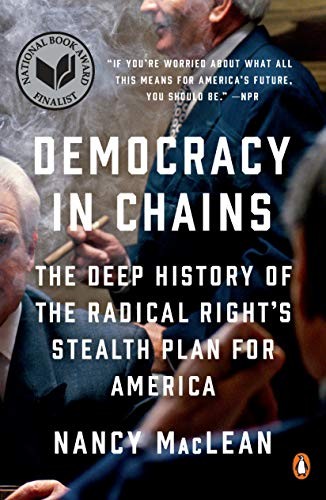
Democracy in Chains
The Deep History of the Radical Right’s Stealth Plan for America
Democracy in Chains is Nancy MacLean’s history of the ideas, institutions, and donors that she argues transformed the American libertarian right into a campaign to restrict majority rule. Its central figure is James McGill Buchanan, the economist associated with public choice theory and constitutional political economy. MacLean follows his career from Virginia’s battles over school desegregation through the growth of university centers and donor-supported policy organizations, culminating in his relationship with Charles Koch’s political network. Her central contention is that an organized movement sought not merely to win elections but to rewrite governing rules so that taxation, regulation, unions, public education, and social programs would become harder for popular majorities to sustain. The book connects intellectual history to practical politics, asking how private wealth can reshape democratic institutions. It is also a sharply contested interpretation: scholars have disputed M…
Where to buy or borrow
Are you selling this book? Bookstores, publishers, authors and libraries can be listed here for free. Request a listing
About this book
Deep Overview
James McGill Buchanan supplies the intellectual center of this account. Public choice theory applied economic assumptions about incentives and self-interest to politics, challenging idealized descriptions of public servants as disinterested guardians of a common good. Buchanan’s related work in constitutional political economy asked a prior question: what rules should structure collective decision-making before particular policy choices are made? MacLean argues that these inquiries became politically useful to people who regarded taxes and redistributive programs as threats to property and individual liberty.
The narrative begins in mid-century Virginia, where Brown v. Board of Education intensified conflict over public authority and segregated schooling. MacLean examines Buchanan’s work at the University of Virginia and his association with economist G. Warren Nutter. She interprets their promotion of market-based educational arrangements and criticism of state power as part of the broader reaction to federal intervention and majority-backed public institutions. This is one of the book’s most disputed moves: critics maintain that MacLean connects Buchanan too tightly to segregationist resistance and does not adequately distinguish his economic reasoning from the motives of Virginia’s white supremacist political establishment.
The story then follows Buchanan’s institutional career through academic centers devoted to political economy and public choice. Universities matter here not simply as settings but as bases for producing ideas, training scholars, building professional networks, and giving political projects intellectual legitimacy. MacLean also places Buchanan in an international context, discussing his engagement with constitutional questions in Chile during Augusto Pinochet’s dictatorship. Her larger concern is how constraints on majority rule can be defended as protections for liberty even when the surrounding political order is profoundly unequal or coercive.
Charles Koch becomes increasingly important in the later chapters. MacLean argues that Koch recognized strategic value in Buchanan’s insistence on changing rules rather than pursuing isolated policy victories. The resulting network supported academic programs, think tanks, legal initiatives, advocacy groups, and campaigns for measures such as tax limitations, privatization, union restrictions, and constitutional restraints on government.
The book ultimately asks readers to reconsider democracy as more than elections. MacLean’s democracy includes organized citizens’ ability to use public institutions to counter concentrated private power. Her warning is that constitutional language can protect legitimate individual rights while also insulating wealth from democratic claims. Whether Buchanan’s scholarship and the Koch network form the coherent, intentional project she describes remains the book’s central interpretive controversy.
Key Themes
• **Changing rules instead of winning debates:** MacLean emphasizes constitutional and procedural strategies that make certain policies difficult to enact or reverse, regardless of shifting electoral majorities.
• **Ideas as political infrastructure:** Economic theories gain practical force through university centers, donors, foundations, think tanks, legal organizations, and trained networks of advocates.
• **Public choice and distrust of government:** Buchanan’s tradition scrutinizes politicians, bureaucrats, and interest groups as self-interested actors. MacLean asks why equivalent scrutiny is not always applied to wealthy private actors.
• **Property rights and popular sovereignty:** The book traces a recurring conflict between protecting private property and allowing citizens to redistribute resources or regulate markets through democratic government.
• **Race and political economy:** Virginia’s resistance to desegregation provides MacLean’s starting context for exploring how racial hierarchy, privatization, and attacks on public institutions could overlap.
• **Transparency and strategic concealment:** A central claim is that unpopular economic objectives were advanced through incremental measures and reassuring public language rather than full disclosure of their ultimate implications.
Historical Context
Virginia responded with “Massive Resistance,” a campaign to obstruct desegregation that included school-closing threats and proposals to subsidize private schooling. MacLean situates Buchanan’s early Virginia career within this environment, though the degree and meaning of his connection to segregationist politics are contested.
The wider intellectual setting included Friedrich Hayek’s defense of market liberalism, Milton Friedman’s arguments for school vouchers and limited government, and a growing network of organizations devoted to free-market ideas. During the late twentieth century, tax revolts, deregulation, privatization, anti-union campaigns, and conservative legal activism moved these arguments into public policy. MacLean interprets the Koch network’s rise within that longer struggle over the New Deal and civil-rights state.
Intended Audience
Readers who want an accessible introduction to public choice theory from its own leading practitioners should supplement MacLean’s critical account with primary texts or a neutral survey. Those seeking a dispassionate, evenly distributed history of the entire postwar right may find its prosecutorial tone and concentration on Buchanan too narrow. It is best suited to readers prepared to distinguish documented events from the author’s broader interpretation of intention and coordination.
Reading Difficulty
The chronology moves across several decades and among academic institutions, donor networks, state politics, and national campaigns. This creates a cumulative argument that rewards careful attention to names and organizational relationships. Extensive notes support deeper investigation, but the main narrative can be read without consulting them continuously. Because the book frequently interprets private strategy and motive, attentive readers should notice when MacLean presents direct documentary evidence and when she constructs a larger inference from several pieces of evidence.
Helpful Background Knowledge
Readers may benefit from knowing that public choice theory uses economic tools to analyze political behavior, including the incentives facing voters, legislators, bureaucrats, and organized interests. Constitutional political economy focuses on the rules within which those actors make choices. No formal economics is required, but this distinction is essential when assessing MacLean’s interpretation of Buchanan.
Some background on the growth of think tanks, philanthropic foundations, campaign-finance networks, and conservative legal organizations after the 1970s will make the institutional portions easier to follow.
Why Read It
It is also worth reading because it generated an unusually revealing scholarly controversy. The debate around the book raises fundamental questions about how historians infer motive, connect intellectual work to political consequences, and write about living ideological conflicts. Reading it critically can therefore teach two subjects at once: the development of the American libertarian right and the evidentiary challenges of politically charged intellectual history.
Reader Takeaways
Readers may also reconsider familiar political vocabulary. “Liberty,” “choice,” “minority rights,” and “constitutional restraint” can describe vital protections against government abuse, but they can also be invoked in disputes over who has the power to tax, regulate, organize workers, or provide public goods. MacLean’s account presses readers to ask whose freedom a rule protects and whose collective agency it limits.
Finally, the book demonstrates the importance of testing large historical narratives. Its strongest insights and most disputed claims both reward comparison with primary writings by Buchanan and with scholarship that challenges MacLean’s interpretation.
Strengths
Its focus on Virginia gives the narrative a concrete historical setting in which race, schooling, property, federal authority, and market proposals intersected. The archival orientation enables MacLean to reconstruct relationships that would be difficult to see from published works alone.
As a work for general readers, it turns a technically demanding subject into a consequential story. Even readers who reject its most expansive conclusions may find its questions about donor power, democratic accountability, and the institutional production of policy agendas difficult to dismiss.
Limitations and Cautions
MacLean’s movement from historical association to claims about purpose requires particular care. The presence of Buchanan’s work amid Virginia’s desegregation crisis does not by itself establish that racial preservation motivated his economic program. Similarly, intellectual influence, donor support, and political alliance do not always prove a centrally directed plan.
The book is therefore most reliable as a clearly argued interpretation rather than a neutral consensus account. Its treatment of events after publication is necessarily limited, and later editions with updated prefatory material should not be confused with the original 2017 text.
Important Concepts, People, and Institutions
• **James McGill Buchanan:** Nobel-recognized economist and central subject of the book. His work on public choice and constitutional rules supplies the intellectual foundation MacLean investigates.
• **Charles G. Koch:** Industrialist and political donor whom MacLean portrays as recognizing the strategic potential of Buchanan’s ideas and supporting a broad network designed to implement market-oriented change.
• **G. Warren Nutter:** Economist associated with Buchanan at the University of Virginia and an important figure in the book’s account of an emerging Virginia school of political economy.
• **John C. Calhoun:** Nineteenth-century defender of slavery and minority veto mechanisms. MacLean invokes him as a historical precursor to systems that allow a propertied minority to restrain political majorities; the analogy is interpretive and controversial.
• **Brown v. Board of Education:** The 1954 Supreme Court decision against public-school segregation. It forms the political backdrop to the book’s Virginia chapters.
• **Massive Resistance:** Virginia’s organized campaign against school desegregation, important to MacLean’s effort to connect racial conflict with proposals to weaken or privatize public education.
• **Public choice theory:** The application of economic reasoning to political behavior, emphasizing that officials, voters, and interest groups respond to incentives rather than automatically serving a unitary public interest.
• **Constitutional political economy:** The study of the rules within which political decisions occur. In the book, it becomes crucial because changing those rules may constrain future democratic majorities.
• **George Mason University:** A major institutional home of Buchanan and public choice scholarship, and the location associated with archival materials central to MacLean’s research.
• **The Koch network:** A constellation of donors and organizations supporting free-market policy, advocacy, scholarship, and political mobilization. MacLean treats it as the major vehicle for scaling Buchanan’s ideas into a national strategy.
Questions the Book Explores
• How do academic ideas move from seminars and research centers into legislation, litigation, and electoral strategy?
• Can political majorities govern effectively when wealthy minorities possess far greater organizational resources?
• Did public choice theory mainly diagnose real failures of government, or did political actors use it to delegitimize public action more broadly?
• How did resistance to civil-rights enforcement intersect with arguments for privatization and local control?
• What evidence is necessary to distinguish ideological coordination from a decentralized alliance of people with overlapping interests?
• Can a movement remain democratic while seeking rules intentionally designed to prevent future majorities from reversing its victories?
Reading Group Guide
Compare the Virginia chapters with the later discussion of the Koch network. Ask whether the narrative demonstrates continuity of purpose, continuity of institutional method, or merely a later political use for earlier ideas. Pay special attention to moments when the book shifts from Buchanan’s published scholarship to private correspondence and organizational history.
A productive discussion should also examine competing conceptions of democracy. MacLean stresses majority capacity, broad participation, and public provision; Buchanan stressed rules, consent, and protections against political exploitation. Consider circumstances in which each approach identifies a genuine danger.
Because the book is contested, groups may pair a chapter with a scholarly critical essay on its interpretation of Buchanan. The goal need not be a simple verdict. A richer question is which parts of MacLean’s thesis survive even if some claims about motive or direct coordination are weakened.
Discussion Questions
2. Which evidence most strongly supports the claim that the movement sought structural change rather than ordinary policy victories?
3. Does the Virginia setting establish a meaningful relationship between segregationist resistance and Buchanan’s political economy? Why or why not?
4. How should historians infer intention from correspondence, institutional affiliations, funding, and later political consequences?
5. Does the book represent public choice theory fairly enough for readers to judge its intellectual merits?
6. When are supermajority requirements and constitutional limits legitimate protections, and when might they entrench minority power?
7. How does MacLean’s treatment of Charles Koch differ from her treatment of Buchanan?
8. Are coordinated funding and institution-building inherently troubling, or does their democratic significance depend on transparency and unequal resources?
9. Which of the book’s arguments remains persuasive even if its strongest “stealth plan” interpretation is rejected?
10. How might the story look different if written from the perspective of Buchanan’s students, civil-rights organizers, public-sector unions, or ordinary Virginia families?
Sources and Verification
The account of the book’s argument was checked against publisher, university, and National Book Foundation descriptions, while its reception was assessed through scholarly reviews and essays representing both supportive and critical interpretations. There is broad agreement about the book’s subject, principal figures, archival basis, and institutional scope. There is no comparable scholarly consensus about its interpretation of Buchanan’s motives, its explanation of public choice theory, or the coherence of the political project it describes. Those contested conclusions are presented here as MacLean’s arguments rather than settled facts.
Comments
No published comments yet.
Available editions
Hardcover
hardcover
- Publisher
- Viking
- ISBN-13
- 9781101980965
- Publication date