
Category

Intellectual & Cultural History

The history of ideas, and of the people who argued over them. Karen Armstrong's A History of God follows how Jews, Christians and Muslims have imagined God over four thousand years, and her The Great Transformation goes back to the Axial Age, when great religious and philosophical traditions took shape. Nancy MacLean's Democracy in Chains traces the economist James Buchanan and the ideas behind a political movement. Big-picture books for readers who like to understand where beliefs come from.

3 published books 0 published articles

Books in this category

Primary category

Democracy in Chains

The Deep History of the Radical Right’s Stealth Plan for America

By Nancy MacLean

Democracy in Chains is Nancy MacLean’s history of the ideas, institutions, and donors that she argues transformed the American libertarian right into a campaign to restrict majority rule. Its central figure is James McGill Buchanan, the economist associated with public choice theory and constitutional political economy. MacLean follows his career from Virginia’s battles over school desegregation through the growth of university centers and donor-supported policy organizations, culminating in his relationship with Charles Koch’s political network. Her central contention is that an organized movement sought not merely to win elections but to rewrite governing rules so that taxation, regulation, unions, public education, and social programs would become harder for popular majorities to sustain. The book connects intellectual history to practical politics, asking how private wealth can reshape democratic institutions. It is also a sharply contested interpretation: scholars have disputed M…
View book

Related category

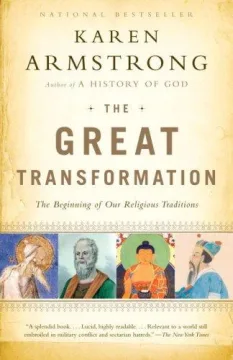
The Great Transformation

The Beginning of Our Religious Traditions

By Karen Armstrong

Karen Armstrong examines the formative centuries commonly called the Axial Age, when major religious and philosophical traditions developed across China, India, Israel, and Greece. Moving among Confucianism, Daoism, Hindu traditions, Buddhism, Israelite monotheism, and Greek rational inquiry, she asks why comparable ethical and spiritual innovations appeared in societies with no single shared history. Armstrong connects these developments to political upheaval, warfare, urbanization, and changing social structures. Her central emphasis is not doctrinal agreement but a recurring turn away from ritual performed for its own sake and toward inward discipline, compassion, self-criticism, and responsibility for others. Figures including Confucius, the Buddha, Socrates, and the prophet Jeremiah become part of a comparative account of humanity’s attempts to answer violence without reproducing it. The result is an ambitious history of ideas that also challenges modern readers to reconsider wha…

View book

Related category

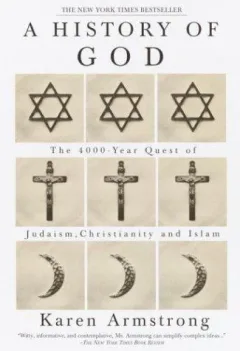
A History of God

The 4,000-Year Quest of Judaism, Christianity and Islam

By Karen Armstrong

Karen Armstrong traces changing ideas and experiences of God across Judaism, Christianity, and Islam, beginning in the ancient Near East and continuing through classical philosophy, medieval mysticism, the Reformation, the Enlightenment, modern atheism, and twentieth-century theology. Rather than attempting to prove or disprove God’s existence, the book examines how communities repeatedly reformulated the divine in response to intellectual, political, and spiritual change.

View book

Articles in this category

No published articles are currently connected to this category in this language.