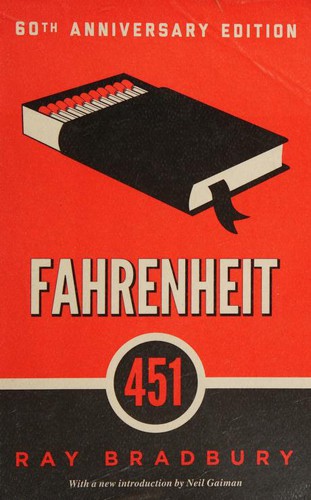
Cover for Fahrenheit 451

Dystopian & Social Science Fiction

Fahrenheit 451 by Ray Bradbury

Ray Bradbury's Fahrenheit 451 is one of the most widely read dystopian novels of the twentieth century. It follows Guy Montag, a fireman in a future America whose job is to burn books rather than put out fires. Montag's routine starts to crack after he meets a curious teenage neighbor and sees how empty his own marriage has become, and he begins hiding books he is supposed to destroy. The story is short, but it asks large questions about what a society loses when speed, noise and comfort replace reflection. Bradbury shows citizens who help dismantle their own intellectual life, not merely a state that suppresses it. Readers who want science fiction that doubles as a conversation about attention, memory and freedom will find a compact, vivid place to begin.

Where to buy or borrow

Are you selling this book? Bookstores, publishers, authors and libraries can be listed here for free. Request a listing

About this book

Fahrenheit 451 is a science fiction novel, first published by Ballantine Books in 1953. It sits beside other classic dystopian novels but differs from many of them in tone. Where numerous cautionary tales stress surveillance and terror, Bradbury writes in a lyrical, image-heavy style. He keeps the focus on appetite, distraction and the quiet withdrawal of a whole population from difficult ideas. The book grew out of Bradbury's earlier short fiction, including a longer magazine story called "The Fireman," and was reworked into a novel in three parts: "The Hearth and the Salamander," "The Sieve and the Sand," and "Burning Bright." The scope is intimate rather than panoramic. Readers see one city, a handful of memorable characters and a few days of upheaval, while the wider society is sketched through its entertainments, slogans and habits. That economy is part of why it is often counted among the books that make you think, and why classrooms return to it so often. This profile covers the Simon & Schuster paperback with ISBN 9781451673319.

Deep Overview

The novel opens with Guy Montag enjoying his work. As a fireman in a city where houses are fireproof and books are contraband, he is paid to set fire to hidden libraries, and he takes a certain pleasure in the spectacle. That ease is disturbed by Clarisse McClellan, a teenage neighbor who asks him unexpected questions, notices small things such as dew and the faces of passers-by, and wonders aloud whether he is happy. Soon afterward Montag finds that his wife, Mildred, has overdosed on sleeping pills and is treated by technicians who handle the emergency as routine. When an elderly woman chooses to burn along with her books rather than leave them, Montag quietly takes one home. From that point he can no longer treat his job as neutral.

Part One establishes the world through contrasts: Clarisse's curiosity against Mildred's immersion in wall-sized screens and ear-borne radios, and Montag's private unease against the confidence of his captain, Beatty. Beatty is the book's most intellectually interesting figure, because he is a former reader who knows exactly what he is destroying. His long explanation of how books fell out of favor is the novel's central argument. In his account, censorship was not imposed from above at first. Mass media, shorter attention spans, pressure from groups who disliked being offended, and a public that preferred amusement all pushed reading aside, and the government only completed the job.

Part Two follows Montag's attempts to make sense of what he has taken. He seeks out Faber, a retired English professor who lacks the courage to act but supplies a way forward, including a small earpiece through which the two can talk. Montag's frustration with Mildred and her friends peaks when he reads poetry aloud to them and exposes how thoroughly they have been numbed. Beatty, meanwhile, appears to know more about Montag's doubts than he should.

Part Three is the most kinetic. Montag is forced to act against Beatty, becomes a fugitive pursued by the Mechanical Hound and by a broadcast manhunt, and escapes the city by way of the river. He meets Granger and a group of wanderers who preserve literature by memorizing it, treating each person as a living book. As the city is struck by war, the survivors are left to consider what a rebuilt society might do differently.

What Bradbury is trying to show is that a culture can lose its inner life by degrees, through comfort and convenience, and that individuals, not just institutions, decide whether memory survives.

Key Themes

Censorship as a social process: the novel presents book burning as the end point of public indifference and intolerance, not only of state decree.

Media saturation and attention: constant sound and moving images leave little room for solitude or thought, and Bradbury treats this as a danger to civic and emotional life.

Knowledge versus information: Faber and Beatty both distinguish between facts that pile up and the reflective understanding that books can encourage.

Conformity and happiness: the society pursues a frictionless contentment, and the book asks what is lost when discomfort and grief are removed from life.

Memory and renewal: the book people and the recurring phoenix imagery suggest that knowledge can be carried by persons and begin again after destruction.

Individual responsibility: Montag's change is gradual and costly, and the story keeps asking what a single person owes to a shared culture.

Historical Context

Bradbury developed the story in the years after the Second World War. The first Cold War decade brought fears of atomic weapons, political suspicion and pressure to conform, and a reference work on the novel connects it to a climate in which unpopular ideas could carry social and economic penalties. Memories of organized book burnings in 1930s Germany also shadow the premise, even though the novel's fictional society is not simply a copy of any real regime.

The book also reflects the arrival of mass television and radio in American homes. Bradbury's earlier fiction, including a short story about a lone walker questioned by police in an empty city, fed into the novel's atmosphere. Accounts of the book's writing note that he composed an early version on rented typewriters in a university library in Los Angeles, which is part of the novel's own legend. Bradbury later stressed in interviews that he saw broadcast media as the main subject; readers still debate how much weight to give that against the more familiar censorship reading.

Intended Audience

This novel suits first-time readers of dystopian or speculative fiction, high school and college students, book clubs looking for a short title with plenty to argue about, and anyone curious about a work that is often cited but less often reread closely. Adults who loved it in school may find new layers on a second visit, particularly in Beatty's speeches.

Readers who want a tightly plotted thriller, hard science fiction with technical explanation, or a fully realized political system may be less satisfied. Bradbury's prose is poetic and metaphor-rich, and the world-building is impressionistic.

Reading Difficulty

The language is accessible, and the book is short enough to finish in a few sittings. The difficulty lies elsewhere. Bradbury uses dense figurative language, quick shifts between vivid action and reflective speech, and many literary and biblical allusions, especially in the final part. Beatty's monologues move quickly and mix quotation, argument and manipulation, so careful readers may want to reread them. No technical or scientific background is needed. This is a paperback edition; page count is not confirmed here, and the length can vary by printing, since some editions add an introduction, afterword or coda.

Helpful Background Knowledge

No preparation is required, but a few reference points enrich the reading. A general sense of Cold War anxieties and of the history of book burning helps explain the book's stakes. Passing familiarity with poems and Biblical passages that Montag and others recall, such as Matthew Arnold's "Dover Beach" and Ecclesiastes, makes the later chapters more resonant. Readers who know Bradbury's short stories, such as "The Pedestrian," will recognize themes the novel develops. Finally, it helps to keep in mind that a novel can predict habits and tensions rather than specific devices, so its technology should be read as imagery for attitudes.

Why Read This Book?

Many dystopian novels dramatize how power controls people. This one dramatizes how people hand over their own attention, and it does so in a story that runs only a few hundred pages at most. Its characters are small in number but sharply drawn, and Beatty gives the book an antagonist who argues rather than merely threatens. Reading it also gives context to a great deal of later writing and conversation about screens, distraction and the cultural role of reading. For readers who like to test a famous idea against the text itself, it is a rewarding pick, because the familiar summary (a government burns books) is only part of what Bradbury actually argues.

Reader Takeaways

A careful reader may come away able to separate state censorship from cultural withdrawal, and to see how Bradbury links them. They may reconsider the difference between being informed and being thoughtful, notice how the book treats grief, boredom and silence as things society tries to avoid, and recognize the importance of the book's final emphasis on rebuilding. Some will also reflect on their own habits of attention and on which texts, if any, they would feel responsible for remembering.

Strengths

The novel is economical and memorable, with images such as the Mechanical Hound, the parlor walls and the walking libraries that remain vivid after the plot fades. Its central argument is presented through Beatty in a way that is hard to dismiss, which gives the story real intellectual tension. The three-part structure moves from curiosity to confrontation to flight and renewal with clear pacing. Because it can be read as a story about censorship, media, conformity or personal awakening, it supports a wide range of discussion without requiring specialist knowledge.

Limitations and Cautions

The world is sketched rather than built, so readers wanting detailed institutions, economics or politics will find gaps. Female characters, especially Mildred, are largely seen through Montag's frustration, which some readers find limiting. The novel's view that mass entertainment and fast media erode thoughtful reading is the author's view, and it is contested: critics argue that new media can also widen access to ideas, and that the book's contrast between serious reading and popular culture can be elitist. The book also contains scenes of self-harm, suicide-related imagery, and violence, including the burning of a person. Finally, as a mid-century work, some of its technology and social details are dated, and editions differ in extras and printing details.

Important Concepts, People, and Places

Guy Montag: the protagonist, a fireman whose growing doubts drive the story.

Clarisse McClellan: the teenage neighbor whose curiosity first unsettles Montag.

Mildred Montag: Montag's wife, whose life revolves around screens and sedation and who illustrates the society's emptiness.

Captain Beatty: Montag's superior, a well-read advocate of the system and the book's main voice of argument.

Faber: a retired English professor who becomes Montag's reluctant ally and links him to the world of ideas.

Granger and the book people: wanderers who preserve literature by memorizing it, offering the novel's answer to destruction.

The Mechanical Hound: an automated hunter that symbolizes impersonal enforcement.

The firehouse and the fire department: the institution that has taken over the role of burning books instead of fighting fires.

The parlor walls and the seashell radios: the media environment that fills people's days.

"Dover Beach" and Ecclesiastes: literary and scriptural works that Montag turns to when he looks for meaning.

The phoenix: a recurring image of destruction followed by renewal, tied to the novel's earlier drafts and to its ending.

Ray Bradbury: the author, whose earlier stories "The Pedestrian" and "The Fireman" fed into the novel.

Questions the Book Explores

How does a society come to give up reading without anyone formally voting to do so? What is the relationship between happiness and honest confrontation with pain? Can information, however abundant, replace understanding? Who is responsible when knowledge is lost: governments, institutions or ordinary people? Is memory, held by individuals, a sufficient defense for culture, or does it need physical books and public institutions as well?

Reading Group Guide

A useful way to structure a meeting is to take the three parts in turn. Begin with first impressions of the world, including what seems plausible and what seems exaggerated. Then spend time on Beatty's explanation of how books were abandoned and test it against your own experience. A third session can concentrate on the ending and what the characters hope to rebuild. Groups may want to bring a short passage of poetry or prose they would choose to preserve, and compare their choices. It also works well to read alongside a short, related work, such as Bradbury's story "The Pedestrian," to see how his ideas grew. Because the book touches on self-harm and violence, facilitators may wish to give a brief heads-up.

Discussion Questions

1. Why does Bradbury make Beatty a former reader rather than an uneducated enforcer, and how does that change the force of his arguments?

2. Which does the novel treat as more dangerous: government control of ideas or public indifference to them? Where do you see the two overlapping?

3. What does Mildred's life reveal about the society's idea of happiness, and does the novel treat her with sympathy?

4. Montag keeps changing, but he also hesitates. Which of his choices feel earned, and which feel sudden?

5. Does preserving books by memory solve the problem the novel poses, or only postpone it?

6. Which parts of the book's media world seem closest to, or furthest from, your own day-to-day experience?

7. What responsibilities do readers, teachers and librarians have in the world the novel describes?

Sources and Verification

This profile draws on bibliographic and bookseller records to confirm the title, author, publisher, format and ISBNs of the Simon & Schuster paperback, along with a library-based reference on the work's first publication. Background on the novel's origins and context comes from an encyclopedia entry, a university library exhibit, a study-guide overview, a university magazine article and a general reference article. Sources disagree on this printing's exact publication date and edition label, and page counts were not confirmed, so those details are left blank. The interpretive discussion is the editor's own synthesis, and remarks about Bradbury's later comments on television are based on widely reported interviews that readers may wish to check themselves.

Comments

No published comments yet.

Sign in to add a comment.

Available editions