
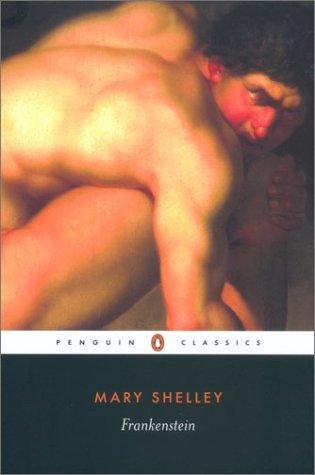
Frankenstein
Mary Shelley's Frankenstein follows a young scientist who builds a living being from lifeless matter, recoils from it in horror, and then watches the consequences spread from Switzerland across Europe and into the Arctic. The story is told through nested voices: an explorer, the scientist and the created being himself. Together they ask who is answerable for what knowledge produces, and what a maker owes to the one he has made. This Penguin Classics paperback, edited by Maurice Hindle, presents the revised 1831 text with a critical introduction, notes and extra material. It is often counted among the foundational science fiction books, and it remains one of the classic novels to read for anyone curious about the roots of modern arguments over technology, ambition and compassion.
Where to buy or borrow
Are you selling this book? Bookstores, publishers, authors and libraries can be listed here for free. Request a listing
About this book
Deep Overview
Victor describes a loving childhood in Geneva, close ties with his adopted cousin Elizabeth Lavenza and his friend Henry Clerval, and a growing obsession with natural philosophy. At university in Ingolstadt he pursues the secret of life itself. The novel passes quickly over the actual act of creation. What matters to Shelley is the instant after it, when Victor sees what he has made and flees. From that moment he is guilty of neglect, not of crime in any simple legal sense, and the rest of the book follows that distinction.
The creature is not the mindless brute of later stage and film versions. When he finally speaks, in the book's centre, he is articulate and observant. He teaches himself language by watching a poor family in a cottage, reads books that shape his sense of the world, and slowly understands that people will recoil from his appearance whatever his character. He asks Victor for a companion of his own kind. Victor begins the task, then destroys it out of fear. The creature's revenge falls on those Victor loves.
Shelley uses the three narrators to unsettle any easy judgement. Walton is on the edge of repeating Victor's mistake of sacrificing human ties to glory. Victor presents himself as a victim of fate, yet his own account reveals avoidance and secrecy. The creature argues persuasively that his violence grew from rejection, yet he also commits cruelties that cannot be excused. Readers are repeatedly asked to compare the three accounts rather than trust one.
The edition's 1831 text differs from the 1818 original in emphasis. Scholars have long discussed how the revisions affect the treatment of fate, responsibility and Victor's innocence, and Hindle's notes and collation help readers see the differences. The Penguin volume also places the novel beside Polidori's vampire story and Byron's fragment. These pieces came out of the same social world that produced Frankenstein, so a reader can see how Gothic horror was being reshaped in those years.
The book is ultimately less about a monster than about what happens when creation is separated from care. Victor's laboratory success is immediate, while his moral failure is slow and cumulative. Shelley turns that gap between making and nurturing into the novel's central problem.
Key Themes
Ambition and the limits of knowledge run through all three narrators. Walton's polar quest and Victor's scientific pursuit both show how the desire for glory can overrule affection, prudence and consequence.
Isolation and the need for companionship shape the creature's tragedy. His wish for a companion is not a side plot but the logical outcome of his rejection, and its denial drives the book's final cycle of loss.
Nature, family and domestic affection act as counterweights to obsessive ambition. Shelley contrasts the warm households Victor neglects with the solitary work that consumes him.
Self-justification and unreliable narration matter because every account is told by someone with a stake in how he is judged. The nested structure invites readers to weigh motives as well as events.
Justice, prejudice and appearance appear in the way people judge the creature on sight, and in the way innocent people suffer when Victor stays silent.
Historical Context
The first edition appeared in three volumes in 1818, published anonymously, with a preface by Percy Shelley. A French-language edition followed in 1821, and the best-known later change was the thoroughly revised 1831 text. Bibliographic scholarship describes several distinct versions of the work, including manuscripts, which is why editions can differ in wording and emphasis. Britannica notes that the 1831 version is the one most often reprinted, and that is the text used in this Penguin edition.
The book belongs to the Romantic period, when writers and thinkers were debating the promises and dangers of reason, scientific experiment and individual genius. The subtitle, The Modern Prometheus, ties the story to the myth of the figure who stole fire for humanity and was punished for it. Readers often connect the novel to the period's fascination with electricity and the nature of life, though how far particular scientific debates shaped Shelley's story is a matter for specialists. Mary Shelley also came from an intellectual family; her parents were the radical writers William Godwin and Mary Wollstonecraft, and that background informs many readings of the book's interest in education, parenting and social responsibility. Percy Shelley's death by drowning in 1822 came a few years after the first edition and well before the revised 1831 text.
Intended Audience
General readers who know Frankenstein mainly through films, cartoons or Halloween imagery are an especially good fit. The book is quite different from the popular image, and a careful reading corrects many assumptions about who the monster is and what he says.
Readers interested in the history of science fiction, in debates about technology and ethics, or in the literary world of Byron and the Shelleys will get a lot from the extras.
People who want a purely fast-moving horror story may find the long reflective passages, formal narration and extensive scholarly apparatus slow going. Readers who prefer a minimal edition with no notes may prefer a plain-text reprint.
Reading Difficulty
The nested narration needs attention. A reader must keep track of whether Walton, Victor or the creature is speaking, and of how each reports the others' words.
The ideas are accessible, since no scientific or philosophical training is required, though references to classical myth and to poetry reward some familiarity. In this edition the introduction, notes and appendices add reading time. The paperback runs to about 352 pages, including the extra material, so the novel itself is shorter than that. Newcomers may prefer to read the notes after finishing the story to avoid spoilers.
Helpful Background Knowledge
A short look at the 1816 Lake Geneva circle of Mary Godwin, Percy Bysshe Shelley, Lord Byron and John Polidori explains why this edition prints companion pieces by Byron and Polidori. Readers who have seen film adaptations should be prepared to set aside much of what those versions added, such as the lightning-lit laboratory, the assistant, the stitched-together lumbering monster and the idea that he cannot speak.
The edition's own introduction is a good place to find further reading, and the 1831 introduction by Mary Shelley is worth reading as her own account of how the story began, though it should be read as recollection written years later.
Why Read This Book?
The novel is also a useful case study in how an idea became a genre. If you are building a reading list of science fiction books, this is a natural starting point, and its questions about creation, responsibility and consequence are still at the centre of public discussion about technology.
This edition adds specific value. Its text follows the version most readers know, while the appendices and notes make the changes from 1818 visible. The inclusion of Polidori's vampire story and Byron's fragment places the novel within the literary contest that produced it, so readers get a small anthology of early Gothic writing along with the main work.
Reader Takeaways
You may notice how storytelling frames shape sympathy. The same events look different in Walton's, Victor's and the creature's tellings.
You may reconsider the common idea that the story warns against science itself. A closer reading suggests it is as much about neglect, secrecy and the refusal to face consequences.
You may also see how the revision history matters. Comparing the 1831 edition with the 1818 text, as this edition encourages, shows that a classic is not a fixed object but the product of an author's changing choices.
Strengths
The novel itself is remarkable for its structural ingenuity. Nested narrators create moral complexity without a narrator who tells readers what to think.
The book is original in its idea and enduringly relevant. It raises questions about creators and creations that can be applied to many later technologies without the novel needing to predict any of them.
The addition of Byron's and Polidori's pieces gives useful literary context in one volume, which is rare in a standard classic paperback.
Limitations and Cautions
The scholarly apparatus reflects the interpretive choices of its editor, and readings of the novel are varied and sometimes disputed, for example over how far the revisions changed its treatment of fate and responsibility.
The novel's pacing and formal prose can feel distant to modern readers, and some passages of description and moral reflection are long. Its cast is also small and largely European, and its women characters are mostly seen through male narrators.
Publication details for this edition vary by region and seller, so check the ISBN before buying if you need this exact version.
Important Concepts, People, and Places
Elizabeth Lavenza and Henry Clerval represent the family and friendship ties that Victor's secrecy endangers. The De Lacey family, observed by the creature, is the model of human community he longs to join.
Geneva, Ingolstadt and the Arctic are the key settings. Geneva stands for home and civic life, Ingolstadt for the university and the experiment, and the Arctic for the extremes of ambition and isolation.
Mary Shelley, Percy Bysshe Shelley, Lord Byron and John William Polidori are the writers connected with the novel's origin in the 1816 ghost-story contest near Lake Geneva. Percy Shelley wrote the preface to the first edition; Polidori's The Vampyre and Byron's A Fragment are reprinted in this volume.
The Modern Prometheus is the subtitle, linking Victor to the myth of the fire-bringer. The 1818 and 1831 editions are the two main printed versions that readers encounter, and Maurice Hindle is the editor whose introduction and notes shape this edition.
Questions the Book Explores
Can the pursuit of knowledge be separated from the consequences it brings, and who decides which discoveries to pursue?
How far is character shaped by treatment, upbringing and society, and how far by nature?
What makes someone a monster, appearance or action?
Can a narrator who tells his own story be trusted to judge his own guilt?
What is the relationship between ambition and human attachment, and can the two ever coexist in the characters we meet?
Reading Group Guide
Before the first meeting, ask members to note what they expected from the story based on films and popular culture, then compare these notes with what they find. This often produces a lively opening conversation.
Groups using this edition may want to read the 1831 introduction together and discuss how far an author's later recollection can be trusted. A short session on the appendices, particularly The Vampyre, can broaden the discussion to the wider Gothic tradition.
If members have read different editions, compare passages from the 1818 and 1831 texts to see whether the wording changes the sense of responsibility and fate.
Discussion Questions
2. At which point in the novel does Victor become most responsible for what follows?
3. How does the creature's account of learning language and reading books affect your view of him?
4. In what ways does Walton resemble Victor, and what does he do differently?
5. What role do Elizabeth, Justine and the other women play, and how are they presented through the male narrators?
6. How do the settings of Geneva, Ingolstadt, the Scottish Isles and the Arctic reflect the story's changing moods?
7. Which parts of the novel's moral questions feel most relevant to contemporary debates about technology?
8. What does reading Polidori's and Byron's pieces alongside Frankenstein add to your understanding of the book?
9. How might the book read differently if Victor had told the story to a different listener?
Sources and Verification
Comments
No published comments yet.
Available editions
Paperback
Revised edition, edited with an introduction and notes by Maurice Hindle; text based on the 1831 edition
- Publisher
- Penguin Classics
- ISBN-13
- 9780141439471
- Pages
- 352