
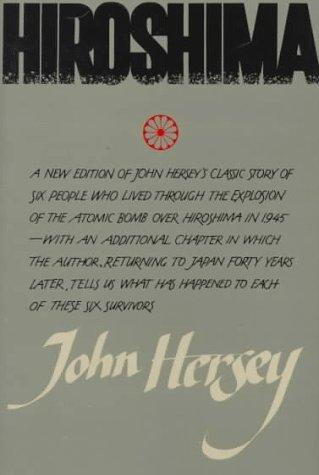
Hiroshima
John Hersey's Hiroshima follows six people through the atomic bombing of Hiroshima on August 6, 1945, and the weeks, months and years that followed: two physicians, a clerk, a tailor's widow, a Methodist pastor and a German Jesuit priest. Rather than arguing about strategy or morality, Hersey reconstructs what each person saw, did and suffered, and lets plain detail carry the scale of the catastrophe. The text first appeared in The New Yorker in 1946 and then became a book that has stayed in print. This 1985 Knopf edition adds a closing chapter based on Hersey's return to Japan four decades later. For anyone assembling world war 2 books, it is a short, humane and influential piece of reporting that shows how the war's end looked from the ground.
Where to buy or borrow
Are you selling this book? Bookstores, publishers, authors and libraries can be listed here for free. Request a listing
About this book
Deep Overview
Hersey's central choice is scale. Instead of reporting a city's destruction in totals, he asks what a particular person could see from a particular spot and what that person did next. The aggregate emerges from accumulation: the silence, the improvised help, the strangers who ask for water, the survivors who walk without understanding where they are going. Because the six come from different positions in society and include a foreign priest as well as Japanese residents, the narrative can show varied reactions without turning into a single heroic or victim story.
The middle of the account concerns the first days, when the city's officials and survivors did not yet understand the weapon. Hersey traces how rumours circulated, how people tried to make sense of an injury pattern that fit no ordinary air raid, and how an illness arrived weeks later in people who seemed to have escaped harm. The slow arrival of radiation sickness, and the fear that came with it, gives the book its second movement: after the horror of the event comes the horror of not knowing.
Hersey's style is deliberately level. He seldom adjectivises suffering and does not spell out moral conclusions, trusting the sequence of facts to do that work. He also does not argue whether the bombing was justified; the book's concern is the human consequence. That reticence made the text unusually persuasive to American readers in 1946, who had previously met the bomb mainly as a triumph of science and a means of ending the war.
The added chapter in this 1985 edition shifts the time frame. Hersey went back to Japan to learn how the six had lived in the decades afterward, and the new material turns the story from catastrophe to long aftermath. It asks how survivors carried memory, illness, stigma, faith and responsibility, and it suggests that the bomb's effects were not confined to one August morning. Read together, the two parts show a book about an event and then a book about its duration.
Key Themes
A second theme is chance. Survival often depends on where someone happened to be standing, what room they were in, or a last-minute change of plan, and Hersey lets those contingencies stand without explaining them away.
A third is uncertainty and the failure of understanding. Survivors and officials alike lack a framework for what has happened, and illness that appears later compounds the confusion.
A fourth is the contrast between public narrative and private experience. The book deliberately sidesteps the arguments that dominated discussion of the bomb in the United States and instead gives readers a view that those arguments tended to omit.
Finally, the 1985 chapter adds the theme of long-term consequence: memory, bodily harm, social standing and the ways survivors made meaning from what happened to them.
Historical Context
The piece also belongs to a tradition of American war reporting that Hersey had already practised. Before Hiroshima he had become known as a correspondent and for his novel A Bell for Adano, which won a Pulitzer Prize.
In the 1946 setting, Japan was under Allied occupation, and discussion of the bombing was constrained there. The wider debates over the decision to use the bomb, over wartime responsibility and over the later nuclear arms race all intensified in the decades that followed. The 1985 edition appeared at another charged moment, forty years on and during renewed Cold War anxiety, which gives the added chapter its own context. In 1999 a panel convened by New York University's journalism department ranked the work first on its list of the top 100 works of American journalism in the twentieth century.
Intended Audience
It is also a good fit for readers who have encountered the strategic argument about the bomb and want to see the experience the argument concerns. Journalists and writers can read it as a study in restraint and structure.
Readers who want a comprehensive political, military or scientific history of the bombing, or a Japanese-authored account, will find this book only a starting point. Those who are strongly distressed by graphic descriptions of burns, death and illness should prepare themselves, since the plain tone does not soften the content.
Reading Difficulty
The emotional difficulty is greater than the intellectual one. The scenes of injury and death are specific, and the pace of the central chapters is relentless. The book is short enough to read in a sitting or two, but many readers choose to pause between sections. This edition is a hardcover; printings differ in length and layout, so page counts vary between copies.
Helpful Background Knowledge
Some familiarity with how Japan was governed under the postwar occupation can clarify why the story took so long to reach some audiences. A little knowledge of radiation sickness will help you understand why survivors and doctors in the book were so puzzled by symptoms that appeared late.
No prior reading is required, and it can be more productive to read the book first and then turn to broader histories to fill in the strategic and political argument it deliberately sets aside.
Why Read This Book?
It is also worth reading for its place in publishing and journalism history. Few magazine pieces have turned into books that remained in circulation for decades and that continue to inform how people talk about nuclear weapons. Reading it gives context for later debates, documentaries and memoirs of survivors.
This particular edition adds the 1985 chapter, which turns the account into a study of aftermath. That makes it more useful for readers who wonder what survival meant over a lifetime and not only on the day of the bombing.
Reader Takeaways
They may also notice how Hersey constructs authority through omission: no rhetoric, no stated verdict, and an insistence on what witnesses could actually observe. That is a transferable lesson for anyone who reads or writes factual narrative.
Readers may reconsider the distinction between ending a war and ending its consequences, and notice how the book's later chapter frames survival as a continuing process. It can also prompt reflection on how stories reach audiences, since the book's impact depended on a particular magazine, a particular year and a particular reading public.
Strengths
The tone is another strength. The refusal to editorialise gives the facts weight and lets readers form their own responses.
The prose is accessible and the length manageable, which has made the book durable in classrooms and among general readers. The 1985 chapter adds depth by showing what became of the people the reader has come to know, and it prevents the book from being read only as a snapshot of a single day.
It also has considerable historical value as a document of how the bombing was first presented to a wide English-language readership.
Limitations and Cautions
The six subjects are a small group. They include no soldiers, and the narrative does not follow other groups of victims, such as Korean residents or forced labourers present in the city, so the picture is selective. Because one of the six is a European priest and the author was an American writing for an American magazine, some critics and readers have asked how far the perspective can represent Japanese experience.
The account is also dated in its medical and scientific understanding of radiation effects, which has advanced considerably since 1946. And the book's calm style, though admired, can leave readers wanting more analysis than it offers. The 1985 chapter reflects the circumstances of that year and is not an up-to-date account of the survivors.
Important Concepts, People, and Places
The New Yorker and William Shawn: The magazine that ran the work in full in its August 31, 1946 issue, and the editor with whom Hersey discussed the project at the outset.
Hiroshima and August 6, 1945: The city and date of the first atomic bombing of a city; the book opens at the moment of the blast.
Toshiko Sasaki: A young clerk at the East Asia Tin Works, whose injuries and long recovery form one of the six threads.
Dr. Masakazu Fujii: A physician whose private hospital is wrecked by the explosion.
Hatsuyo Nakamura: A widow raising three children, whose struggle to keep the family going extends beyond the first days.
Dr. Terufumi Sasaki: A young surgeon at the Red Cross hospital, who faces a flood of casualties.
Father Wilhelm Kleinsorge: A German Jesuit priest living in Hiroshima, whose position makes him both witness and outsider.
The Reverend Kiyoshi Tanimoto: A Methodist pastor who helps the injured and whose later work with young women disfigured by the bomb, often called the Hiroshima Maidens, features in the longer story.
Radiation sickness: The delayed illness that struck people who had seemed uninjured; it is central to the book's treatment of uncertainty and fear.
Questions the Book Explores
The book also raises questions about knowledge: how do individuals, doctors and officials make sense of a new kind of harm when no one has a name for it? And it asks about the ethics of witness: who has the right to narrate such an event, and what is gained or lost when an outsider does so?
The later chapter asks a different question again: how does a person carry an extraordinary event through ordinary decades?
Reading Group Guide
A useful starting exercise is to ask each member which of the six they remember most vividly and why; the answers often reveal how Hersey's choices guided attention. Another is to compare the book's restraint with how other works treat the same event. Groups should acknowledge the distressing content at the outset and let members pause. These book discussion questions in the next section can be used in any order.
Discussion Questions
2. How does the plain, even tone affect your response to the most harrowing scenes? Would a more emotional style have been more or less effective?
3. The book does not discuss whether the bomb should have been used. Does that omission strengthen the account, limit it, or both?
4. What role does chance play in who lives and who dies, and how does the narrative make that visible?
5. How do the survivors' beliefs, whether religious, professional or personal, shape their reactions?
6. What does the added 1985 chapter change about your reading of the earlier chapters?
7. Who is not represented among the six, and how might their accounts alter the picture?
8. Why might a magazine devote an entire issue to a single article, and what does that suggest about the relationship between journalism and public conscience?
9. How should a modern reader weigh a 1946 text when thinking about contemporary debates over nuclear weapons?
Sources and Verification
Comments
No published comments yet.
Available editions
Hardcover
New edition with a final chapter written forty years after the bombing (1985)
- Publisher
- Alfred A. Knopf
- ISBN-13
- 9780394548449