
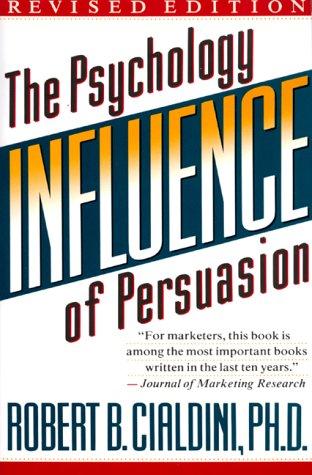
Influence
The Psychology of Persuasion
Why do people agree to requests that they might reject under more deliberate conditions? In Influence, social psychologist Robert B. Cialdini explains how familiar cues can trigger rapid compliance. The 2007 revised edition organizes its account around six principles: reciprocation, commitment and consistency, social proof, liking, authority, and scarcity. Each principle can support legitimate cooperation, but each can also be engineered by sellers, fundraisers, negotiators, advertisers, and others seeking agreement. Cialdini combines research from social psychology with observations of persuasion in everyday and commercial settings, emphasizing both how influence works and how readers can recognize questionable uses of it. The result is an accessible framework for examining decisions that may feel personal and spontaneous but are often shaped by context. Its central value lies not in promising immunity from persuasion, but in making common influence patterns easier to notice, evaluat…
Where to buy or borrow
Are you selling this book? Bookstores, publishers, authors and libraries can be listed here for free. Request a listing
About this book
Deep Overview
The first major principle, reciprocation, concerns the pressure to return benefits, favors, gifts, and concessions. Its force helps sustain exchange and cooperation, yet an unsolicited favor can create an obligation that exceeds the value of what was given. The related rejection-then-retreat pattern shows how a large initial request can make a smaller request feel like a concession that ought to be matched.
Commitment and consistency address the desire to appear aligned with earlier choices. Once people take a position—especially an active, public, effortful, or apparently voluntary one—they may defend it through later behavior. Cialdini’s concern is not consistency itself but the possibility that a small commitment can become the first step in a much larger course of action.
Social proof shifts attention from one’s prior conduct to the conduct of others. When circumstances are uncertain, people commonly interpret widespread behavior as evidence of what is correct. This can be informative, particularly when the observed group is relevant and genuinely independent. It can also produce cascading error when everyone is reading everyone else’s uncertainty.
Liking explains why affection, familiarity, similarity, praise, attractiveness, association, and cooperation can influence compliance. A request may receive favorable treatment because the requester or associated person is appealing, even when that appeal is irrelevant to the proposal. Authority works similarly through deference to expertise and legitimate hierarchy. Titles, clothing, and other status symbols can activate obedience before a person verifies whether the authority is real or pertinent.
Scarcity completes the six-principle structure. Limited availability can increase perceived value, while threatened loss can make action feel urgent. Competition and deadlines intensify this effect by narrowing the time available for reflection. Across these chapters, Cialdini returns to a common defensive move: identify the emotional or situational trigger, separate it from the merits of the request, and reassess what is actually being offered. The book therefore presents persuasion as an interaction between useful human tendencies and environments designed to exploit them.
Key Themes
• **Obligation and exchange:** Reciprocity supports trust and cooperation while also allowing gifts, favors, and concessions to become tools for manufacturing indebtedness.
• **Identity through consistency:** Earlier statements and actions can shape later conduct because people want their choices to form a coherent self-image.
• **Uncertainty and imitation:** The less certain a situation feels, the more attractive other people’s behavior becomes as evidence—whether or not the crowd is well informed.
• **Source cues versus substantive merit:** Liking and authority can cause an audience to evaluate the messenger’s appeal or status instead of the request itself.
• **Urgency, loss, and restricted choice:** Scarcity increases attention and desire by suggesting that delay will close an opportunity.
• **Ethical ambivalence:** The principles describe ordinary social coordination as well as manipulation. Ethical evaluation depends on honesty, relevance, informed choice, and whether the influence attempt respects the other person’s interests.
Historical and Intellectual Context
The 2007 edition belongs to an era before algorithmic feeds, influencer marketing, and contemporary interface design became dominant subjects of public discussion. Its framework nevertheless transfers readily to those environments because digital systems also display popularity, expertise, affinity, commitment, and limited availability. Readers should make that extension thoughtfully rather than assume that every modern platform or practice was analyzed in this edition.
Intended Audience
Reading Difficulty
Helpful Background Knowledge
Why Read This Book?
Reader Takeaways
Strengths
Limitations and Cautions
Important Concepts and People
• **Compliance professionals:** Cialdini’s broad label for people whose work depends on obtaining agreement, including salespeople, fundraisers, advertisers, recruiters, and negotiators.
• **Automatic responding:** Fast, cue-driven decision-making that conserves attention but may bypass fuller evaluation.
• **Reciprocation:** The felt duty to repay a benefit or concession, even when the initial act was unsolicited.
• **Rejection-then-retreat:** A sequence in which retreating from a large request to a smaller one creates the appearance of concession and encourages reciprocal agreement.
• **Commitment and consistency:** The pressure to make present behavior accord with earlier statements, choices, or identities.
• **Social proof:** The use of other people’s behavior as evidence of what is correct, especially under uncertainty or among similar peers.
• **Liking:** Increased receptiveness to requests from people perceived as attractive, familiar, similar, complimentary, cooperative, or pleasantly associated.
• **Authority:** Deference to perceived expertise or legitimate status, sometimes activated by titles, uniforms, clothing, or other symbols rather than verified competence.
• **Scarcity:** The tendency to value opportunities more when access appears limited, threatened, competitive, or time-sensitive.
• **Mental shortcuts:** Efficient rules of thumb that enable rapid decisions and create the common mechanism connecting the book’s principles.
Questions the Book Explores
• When does reciprocity become manufactured obligation?
• How can a minor commitment redirect a much larger sequence of choices?
• Why does uncertainty increase dependence on the behavior of others?
• Which qualities make a requester likable, and why do those qualities affect unrelated judgments?
• How do symbols of expertise acquire power even when relevant expertise has not been established?
• Why can restricted availability intensify desire rather than merely limit supply?
• How can people interrupt an automatic response without abandoning useful decision shortcuts altogether?
• What separates ethical persuasion from manipulation?
Reading Group Guide
Discussion Questions
2. When does accepting a favor create a legitimate obligation, and when is that obligation artificially imposed?
3. Can consistency become irrational even when the original commitment was reasonable?
4. How can a person distinguish informative social proof from manufactured popularity?
5. Which forms of liking are relevant to trust, and which distract from the merits of a request?
6. What evidence should be required before accepting someone as an authority on a particular question?
7. Why might potential loss motivate action more strongly than an equivalent opportunity for gain?
8. Are Cialdini’s recommended defenses realistic when decisions must be made quickly?
9. How do online ratings, follower counts, limited-time offers, and personalized messages map onto the book’s principles?
10. What obligations do marketers, leaders, educators, and fundraisers have when applying these ideas?
11. Does naming an influence technique reduce its power, or can awareness coexist with compliance?
12. What important forms of persuasion fall outside this six-principle framework?
Sources and Verification
Comments
No published comments yet.
Available editions
Paperback
Revised edition; first Collins Business Essentials edition; paperback
- Publisher
- Collins
- ISBN-13
- 9780061241895