Category

Groups & Social Influence

2 published books 0 published articles

Books in this category

Primary category

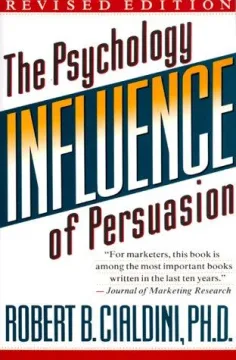
Influence

The Psychology of Persuasion

By Robert B. Cialdini

Why do people agree to requests that they might reject under more deliberate conditions? In Influence, social psychologist Robert B. Cialdini explains how familiar cues can trigger rapid compliance. The 2007 revised edition organizes its account around six principles: reciprocation, commitment and consistency, social proof, liking, authority, and scarcity. Each principle can support legitimate cooperation, but each can also be engineered by sellers, fundraisers, negotiators, advertisers, and others seeking agreement. Cialdini combines research from social psychology with observations of persuasion in everyday and commercial settings, emphasizing both how influence works and how readers can recognize questionable uses of it. The result is an accessible framework for examining decisions that may feel personal and spontaneous but are often shaped by context. Its central value lies not in promising immunity from persuasion, but in making common influence patterns easier to notice, evaluat…
View book

Related category

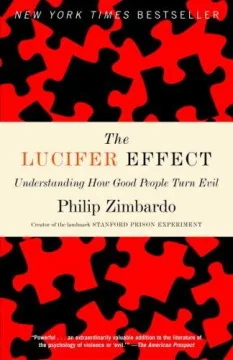
The Lucifer Effect

Understanding How Good People Turn Evil

By Philip Zimbardo

Why do ordinary people sometimes participate in cruelty, humiliation, and organized violence? Social psychologist Philip Zimbardo argues that explanations centered only on defective character—the proverbial “bad apple”—overlook the power of situations and the institutions that construct them. The book’s central case is the 1971 Stanford Prison Experiment, in which students assigned to prisoner and guard roles occupied a simulated prison until the study was stopped after six days. Zimbardo uses his account of that project to examine conformity, obedience, deindividuation, role absorption, moral disengagement, and the diffusion of responsibility. He then connects these processes to abuses at Abu Ghraib prison and to broader instances of institutional wrongdoing. Although the Stanford study’s methods and interpretation have since faced substantial scholarly criticism, the book remains influential as an argument about how systems distribute power and normalize misconduct. Its final moveme…

View book

Articles in this category

No published articles are currently connected to this category in this language.