
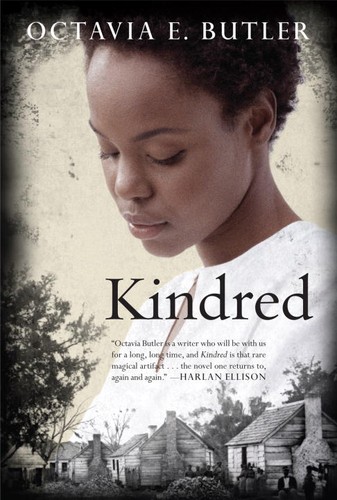
Kindred
In 1976 California, Dana Franklin, a Black writer, is repeatedly and inexplicably transported to antebellum Maryland. Each journey places her near Rufus Weylin, a white ancestor whose survival is necessary for Dana’s own birth. What initially appears to be a series of rescues becomes prolonged exposure to the plantation on which Rufus is being formed by slavery’s habits of ownership, violence, and entitlement. Dana must protect him without accepting the system he represents, while also trying to help the enslaved people whose lives are bound to her family history. When her white husband, Kevin, is carried into the past with her, their marriage is tested by a society that assigns them radically unequal positions. Combining time travel, historical fiction, and the tradition of the slavery narrative, Kindred turns ancestry into an immediate physical crisis. Butler asks what it means to inherit a history that remains present in bodies, families, institutions, and relationships.
Where to buy or borrow
Are you selling this book? Bookstores, publishers, authors and libraries can be listed here for free. Request a listing
About this book
Deep Overview
Dana soon learns that Rufus belongs to her family line. For Dana to exist, he must live long enough to father a child with Alice Greenwood, a free Black girl who is later subjected to the plantation’s control. Knowledge of this genealogy does not supply Dana with a morally acceptable course of action. Preserving her own future may require her to protect a person who becomes increasingly capable of cruelty. Butler therefore transforms the familiar time-travel problem of preserving history into an ethical conflict about complicity, resistance, and survival.
The plantation is not presented only as a site of spectacular violence. Its power also operates through food, shelter, literacy, family separation, surveillance, sexual coercion, punishment, and the constant threat of sale. Dana’s modern education and confidence give her certain resources, but they do not exempt her from these conditions. She must learn how quickly legal vulnerability can become bodily vulnerability. Her efforts to teach reading, offer medical assistance, and negotiate with Rufus show both the value and the limits of individual intervention within an institution designed to turn people into property.
Kevin Franklin, Dana’s white husband, accompanies her on one journey. In Maryland, strangers interpret him as a white master and Dana as an enslaved woman under his authority. Their private understanding cannot prevent the surrounding society from imposing these identities. The resulting strain reveals how social power enters intimate relationships, even when neither partner consciously endorses the hierarchy granting one of them protection and exposing the other to danger.
Rufus is central because Butler refuses to make him a static emblem. Dana knows him first as a frightened child and watches entitlement harden into behavior. His affection, dependency, jealousy, and capacity for violence coexist, preventing personal attachment from becoming evidence of moral innocence. Dana’s connection to Alice is equally important: Alice must endure the consequences of choices made by Rufus and, at times, mediated by Dana. Through these relationships, the novel examines how slavery corrupts kinship itself. Family history becomes inseparable from forced reproduction, possession, and survival under coercion.
The novel ultimately rejects the fantasy that a modern observer can visit slavery, remain detached, and return unchanged. Dana brings historical knowledge into the past, but experience alters what that knowledge means. Her body becomes the record of an encounter that cannot be contained safely in another century.
Key Themes
Power and dependency form another major pattern. Rufus needs Dana, yet his racial, legal, and economic position allows him to control and endanger her. Butler uses this imbalance to question whether dependence produces empathy or simply another means of possession.
Kinship is treated as both connection and entrapment. Dana’s family line ties her to Rufus and Alice, but that lineage originates in coercive circumstances. The title thus encompasses biological relationship, chosen loyalty, racial history, and the disturbing intimacy created by unequal power.
Literacy and knowledge offer limited forms of resistance. Reading can widen possibilities and preserve identity, but teaching enslaved people carries severe danger. Dana’s twentieth-century knowledge helps her interpret events without giving her mastery over them.
The novel also distinguishes survival from submission. Characters make compromises because their available choices have been violently narrowed. Butler asks readers to judge those compromises within the conditions that produced them rather than through abstract expectations of heroism.
Historical and Literary Context
Most of the historical action occurs in antebellum Maryland, a slave state whose location complicates simplified divisions between a free North and a slave South. Enslavement there rested on legal ownership, forced labor, racial surveillance, physical punishment, restrictions on movement and literacy, family separation, and the threat of sale. Free Black people also faced severe insecurity and could be assaulted, kidnapped, or drawn into slavery’s machinery.
Literarily, the novel is often read alongside historical slavery narratives and later neo-slave narratives: modern works that revisit slavery through fiction. Dana’s first-person account, the attention paid to literacy and bodily punishment, and the struggle to testify about an almost incommunicable experience connect the novel to that tradition. Its time-travel structure also allows a contemporary Black woman to bring expectations shaped by the civil-rights era into direct conflict with an earlier racial order.
Intended Audience
The novel is widely teachable at advanced secondary and college levels, but suitability depends on readiness for its subject matter. It contains enslavement, racist language and violence, whipping, sexual coercion, threats of family separation, suicide, and other traumatic material. Readers seeking escapist time travel or a puzzle centered on the mechanics of changing history may find the book’s emphasis considerably darker and more socially focused.
Reading Difficulty
The principal difficulty is emotional and ethical rather than stylistic. Readers must follow changing relationships in which affection, fear, calculation, dependency, and coercion overlap. The contrast between brief intervals in 1976 and much longer periods experienced in the past may also require attention. Historical vocabulary and plantation roles are usually understandable from context, though readers unfamiliar with American slavery may benefit from consulting a basic historical reference.
Helpful Background Knowledge
Familiarity with the difference between a historical slavery narrative and a modern neo-slave narrative can also clarify Butler’s approach. Readers do not need detailed knowledge of time-travel fiction, because the novel deliberately leaves its central phenomenon unexplained.
Why Read Kindred?
The novel is also valuable for its refusal to simplify morally compromised relationships. Dana cannot reduce Rufus to the frightened child she first meets or ignore the adult he becomes. She must calculate when to resist, negotiate, deceive, rescue, or withdraw. These pressures make the book useful for discussing how institutions shape personal behavior and how survival can demand choices that look troubling outside their circumstances.
As an introduction to Butler, it displays several qualities associated with her broader work: lucid storytelling, sustained attention to hierarchy, complicated interdependence, and suspicion of easy moral innocence.
Reader Takeaways
Readers may also reconsider the language of ancestry. Genealogy can recover connections erased by history, but Kindred shows that a family line may contain violence alongside continuity. The novel encourages skepticism toward accounts that make survival appear simple or treat resistance as a single dramatic act. It also demonstrates how unequal institutions can distort intimacy, making care and dependence coexist with coercion.
Strengths
Dana, Rufus, Alice, and Kevin form a powerful network of contrasting relationships. Their interactions show that personal feeling neither erases institutional power nor makes every individual response predictable. Butler is particularly effective at depicting the incremental normalization of danger: conduct that initially shocks Dana can become part of the routine she must navigate.
The accessible prose and strong narrative momentum make demanding ideas available without reducing their complexity. The novel also bridges several reading communities—science fiction, historical fiction, African American literature, and literary fiction—without fitting comfortably inside only one.
Limitations and Considerations
Some readers may want more interior access to Alice and other enslaved characters, whose experiences are often mediated through Dana’s perspective. The time-travel mechanism remains unexplained, which supports the novel’s thematic purpose but may frustrate readers expecting detailed speculative rules.
Butler later acknowledged exercising restraint in depicting slavery’s brutality. The book remains harrowing, but its representation does not encompass the full documented range of violence within the institution. Readers should also approach its scenes of sexual coercion and suicide with appropriate care.
Important Concepts, People, and Places
Rufus Weylin is Dana’s white ancestor and the person whose danger triggers her journeys. His development from child to slaveholder allows the novel to examine how affection, fear, patriarchal authority, and racial entitlement interact.
Alice Greenwood is a free Black girl connected to Dana’s ancestry. Her loss of freedom and forced relationship with Rufus reveal that Dana’s family history depends upon coercion, making Alice essential to the novel’s treatment of kinship and survival.
Kevin Franklin is Dana’s white husband. Antebellum society reads him as Dana’s owner, testing whether private equality can remain untouched by public structures that privilege him.
Tom and Margaret Weylin are Rufus’s parents. Their household demonstrates different forms of authority within a slaveholding family, while Tom’s legal and economic power determines the conditions under which everyone on the plantation lives.
Sarah is the plantation cook and an enslaved woman whose family has been devastated by sale. Her guarded behavior illustrates how apparent compliance may conceal grief, judgment, and practical resistance.
Nigel is enslaved on the Weylin plantation from childhood. His pursuit of literacy and family life shows the risks involved in building a future within a system that can overturn it at any moment.
Antebellum Maryland is the principal historical setting. As a slave state, it provides a social and legal order in which Dana’s race determines how others classify and control her.
The neo-slave narrative is a modern literary form that imaginatively revisits slavery and its legacy. Kindred combines this tradition with time travel so that historical memory becomes lived experience.
Literacy functions as both practical power and contested freedom. Reading and writing can support communication, knowledge, and self-determination, which is precisely why slaveholders perceive them as threats.
Questions the Book Explores
Can affection remain meaningful when one person possesses overwhelming legal and physical power over another?
How does an oppressive institution teach ordinary people to accept, exercise, or accommodate cruelty?
What is the difference between adapting in order to survive and accepting the values of one’s oppressors?
How do modern observers underestimate the pressures that shaped the choices of people living under slavery?
Can private relationships escape public hierarchies of race, gender, and status?
What kinds of evidence can communicate a traumatic history to people who have not experienced it?
Reading Group Guide
Compare Dana’s relationship with Rufus to her relationships with Alice and Kevin. Each involves dependence, but the source and distribution of power differ sharply. Consider who is allowed to make choices, who bears the consequences, and who can leave.
Notice the chapter titles—“The River,” “The Fire,” “The Fall,” “The Fight,” “The Storm,” and “The Rope.” A group can examine how each names both an event and a stage in Dana’s changing relationship to the past.
Pay attention to scenes involving books, letters, teaching, medicine, food, and work. These ordinary activities reveal how slavery controls knowledge and daily life, not only how it inflicts visible punishment.
Because the novel includes severe racial and sexual violence, groups should establish a discussion approach that permits participants to address difficult material without requiring personal disclosure.
Discussion Questions
2. How does knowing Rufus as a child influence Dana’s responses to the adult he becomes?
3. At what points does Dana’s influence over Rufus appear strongest, and why does that influence remain limited?
4. How does Alice’s perspective complicate Dana’s belief that she is helping her ancestors?
5. What does Kevin learn from the past that Dana cannot learn, and what remains unavailable to him because he is treated as a white man?
6. How does the novel distinguish strategic accommodation from willing submission?
7. Why are literacy and education treated as threats on the plantation?
8. How do family relationships operate differently for slaveholders and enslaved people?
9. In what ways does Dana’s body become a historical record?
10. Does Dana return with a greater ability to explain slavery, or with a clearer sense of what cannot be communicated fully?
11. How does the novel challenge romantic or simplified ideas about ancestry?
12. What does Kindred suggest about the relationship between personal character and institutional power?
Sources and Verification
Comments
No published comments yet.
Available editions
Hardcover
First edition; hardcover
- Publisher
- Doubleday & Company, Inc.
- ISBN-13
- 9780385150590
- Pages
- 264