
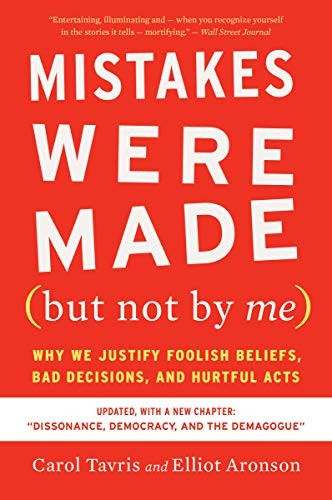
Mistakes Were Made (But Not by Me)
Why We Justify Foolish Beliefs, Bad Decisions, and Hurtful Acts
Why do intelligent, decent people defend poor decisions long after the evidence has turned against them? Carol Tavris and Elliot Aronson answer through cognitive dissonance: the discomfort produced when facts or actions collide with a favorable view of oneself. Rather than revise that self-image, people often reinterpret evidence, alter memories, blame others, or intensify their original commitment. The authors trace this machinery of self-justification from private quarrels to professional judgment, criminal investigations, political allegiance, prejudice, and international conflict. Their central warning is not merely that people deceive others, but that sincere self-deception can make error remarkably durable. At the same time, the book argues that defensiveness is not destiny. By separating wrongdoing from a total condemnation of the self, individuals and institutions can become more capable of correcting errors, making meaningful apologies, and learning before a small mistake har…
Where to buy or borrow
Are you selling this book? Bookstores, publishers, authors and libraries can be listed here for free. Request a listing
About this book
Deep Overview
That relief has consequences. People search for confirming evidence, discount criticism, remember events in self-serving ways, and describe harmful choices as necessary or benevolent. Small decisions can therefore create diverging paths. Once someone publicly commits to one side, sacrifices for it, or injures another person in its name, retreat becomes psychologically costly. Further commitment can feel easier than admitting that the original choice was mistaken. The book uses this escalation to connect everyday stubbornness with institutional failures.
The authors next explore the blind spots surrounding prejudice, conflicts of interest, and professional certainty. Good intentions do not provide immunity from bias; they may instead make bias harder to detect because the person feels morally protected. Memory creates another layer of difficulty. Recollection is not presented as a neutral recording but as a reconstructive process that can preserve a flattering account of past motives and behavior. Two people may sincerely remember the same quarrel differently because each memory has been organized around a different story of injury and innocence.
These mechanisms become especially dangerous when authority is involved. In clinical practice, a practitioner may interpret every outcome as confirmation of an initial theory. In policing and prosecution, investigators who become convinced of a suspect’s guilt may reinterpret ambiguous evidence, resist exculpatory information, and defend a conviction even after serious flaws emerge. The problem is not limited to uniquely malicious officials; systems that punish admission and reward certainty amplify ordinary defensive tendencies.
In intimate relationships and collective conflicts, reciprocal self-justification creates a loop. Each party treats its own action as a reasonable response to the other side’s provocation, while viewing the opponent’s response as proof of bad character. Grievances accumulate, empathy declines, and compromise begins to resemble surrender. The political material in the third edition extends this analysis to partisan identity, leaders, and polarized democratic life.
The final movement is practical but not simplistic. Accountability requires tolerating the discomfort of being wrong without converting a specific failure into the conclusion that one is wholly stupid or wicked. The authors favor habits and structures that make correction less humiliating: openness to disconfirming evidence, procedures that reduce conflicts of interest, and apologies that acknowledge injury rather than merely defend intention. Learning begins when preserving an innocent self-image stops being more important than understanding what happened.
Key Themes
• Commitment changes judgment: After choosing a course, especially at personal cost, people tend to reinterpret evidence in ways that validate the choice.
• Sincerity does not guarantee accuracy: Distorted memories and biased conclusions may be honestly held, which makes them more difficult to correct than deliberate lies.
• Good intentions can conceal harm: Professionals and institutions may use benevolent motives as evidence that their methods cannot be mistaken.
• Conflict sustains itself through symmetry: Opposing sides excuse their own aggression as reactive while treating the same conduct by others as revealing an aggressive nature.
• Accountability is a learnable capacity: Error correction becomes possible when people can admit a bad act or decision without experiencing it as total personal annihilation.
Historical and Intellectual Context
The work also participates in broader debates about reconstructive memory, recovered-memory claims, professional conflicts of interest, false confessions, wrongful convictions, prejudice, and the tendency of institutions to defend prior judgments. First published in 2007 and revised in later editions, it spans controversies from the late twentieth and early twenty-first centuries. The 2020 edition adds the context of intensifying American political polarization and applies dissonance theory to allegiance, democratic norms, and the appeal of demagogic leadership.
Intended Audience
Reading Difficulty
Helpful Background Knowledge
Why Read This Book?
Reader Takeaways
Strengths
Limitations and Cautions
Important Concepts, People, and Institutions
• Self-justification: The process of defending actions and beliefs in ways that preserve a favorable identity, often without conscious deceit.
• Leon Festinger: The social psychologist who formulated cognitive dissonance theory, providing the book’s principal intellectual foundation.
• Elliot Aronson: Coauthor and social psychologist whose work emphasized the connection between dissonance and threats to the self-concept.
• Carol Tavris: Coauthor and social psychologist who applies psychological research to public controversies and everyday reasoning.
• Confirmation bias: The tendency to favor evidence that supports an existing belief and discount evidence that challenges it.
• Reconstructive memory: The understanding that remembering is an active reconstruction shaped by later beliefs, emotions, and self-protective narratives.
• Conflicts of interest: Influences that can bias professional judgment even when the decision-maker sincerely believes in personal objectivity.
• Police interrogation and prosecution: Institutional settings in which early commitment to guilt can create tunnel vision, resistance to exculpatory evidence, and false confessions or wrongful convictions.
• Clinical judgment: A domain used to show how practitioners can enter a closed explanatory loop in which success confirms a method and failure is reinterpreted to protect it.
• Marriage and intimate relationships: A setting where partners can build opposing histories of provocation and innocence, causing resentment to reinforce itself.
• Political polarization: The transformation of political commitments into identity commitments, making correction, compromise, and criticism of one’s own side more difficult.
• Dissonance, Democracy, and the Demagogue: The third edition’s added political chapter, extending the argument to partisan loyalty, leadership, and democratic norms.
Questions the Book Explores
• How does a small commitment become a long-term pattern of escalation?
• Can sincere people give false accounts of their motives and memories?
• Why are experts vulnerable to conflicts of interest despite professional training?
• How can investigators and prosecutors become trapped by an early theory of guilt?
• Why do intimate partners remember the origins of a conflict so differently?
• How do groups transform aggression into righteous retaliation?
• What allows a meaningful apology to interrupt self-protection?
• Which institutional designs make it safer to acknowledge and repair error?
• How does partisan identity alter the standards people apply to leaders and evidence?
Reading Group Guide
A useful exercise is to select one institutional case and map its feedback loop: initial belief, commitment, disconfirming evidence, defensive reinterpretation, and increased commitment. Then ask what procedural intervention could have interrupted the loop. For the final chapters, compare apology, excuse, forgiveness, and accountability rather than treating them as synonyms. Groups discussing the political chapter should apply the argument symmetrically to multiple affiliations and remain alert to the temptation to use the book only as a diagnosis of opponents.
Discussion Questions
2. Is self-justification more dangerous when it is sincere than when it is consciously deceptive?
3. Which example best demonstrates the process of escalating commitment, and why?
4. How should courts and investigators account for the fallibility of memory without dismissing testimony wholesale?
5. What forms of professional oversight could reduce closed loops of judgment?
6. Why do good intentions sometimes make correction less likely rather than more likely?
7. How can two people hold incompatible memories of a relationship and both feel truthful?
8. What distinguishes an apology that repairs harm from one that merely protects reputation?
9. Does the book apply its psychological framework evenly across political groups and institutions?
10. Where might material incentives or power explain behavior better than cognitive dissonance?
11. What practices could make a family, workplace, or government more tolerant of acknowledged error?
12. Did reading the book make it easier to detect self-justification in yourself, or mainly in other people?
Sources and Verification
Comments
No published comments yet.
Available editions
Paperback
Third edition; paperback
- Publisher
- Mariner Books
- ISBN-13
- 9780358329619
- Publication date
- Pages
- 464