
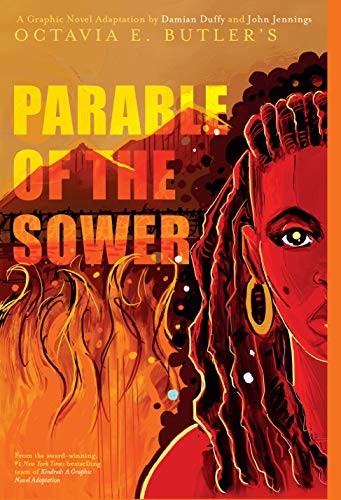
Parable of the Sower
In a near-future California destabilized by climate disruption, extreme inequality, privatization, addiction, and failing public institutions, teenager Lauren Olamina recognizes that her walled neighborhood cannot remain safe. She also lives with hyperempathy, a condition that makes her physically experience the suffering she witnesses. When violence destroys her home, Lauren travels north among displaced people, concealing her vulnerability while gathering companions and testing the principles of Earthseed, the belief system she has begun to formulate. Told chiefly through Lauren’s dated journal entries, the novel combines a dangerous migration story with an inquiry into leadership, faith, adaptation, and collective survival. Butler’s future is frightening not because it depends on a single spectacular catastrophe, but because familiar social failures intensify and reinforce one another. The result is both dystopian science fiction and a coming-of-age novel about building purpose wit…
Where to buy or borrow
Are you selling this book? Bookstores, publishers, authors and libraries can be listed here for free. Request a listing
About this book
Deep Overview
Her alternative is Earthseed, a system she records in a developing text called The Books of the Living. Its central proposition is that change governs existence and that people must learn to shape change while accepting that they are also shaped by it. This is not merely an abstract doctrine. Lauren studies local dangers, collects survival knowledge, prepares an emergency pack, learns to use weapons, and urges others to confront possibilities they would rather dismiss. Her realism creates tension with people who interpret preparation as pessimism or disloyalty.
Lauren’s hyperempathy complicates that practical outlook. She experiences the observed pain—and sometimes the pleasure—of others as bodily sensation. The condition can incapacitate her and makes violence unusually dangerous, but it also prevents suffering from remaining comfortably remote. Butler does not present empathy as automatic moral purity. Lauren must sometimes conceal it, calculate around it, or act violently despite the consequences to herself. The resulting conflict between compassion and survival runs through the journey.
After Robledo is destroyed, Lauren disguises herself as a man and heads north. She is joined first by Harry Balter and Zahra Moss, then by other travelers, including Travis Charles, Natividad Douglas, and Bankole. Their movement along California’s highways converts isolated survival into an experiment in trust. The group must decide whom to admit, what to share, when to fight, and whether Lauren’s ideas offer more than personal consolation. Race, gender, literacy, age, family responsibility, and access to money all affect how safely individuals can move through this landscape.
The novel’s endpoint is not a restoration of the lost neighborhood. Instead, Lauren and her companions attempt to establish a new community under damaged but more hopeful conditions. Planting, naming, mourning, and organizing become connected acts. Butler leaves readers with a difficult proposition: durable hope is neither confidence that matters will improve nor nostalgia for a vanished order. It is the disciplined effort to create relationships and institutions capable of surviving change.
Key Themes
**Community as practice:** Belonging is built through shared risk, negotiated rules, labor, and accountability. Butler repeatedly tests the difference between a community and a temporary alliance of frightened individuals.
**Empathy and vulnerability:** Hyperempathy literalizes the cost of witnessing another person’s pain. It asks whether sensitivity encourages ethical action, creates exploitable weakness, or does both at once.
**Religion and authorship:** Earthseed emerges through writing, revision, teaching, and lived experience. The novel examines how a belief system gains authority and what happens when its founder is also its interpreter.
**Inequality during collapse:** Disaster does not affect everyone evenly. Wealth can purchase walls, water, transport, and protection, while poverty exposes people to coercive labor, homelessness, and violence.
**Hope without reassurance:** Lauren’s hope rests on work and purpose rather than on an expectation of safety. The book challenges versions of optimism that refuse to acknowledge danger.
Historical and Literary Context
Lauren’s role as a young Black woman who becomes a religious thinker and community founder also expands a field historically associated with white male protagonists and technological conquest. The book is frequently discussed in relation to Afrofuturism, Black speculative writing, environmental literature, and feminist science fiction. Its title invokes the biblical parable in which scattered seeds meet different kinds of ground; Butler transforms that image into a question about whether an idea can take root amid displacement and social breakdown.
Intended Audience
Readers seeking escapist adventure or a reassuring recovery narrative may find it severe. The book contains sustained depictions of murder, sexual violence, enslavement, addiction, fire, family loss, and threats against children. Its emotional and physical brutality is purposeful but demanding.
Reading Difficulty
The journey section introduces a growing cast, but the first-person viewpoint provides continuity. Readers should also note that Lauren’s account is purposeful rather than neutral: she records what she considers relevant to survival and to Earthseed’s development.
Helpful Background Knowledge
Readers may also benefit from remembering that the book was published in 1993. Its future should be read as an extrapolation from late-twentieth-century conditions, not as a transcript of the actual 2020s.
Why Read It?
The novel is also distinctive in treating the creation of a religion as an intellectual and social process unfolding within the action. Readers can evaluate Earthseed not only by its aphorisms, but by the conduct it inspires and the authority it gives its founder.
Reader Takeaways
It also complicates familiar moral categories. Compassion without strategy can be dangerous, but strategy without concern for others reproduces the brutality it seeks to escape. Leadership requires foresight, yet it can become controlling. Shared belief can sustain a group, yet any new doctrine deserves scrutiny. Above all, Butler invites readers to distinguish accepting the reality of change from accepting injustice as inevitable.
Strengths
Lauren is an unusually layered narrator: observant and compassionate, but also guarded, ambitious, and capable of harsh calculation. The journal form creates urgency while allowing Earthseed to develop incrementally. Butler also excels at depicting community formation without romanticizing it. Cooperation matters, but it requires resources, rules, judgment, and continuing negotiation.
Limitations and Cautions
Some readers may also question Earthseed’s expansionist aspiration toward humanity’s future beyond Earth, especially when the characters’ immediate problems arise from damaged relationships to land, labor, and power. That tension can be read as productive, but the first volume does not settle it. The ending establishes a beginning rather than completing Lauren’s larger project; its political and personal consequences continue in Parable of the Talents.
Important Concepts, People, and Places
**Earthseed:** Lauren’s emerging belief system, organized around change as the fundamental condition of life. It provides a vocabulary for adaptation and a program for collective purpose.
**The Books of the Living:** Lauren’s developing collection of Earthseed verses. Its presence shows doctrine being composed and revised rather than received as a finished revelation.
**Hyperempathy:** Lauren’s condition of physically sharing perceived pain and pleasure. It makes empathy bodily, involuntary, and potentially disabling.
**Robledo:** The walled Southern California neighborhood where Lauren grows up. It represents both meaningful mutual protection and the limits of defensive isolation.
**Reverend Olamina:** Lauren’s Baptist father and an established leader in Robledo. His faith and practical competence influence Lauren even as she departs from his theology.
**Zahra Moss and Harry Balter:** Survivors from Robledo who become Lauren’s earliest traveling companions. Their presence forces trust to be built across differences in experience and social position.
**Taylor Franklin Bankole:** An older physician who joins the travelers and becomes important to Lauren personally and to the group’s search for a place to settle.
**Pyro:** A fictional drug associated with an intense attraction to fire. It amplifies the destructive conditions already produced by desperation and social breakdown.
**California’s northbound highways:** The central route of migration, where displaced families, workers, predators, and would-be communities occupy the same dangerous public space.
Questions the Book Explores
Can empathy remain a moral strength when other people can weaponize it?
How does a collection of private convictions become a religion, movement, or institution?
When does leadership become manipulation, and can secrecy be justified by responsibility?
Can a community pursue long-term ideals while its members remain preoccupied with immediate survival?
Does accepting change expand human agency, or risk turning preventable suffering into a law of nature?
What obligations do comparatively secure people have toward strangers during widespread displacement?
Reading Group Guide
Follow how the traveling party changes its standards for admitting newcomers and sharing information. Groups can compare Lauren’s stated principles with the decisions she makes under pressure. Pay particular attention to the Earthseed verses that open entries or sections: consider whether the narrative demonstrates, complicates, or contradicts each idea.
For a broader conversation, compare the walls of Robledo with the community formed near the end. Both promise safety, but they differ in origin, membership, and purpose. Conclude by asking whether the book’s ending represents success, a temporary refuge, or the beginning of a new set of risks.
Discussion Questions
2. How does the journal form shape what readers trust or question about Lauren?
3. Does hyperempathy make Lauren more compassionate, more cautious, or both?
4. Why do Robledo’s residents struggle to imagine the destruction of their community?
5. How do race, gender, age, money, and family status affect safety on the road?
6. What does Lauren inherit from her father even though she rejects his understanding of God?
7. Is Earthseed primarily a religion, a survival philosophy, a political project, or something else?
8. When does Lauren earn the authority to lead, and when might that authority deserve resistance?
9. What separates the traveling group from the predatory groups encountered along the way?
10. Does the destination beyond Earth strengthen Earthseed or distract from responsibilities on Earth?
11. What does the act of planting at the end suggest about grief and collective memory?
12. Where does the novel locate hope, and what does that hope demand from its characters?
Sources and Verification
Comments
No published comments yet.
Available editions
Hardcover
First edition; hardcover
- Publisher
- Four Walls Eight Windows
- ISBN-10
- 0941423999