
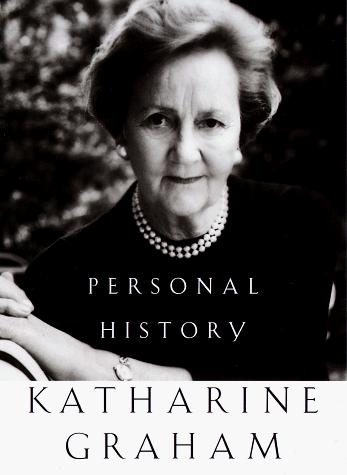
Personal History
Katharine Graham’s Personal History joins family memoir, corporate history, and an eyewitness account of twentieth-century American journalism. Graham traces her emotionally isolated childhood in a wealthy, politically connected household; her marriage to the charismatic and troubled Philip Graham; his mental illness and death by suicide; and her unexpected succession to leadership of the Washington Post Company. The professional story follows her movement from self-doubt toward authority as the Post confronted the Pentagon Papers, investigated Watergate, and endured a destructive labor conflict. Graham does not present this development as an inevitable triumph. Instead, she records hesitation, dependence, mistakes, and the slow acquisition of judgment. The result is both an autobiography of personal transformation and an insider’s examination of how ownership, editorial independence, business risk, government pressure, and workplace power converge inside a major news institution.
Where to buy or borrow
Are you selling this book? Bookstores, publishers, authors and libraries can be listed here for free. Request a listing
About this book
Deep Overview
After college and early newspaper work, she married Philip L. Graham. Their marriage becomes one of the book’s central and most painful subjects. Phil emerges as brilliant, energetic, politically connected, and instrumental in expanding the Post enterprise, yet also increasingly unstable. Graham recounts his mental illness, infidelity, hospitalization, and death by suicide without reducing either the marriage or the man to a simple cautionary tale. Her own position during these years is equally important: she had accepted assumptions that placed authority in her husband’s hands and treated her role as secondary.
Phil’s death in 1963 forced Graham into responsibility for the Washington Post Company. The transition was not a sudden conversion into a commanding executive. She describes learning corporate finance, personnel management, publishing, and public leadership while confronting men who often doubted her competence—and while sharing some of their doubts. Her development is therefore cumulative. Meetings, appointments, errors, alliances, and repeated exposure to risk gradually produce a leader capable of making consequential decisions.
The newspaper crises give the memoir its widest historical reach. Publication of the Pentagon Papers placed journalistic duty against legal danger and business vulnerability. Watergate required sustained institutional backing for reporting that challenged the Nixon administration amid uncertainty and pressure. Graham emphasizes that these achievements were collective, giving major roles to executive editor Benjamin C. Bradlee and the Post’s journalists, while also showing why ownership mattered when the organization had to absorb risk.
The later account of the 1975–1976 pressmen’s strike complicates any uncomplicated portrait of Graham as a champion of resistance to power. Here she writes as an employer facing violence, damaged equipment, production problems, and a bitter struggle with organized labor. The episode raises harder questions about the difference between defending press freedom and exercising corporate authority. Across these public events, the book’s governing movement is not from weakness to invulnerability, but from inherited dependence to practiced judgment.
Key Themes
**Gender and internalized limitation:** Sexism appears not only as exclusion by male institutions but also as a set of expectations Graham had absorbed. Her progress requires recognizing how thoroughly she had been trained to defer.
**Family, inheritance, and obligation:** Ownership of the Post gives Graham opportunity, but it also binds personal identity to a family institution. The newspaper is simultaneously inheritance, business, public trust, and source of conflict.
**Marriage, illness, and retrospective judgment:** The treatment of Philip Graham asks how one can acknowledge love, injury, illness, dependence, and responsibility without forcing them into a single moral verdict.
**Press freedom and institutional risk:** The Pentagon Papers and Watergate episodes show that independent journalism depends on reporters and editors, but also on owners prepared to withstand legal, political, and financial pressure.
**Power’s changing moral perspective:** Graham experiences labor questions from different positions over her lifetime. The shift from sympathetic observer to corporate employer exposes how principles can look different when one becomes responsible for an institution.
Historical Context
Its newspaper history is rooted in the family’s 1933 acquisition of a failing Washington Post. By the 1960s and 1970s, national newspapers were assuming a more confrontational role toward government secrecy. The 1971 Pentagon Papers dispute tested the federal government’s attempt to prevent publication of classified material about the Vietnam War. Watergate then demonstrated the potential of persistent investigative reporting to expose abuses surrounding a presidential administration.
The book also belongs to the history of women’s entry into executive authority. Graham inherited substantial privilege, but she entered a newspaper and corporate culture in which senior leadership was overwhelmingly male. Her evolving awareness of gender discrimination parallels the broader women’s movement without turning the memoir into a comprehensive history of feminism.
Finally, the pressmen’s strike reflects a newspaper economy still dependent on specialized printing trades and powerful craft unions. That industrial world differs sharply from the digitally organized media environment familiar to contemporary readers.
Intended Audience
Readers looking only for a fast Watergate narrative may find the extensive family and social history more expansive than expected. Likewise, those wanting an impersonal institutional history should know that events are organized through Graham’s perspective and her effort to understand her own life. The book rewards readers who value gradual development, complex relationships, and detailed reconstruction over a narrowly focused crisis narrative.
Reading Difficulty
The principal challenge is scale. The early family chapters, the intimate account of Philip Graham’s illness, and the later corporate crises have different rhythms and kinds of detail. Reading in stages may help preserve those distinctions. Some period language and attitudes reflect the social assumptions of the decades being described. No specialized academic training is necessary, although familiarity with mid-century U.S. politics and newspaper organization will make the later sections easier to navigate.
Helpful Background Knowledge
It also helps to distinguish newspaper ownership from newsroom management. Graham’s position gave her ultimate corporate responsibility, while editors such as Benjamin C. Bradlee directed journalistic operations. Understanding that separation—and the moments when ownership had to support editorial action—is central to the book.
Readers sensitive to discussions of bipolar illness, infidelity, psychiatric hospitalization, and suicide should be aware that these subjects occupy an important part of the narrative.
Why Read It
The memoir is also valuable because Graham resists rewriting her earlier self as secretly confident or destined to lead. Her record of dependence, hesitation, and learned competence makes the professional transformation more instructive than a conventional success story. At the same time, the book connects public courage to private history: her decisions cannot be separated from family expectations, marriage, loss, and the gradual revision of her beliefs about women’s capacities.
Readers also gain a long view of a media institution, from precarious family acquisition to national influence, rather than an account restricted to one celebrated investigation.
Reader Takeaways
The book also clarifies the institutional foundations of press freedom. Courageous reporting requires individual skill, but its survival may depend on financing, legal advice, corporate governance, production systems, and owners willing to accept consequences.
On a personal level, the memoir encourages reflection on how family roles become internal beliefs. Graham’s delayed recognition of her own authority illustrates how privilege can provide access while gendered expectations still narrow a person’s imagined possibilities.
Finally, the labor conflict warns readers against treating power as a fixed moral identity. A person can be vulnerable in one structure and powerful in another; ethical self-examination must continue after authority has been gained.
Strengths
Its reconstruction is unusually well supported for autobiography. Graham drew on correspondence, company records, interviews, and editorial assistance rather than relying exclusively on memory. This gives many episodes documentary density while preserving a personal voice.
Graham is also notably willing to portray herself as uncertain, socially privileged, occasionally mistaken, and slow to understand structural sexism. That self-scrutiny prevents the leadership story from becoming effortless legend.
The book gives ownership a visible place in journalism history without erasing the contributions of editors and reporters. Its accounts of the Pentagon Papers, Watergate, and the pressmen’s strike reveal different forms of institutional risk and prevent the professional section from resting on a single heroic episode.
Limitations
The memoir’s large cast and social detail can slow the narrative, particularly for readers primarily interested in the landmark journalism cases. Its candor does not eliminate the limits of retrospective interpretation: Graham is reconstructing relationships and decisions after decades of experience and public recognition.
The labor chapters are especially likely to invite competing readings. Graham explains the company’s predicament forcefully, but readers seeking the workers’ full perspective will need additional histories or firsthand accounts.
Because the book appeared before the collapse of the traditional newspaper business model and the rise of digital platforms, it cannot address the economic and technological pressures that now shape press independence.
Important Concepts and People
**Eugene Meyer:** Graham’s father, a financier and former public official who purchased the Washington Post in 1933. His stewardship established the family institution Graham later inherited.
**Agnes Ernst Meyer:** Graham’s mother, a writer, activist, and prominent social figure. Their difficult relationship helps explain Graham’s childhood insecurity and hunger for approval.
**Philip L. Graham:** Katharine Graham’s husband and an influential Post executive and publisher. His abilities, political relationships, mental illness, and death profoundly shaped both her private life and corporate succession.
**The Washington Post and Washington Post Company:** The newspaper and its corporate parent function as workplace, inheritance, public institution, and business. Their development links the family narrative to national events.
**Benjamin C. Bradlee:** The Post’s executive editor during the Pentagon Papers and Watergate era. His editorial partnership with Graham illustrates the relationship between newsroom independence and ownership support.
**The Pentagon Papers:** A classified history of U.S. involvement in Vietnam. The decision to publish material from it placed the Post under legal and financial pressure and became a defining test of Graham’s leadership.
**Watergate:** The political scandal arising from the 1972 break-in and subsequent cover-up. The Post’s reporting made the episode central to the newspaper’s national reputation and to debates over investigative journalism.
**Richard Nixon:** The president whose administration fought publication of the Pentagon Papers and later became the subject of sustained Watergate scrutiny.
**The pressmen’s strike of 1975–1976:** A violent and consequential labor dispute at the Post. In the memoir it tests Graham as an employer and complicates the book’s treatment of institutional power.
**Editorial independence:** The principle that news judgments should not simply serve political or ownership interests. Graham’s experience shows that preserving this independence may still require active protection from owners.
**Internalized sexism:** The absorbed belief that men are naturally better suited to authority. Graham presents overcoming this belief as a slow process, not merely a response to overt discrimination.
Questions Explored
What obligations accompany ownership of a news organization whose work serves a public function?
When should a publisher accept legal, political, or financial danger to protect editorial independence?
How do love and loyalty shape a retrospective account of a spouse’s mental illness and harmful behavior?
Can an autobiography acknowledge immense privilege while still describing genuine forms of exclusion and self-doubt?
How does a leader’s moral perspective change when she moves from employee or observer to employer?
What parts of a celebrated journalistic achievement belong to reporters, editors, owners, lawyers, and the institution as a whole?
How reliably can letters, interviews, company records, and memory reconstruct a life?
Reading Group Guide
Compare the Pentagon Papers, Watergate, and the pressmen’s strike as three institutional tests. In each case, identify who faced risk, who controlled the decision, what values were invoked, and how Graham understood her responsibility.
Pay attention to moments when Graham judges her younger self. Consider when this retrospective perspective creates insight and when it may simplify what she could have known at the time.
Discuss the division of credit between Graham and Benjamin C. Bradlee. What does their partnership suggest about the proper boundaries between publisher and editor?
For a broader conversation, pair the memoir with an account by a reporter, labor participant, historian, or legal scholar. The contrast can illuminate how position within an institution changes the meaning of the same event.
Discussion Questions
2. How does the book distinguish material privilege from emotional security or social authority?
3. Does Graham’s candor about self-doubt increase your trust in her account? Why or why not?
4. How does she balance compassion for Philip Graham with acknowledgment of the damage caused by his behavior?
5. What did the Post’s owners risk by publishing the Pentagon Papers, and how should those risks be weighed against the public interest?
6. How does the Watergate narrative alter when viewed from the publisher’s office rather than the reporter’s desk?
7. What tensions emerge between Graham’s experience of sexism and her exercise of power as an employer?
8. How should readers evaluate her account of the pressmen’s strike when most of the narrative comes from management’s side?
9. What does the memoir suggest about the relationship between confidence and competence?
10. Which aspects of Graham’s model of newspaper stewardship remain relevant in a digital media economy, and which belong to a vanished institutional world?
11. How does the use of letters, interviews, and company records affect the book’s authority as autobiography?
12. Is the title Personal History more descriptive of a private life, a national history seen personally, or both?
Sources and Verification
Comments
No published comments yet.
Available editions
Hardcover
First U.S. edition, hardcover
- Publisher
- Alfred A. Knopf
- ISBN-13
- 9780394585857