
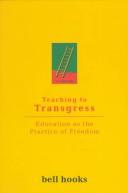
Teaching to Transgress
Education as the Practice of Freedom
In this collection of essays, bell hooks presents education as a potentially liberating practice rather than the one-way transmission of approved knowledge. Drawing on her experiences as a Black student, feminist theorist, and university teacher, she examines how race, gender, class, language, authority, and emotion shape classroom life. Her alternative, “engaged pedagogy,” asks teachers and students to participate actively in learning, connect ideas with lived experience, and recognize that education is never detached from power. hooks develops her position through encounters with critical pedagogy, Black intellectual traditions, feminism, multicultural education, and engaged Buddhism. She also confronts practical tensions: who gets to speak, how authority should operate, whether experience counts as knowledge, and how teachers can invite participation without denying conflict. The result is both an argument about educational freedom and a candid account of how difficult such freedom…
Where to buy or borrow
Are you selling this book? Bookstores, publishers, authors and libraries can be listed here for free. Request a listing
About this book
Deep Overview
Her answer is “engaged pedagogy,” an approach that treats learning as the shared work of becoming more critically aware and more fully human. It challenges the model of the professor as an unquestionable authority who delivers knowledge to passive recipients. Yet hooks does not argue that teachers and students occupy identical positions. Teachers retain responsibilities created by their institutional authority. The task is to use that authority in ways that encourage participation, critical inquiry, and intellectual risk instead of reproducing domination.
Paulo Freire is central to this project. His account of liberatory education gave hooks a language for understanding how conventional classrooms can preserve oppressive social arrangements. She adopts his emphasis on dialogue, critical consciousness, and praxis—the joining of reflection with action—while criticizing the sexism and male-centered assumptions that can remain within revolutionary traditions. Thich Nhat Hanh’s engaged Buddhism supplies another important strand: an insistence on wholeness and on connecting intellectual work with the well-being of embodied persons. Together, these influences help hooks reject the academy’s tendency to separate mind from body, reason from emotion, and professional identity from personal life.
The middle chapters test liberatory ideals against questions of difference. Multicultural change cannot, in hooks’s view, be accomplished merely by adding diverse texts to an unchanged classroom. Teachers must reconsider whose knowledge carries authority, how disagreement is handled, and why some voices are heard as universal while others are reduced to personal testimony. She values experience as a source of insight, especially where established scholarship has ignored marginalized lives, but she also warns against essentialism—the assumption that identity automatically grants a single, unquestionable viewpoint.
Later essays widen the inquiry to feminist solidarity, the position of Black scholars, vernacular language, and class differences often obscured in academic spaces. A dialogue with philosopher Ron Scapp models conversation as a form of inquiry. Discussions of eros and pleasure challenge the belief that serious learning must be emotionally sterile. Across these subjects, hooks presents the classroom as a contested social space: capable of reproducing racism, sexism, and class hierarchy, but also capable of becoming a community where people practice speaking, listening, revising, and acting with greater freedom.
Key Themes
**Engaged pedagogy:** Teachers and students should participate as whole persons. Intellectual rigor is strengthened—not weakened—when education acknowledges embodiment, emotion, experience, and mutual responsibility.
**Power in the classroom:** Authority does not disappear simply because a teacher favors dialogue. hooks asks educators to examine how grading, speech, curriculum, and professional status distribute power.
**Race, gender, and class:** Classroom relations are shaped by social hierarchies brought into the room by institutions and participants. Inclusive content without transformed practice is insufficient.
**Voice, silence, and language:** Who speaks, in which language, and with what presumed credibility are political as well as pedagogical questions. hooks gives particular attention to marginalized voices and Black vernacular expression.
**Theory and practice:** Theory matters when it helps people name suffering, understand structures, and imagine action. Detached theory can become another form of exclusion.
**Community and conflict:** A democratic classroom is not necessarily harmonious. It must make room for disagreement while resisting humiliation and domination.
**Pleasure, care, and eros:** Desire for knowledge, excitement, and caring relationships belong within education, though they require ethical attention to unequal power.
Historical Context
Her memories also reach back to the transition from legally segregated schooling to desegregated institutions in the American South. That history complicates any simple story of educational progress: integration was necessary, yet Black students could enter schools where their intellectual lives were neither centered nor nurtured in the same way.
Intellectually, the book participates in critical pedagogy, particularly the tradition associated with Brazilian educator Paulo Freire. It also draws on Black feminist thought, feminist pedagogy, antiracist cultural criticism, and Thich Nhat Hanh’s engaged Buddhism. Published in 1994, it predates much of today’s terminology surrounding inclusive and culturally responsive teaching, but it addresses many of the underlying concerns: representation, belonging, institutional power, embodied learning, and the relationship between education and democracy.
Intended Audience
Readers seeking a conventional methods handbook, detailed lesson plans, or research-based comparisons of specific instructional techniques may find it less directly practical. The book works best for those willing to examine teaching as a political, relational, and personal practice rather than as a neutral set of classroom procedures.
Reading Difficulty
The main challenge is conceptual rather than stylistic. hooks often holds several tensions open at once: experience can produce knowledge but does not make a claim infallible; teachers should reduce domination but cannot pretend that institutional power has vanished; discomfort can support growth but can also silence vulnerable participants. Readers may need to distinguish these nuanced positions from simpler slogans about student-centered learning.
Background Knowledge
Readers may wish to know that hooks uses personal experience as evidence alongside theoretical argument. Approaching the book with questions about one’s own classroom history—who spoke, who was treated as authoritative, and which forms of language were rewarded—can make its analysis more concrete.
Why Read This Book?
The book is also valuable because it brings traditions into productive tension. hooks learns from Freire without exempting him from feminist criticism, welcomes personal experience without declaring it beyond challenge, and advocates community without equating community with comfort. Readers interested in equity will find more than an argument for representative reading lists; they will encounter a challenge to reconsider the relationships and habits through which knowledge is produced.
Reader Takeaways
Readers may reconsider the roles of emotion, pleasure, bodily presence, and personal experience in serious learning. They may also become more cautious about easy versions of participation: inviting students to speak does not ensure that all speech carries equal risk or receives equal respect. Above all, the book frames freedom as a continuing practice requiring reflection, dialogue, accountability, and institutional awareness—not a condition achieved by adopting the correct vocabulary.
Strengths
Its essay structure allows individual chapters to stand alone while building a coherent philosophy of teaching. The writing also models intellectual engagement across disagreement: hooks can acknowledge a thinker’s formative influence while identifying serious limitations in that thinker’s work. Finally, the book refuses the false choice between rigor and care. It argues that intellectual seriousness can coexist with excitement, vulnerability, and concern for students’ whole lives.
Limitations and Considerations
The examples are concentrated in U.S. higher education, especially discussion-oriented humanities classrooms. Applying the approach to primary schools, large lectures, laboratory courses, online instruction, or highly regulated curricula requires adaptation. Some discussions are also anchored in the institutional and political debates of the early 1990s.
The vision of open dialogue can be difficult to enact where students face unequal exposure, confidence, or consequences for speaking. hooks recognizes conflict and power, but the book does not supply a complete procedural framework for every dilemma involving assessment, privacy, accessibility, trauma, or professional boundaries. Its treatment of eros is particularly likely to require careful contextual and ethical discussion.
Important Concepts and People
**Engaged pedagogy:** hooks’s central educational framework. It asks teachers and students to participate actively and treats intellectual development as connected with embodied, emotional, and ethical life.
**Education as the practice of freedom:** A conception of learning that builds critical awareness and the capacity to resist domination, rather than merely training students to accommodate existing arrangements.
**Paulo Freire:** The Brazilian educator whose critical pedagogy profoundly informs hooks’s thinking. She embraces his liberatory approach while challenging sexist language and assumptions within his work and its reception.
**Thich Nhat Hanh:** The Vietnamese Buddhist teacher whose engaged Buddhism helps hooks formulate an education concerned with wholeness, practice, and well-being as well as intellectual critique.
**Praxis:** The relationship between reflection and action. Theory becomes liberatory when it helps people interpret experience and intervene in the world.
**Critical consciousness:** Awareness of how social and institutional power shapes what appears natural, neutral, or inevitable.
**Essentialism:** The reduction of a group to a single authentic identity or perspective. hooks considers both the importance of marginalized experience and the danger of treating identity as unquestionable authority.
**Ron Scapp:** A philosopher and educator who joins hooks in the book’s extended dialogue about building a teaching community, demonstrating conversation as an intellectual form.
**Black vernacular:** A form of language whose classroom treatment reveals conflicts over cultural authority, assimilation, expression, and the political force of speech.
**Eros in pedagogy:** The enlivening force of desire, passion, and connection in learning—not a license to disregard professional boundaries, but a challenge to the fantasy of disembodied education.
Questions the Book Explores
How can teachers exercise necessary authority without reproducing domination?
What must change beyond the syllabus for a classroom to become genuinely multicultural?
When does lived experience deepen knowledge, and when can appeals to experience close down inquiry?
How do race, gender, class, and language determine who feels entitled—or safe enough—to speak?
Can teachers care for students as whole people while maintaining ethical responsibility within unequal institutional relationships?
What is lost when academic culture separates intellect from body, emotion, pleasure, and spiritual well-being?
How can a learning community sustain disagreement without turning difference into spectacle or coercing disclosure?
Reading Group Guide
Compare the chapters on Freire, experience, and multiculturalism. Notice where hooks accepts a framework, revises it, or exposes tensions within it. A group of educators might select one familiar classroom routine and analyze how authority moves through it. A mixed group of teachers and students can compare the risks attached to speaking from each position without assuming those risks are equivalent.
Give special attention to the essays on class, vernacular language, and eros, which may unsettle otherwise comfortable accounts of inclusion. Establish discussion norms that permit disagreement without requiring anyone to disclose personal experiences. Conclude by distinguishing changes an individual teacher can make from reforms that depend on departments, institutions, funding, or policy.
Discussion Questions
2. Which forms of teacher authority does the book challenge, and which responsibilities does it preserve?
3. How does hooks’s Black feminist perspective change the critical pedagogy she inherits from Paulo Freire?
4. What does lived experience contribute to knowledge, and what limits should be placed on its authority?
5. Can every student be expected to speak in a liberatory classroom? What alternatives might meaningful participation include?
6. How do language standards operate as both educational tools and instruments of social power?
7. What would a genuinely multicultural classroom require beyond diversifying assigned authors?
8. How should educators distinguish productive discomfort from avoidable harm or coercion?
9. What does hooks gain by bringing embodiment, care, pleasure, and eros into an account of education?
10. Which parts of the book are most tied to 1990s U.S. higher education, and which remain broadly applicable?
11. Where does the book place responsibility for change: individual teachers, students, communities, or institutions?
12. What would “transgression” mean in a classroom you know, and who would bear its risks?
Sources and Verification
Comments
No published comments yet.
Available editions
Paperback
1st edition, paperback
- Publisher
- Routledge
- ISBN-13
- 9780415908085
- Publication date