
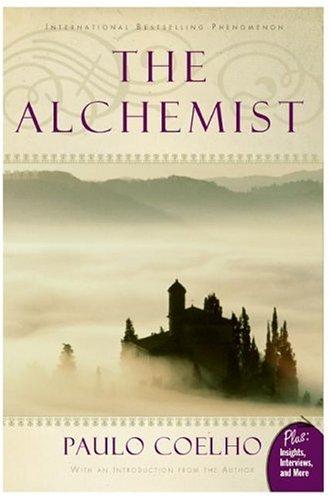
The Alchemist
First published in Portuguese in 1988 and brought to English readers in 1993, The Alchemist is Paulo Coelho's short fable about Santiago, a young Andalusian shepherd who leaves a settled life to follow a recurring dream of treasure near the Egyptian pyramids. Along the way he meets people who test his resolve, and he learns to read omens, absorb setbacks, and tell a true calling from comfortable routine. Its central idea, that each person has a Personal Legend worth pursuing, helped make it one of the most widely circulated novels of recent decades and a frequent pick among spiritual books. Because it reaches English through Alan R. Clarke's translation, it is also a landmark of translated fiction. This profile covers the 2006 HarperCollins paperback and adds context, themes, cautions, and discussion starting points.
Where to buy or borrow
Are you selling this book? Bookstores, publishers, authors and libraries can be listed here for free. Request a listing
About this book
Deep Overview
The journey does not run smoothly. Almost at once he is robbed in Tangier, and his ambition collapses into a practical problem of earning enough to continue. He takes work with a crystal merchant. That job teaches him about commerce and also about a man who knows his dream, the pilgrimage to Mecca, and chooses never to attempt it. Later Santiago joins a caravan crossing the desert and meets an Englishman who has been reading about alchemy and hopes to find a master of the art. At an oasis Santiago falls in love with Fatima, a woman of the desert. There he must decide whether love and a settled future are a reward for his journey or a different kind of detour. The title figure, the alchemist, finally appears and guides him through the last stage.
Structurally the book works as a chain of tests. Each encounter gives Santiago a lesson that the next one complicates. Early on, a dream seems to be enough. The merchant shows that daily comfort can quietly replace a goal. The desert shows that fear is as big an obstacle as poverty. The story keeps returning to omens, which Santiago learns to notice, and to the Soul of the World, a unifying spiritual presence in which all things take part. Alchemy is the governing metaphor. It is less a chemical practice here than an image of transformation, in which patient effort changes the person doing the work as much as the material.
What Coelho appears to be demonstrating is that purpose is something a person has to act on. It does not arrive as an abstract idea. The book also suggests that the journey matters as much as the destination. Santiago's wisdom comes from the people he meets, the work he does and the mistakes he makes, not from a single revelation. The ending turns on an irony about where treasure may actually be found, which is best left for readers to meet unspoiled.
The book's own history echoes its message. Coelho has said he wrote it very quickly. The first Brazilian publisher printed a small run and chose not to reprint, and he later found a larger house and persevered. The English edition then spread through word of mouth into an international success. That history has become part of the book's mystique, and readers can weigh it against the story's themes of persistence and trust.
Key Themes
Omens and intuition form a second strand. Santiago advances by interpreting signs in his surroundings and in chance encounters. The novel asks readers to take that attentiveness seriously. Whether the universe really responds to desire is a separate and debatable question.
The tension between the journey and the destination runs through the plot. Comfort, love and security repeatedly offer Santiago a reason to stop, and the book asks which of them are rewards and which are traps.
Transformation through effort connects the alchemy motif to the human story. Learning a craft, whether herding, trading or reading the desert, is shown as a way of learning about oneself and about a larger order of things.
A more unusual theme is the shared language of the world. Santiago finds that people of different trades and faiths understand something universal. The crystal merchant, the Englishman and the desert people each express it in their own terms.
Historical Context
The English translation by Alan R. Clarke appeared from HarperCollins in the early 1990s, with 1993 usually given as the English-language date. Paperback editions followed through the 1990s and 2000s. The book became known well beyond Brazil. It has been widely reported as the most translated book by a living author, a Guinness World Record, although sources give different years for the record and very different sales totals, ranging from tens of millions to more than 150 million copies.
Intellectually the novel draws on several traditions: Western esoteric alchemy, Mediterranean and Islamic settings, and Sufi-influenced ideas, which Coelho has acknowledged. It also belongs to the long line of quest narratives and wisdom fables. Many readers compare it with the work of other writers of parables, and its mix of spirituality and popular storytelling has helped make it central to debates about popular spiritual literature.
Intended Audience
Teachers and discussion leaders can use it because the language is simple and the ideas invite debate. Readers who want realistic psychology, complex characters, social detail or sustained irony may find it less satisfying. So may readers who distrust optimistic spiritual ideas. Those who prefer nuanced historical or political treatments of North Africa and the Mediterranean should treat the setting as symbolic, not documentary.
Reading Difficulty
The challenge is interpretive. Statements about destiny, the universe and the Soul of the World are presented as truths, and readers must decide how far to accept them. Some references, such as alchemy, the Urim and Thummim, and the crystal merchant's religious obligations, are explained in the text but gain from a little outside knowledge. As translated fiction it reads smoothly in English, but the voice belongs partly to the translator, Alan R. Clarke. No prior knowledge of Brazilian literature is needed.
Helpful Background Knowledge
It also helps to know that the story moves through Andalusia in Spain, Tangier in Morocco and the Egyptian desert, and to know a little about Islamic practices such as pilgrimage to Mecca, which features in the crystal merchant's story. Familiarity with parables and quest stories from many traditions makes the structure easier to see. Readers curious about the author could look at his earlier pilgrimage memoir, The Pilgrimage, and at his comments on Sufi influence, but neither is required.
Why Read This Book?
It is also unusually useful for comparison. You can read it alongside more complex fiction about journeys and vocation, or alongside philosophical and religious texts that treat similar ideas more critically. The book gives you a clear, simple version of a popular belief about purpose, and the clarity makes it easy to examine. Readers who enjoy being persuaded and readers who enjoy pushing back can both get something from it.
Reader Takeaways
Readers may reconsider whether comfort and security are the opposites of purpose or can coexist with it. They may notice how the book handles luck, effort and coincidence, and where it leaves room for doubt. They may also come to see why simple symbolic storytelling can be both appealing and limiting, and what a reader gains or loses when a story offers answers so directly.
Strengths
Its structure is economical. Obstacles escalate sensibly, and the crystal merchant episode in particular gives the story a moment of realism and ambivalence about what dreams cost.
Its breadth of appeal is considerable. It crosses age groups and cultures, and it gives teachers and groups a shared reference point. The alchemy metaphor is also used consistently, linking the narrative to its central idea.
Limitations and Cautions
Characters are symbolic, and women in particular have limited roles. The Fatima episode in the middle of the book has drawn discussion from readers who find it conventional. The settings in North Africa and the Middle East are more symbolic than documentary, so the book should not be used as a guide to those places.
The prose is plain and some readers find it repetitive. Because the book is a translation, nuances of the Portuguese original may not carry across. Sales figures and awards quoted in promotional material vary between sources and should be treated cautiously.
Important Concepts, People, and Places
Personal Legend: the book's term for a person's true purpose, which drives Santiago's decision to travel.
Melchizedek, King of Salem: the old man who first names the idea of the Personal Legend and sends Santiago on his way.
The alchemist: the guide Santiago meets late in the journey, who embodies mastery and patient transformation.
The crystal merchant: Santiago's employer in Tangier, whose unfulfilled dream of pilgrimage serves as a warning.
Fatima: the woman Santiago meets at the oasis, who represents love and the temptation to stop.
The Englishman: a traveller who studies alchemy through books, in contrast to Santiago's learning by experience.
The Soul of the World: the unifying spiritual presence that, in the book's view, links all things and responds to purposeful effort.
Omens: the signs Santiago learns to read as guidance.
Andalusia, Tangier and the Egyptian pyramids: the starting point, the first obstacle and the destination of the journey.
Paulo Coelho and Alan R. Clarke: the Brazilian author and the English translator, whose version is the one profiled here.
Editora Rocco: the small Brazilian publisher that issued the Portuguese original in 1988.
Questions the Book Explores
It raises questions about signs and coincidence: how far a person can trust intuition, and when attention to omens becomes wishful thinking. It also asks whether the journey or the arrival matters more, and whether love and security help a purpose or compete with it.
Finally, it raises a broader question about whether different religions and trades share a common language, and what it would mean for the world to respond to individual desire.
Reading Group Guide
A useful structure is to take the journey in stages, from Andalusia to Tangier, the caravan and oasis, and the final stretch, and to assign one episode to each pair or small group. Ask each to explain what Santiago learns and whether the lesson holds up. Groups may enjoy comparing the book with another quest or wisdom story, or with a more sceptical treatment of vocation. Because it is a translation, someone may like to look at how another English or foreign-language edition handles key passages. Agree beforehand to separate the book's literary qualities from agreement with its beliefs, so that readers on both sides can talk openly.
Discussion Questions
2. Why do you think the crystal merchant episode is placed where it is in the journey?
3. How does the book treat luck, effort and coincidence, and where do you think it asks readers to accept more than they can verify?
4. Is Santiago's choice at the oasis a loss, a test or something else? What does it say about the relationship between love and purpose?
5. How does the contrast between the Englishman and Santiago shape the book's view of knowledge?
6. How does the book's simple style affect your response to its ideas?
7. What might readers whose circumstances limit their choices say about the book's message?
8. How might reading it in translation change your understanding of the voice and tone?
9. What does the book's own publication history add to or take from its message?
10. Where would you place this book next to other stories of journeys and vocation you have read?
Sources and Verification
Sources disagree on the exact 2006 publication date, the page count, the imprint name and the total copies sold, so those details are left out or described as estimates. The plot summary is based on the book itself and may differ slightly in emphasis from other descriptions. All descriptive prose is original.
Comments
No published comments yet.
Available editions
Paperback
- Publisher
- HarperCollins
- ISBN-13
- 9780061122415