
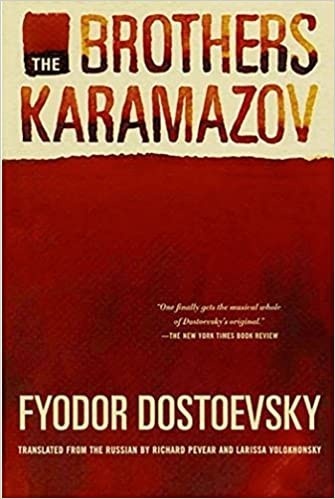
The Brothers Karamazov
A Novel in Four Parts with Epilogue
Dostoevsky's final novel starts as a family quarrel over money and a woman. It grows into one of the most searching inquiries in Russian literature into faith, guilt and freedom. The cruel, buffoonish landowner Fyodor Pavlovich Karamazov has three legitimate sons: passionate Dmitri, intellectual Ivan and gentle, monastery-trained Alyosha. A servant, Smerdyakov, is rumored to be a fourth, illegitimate son. When the father is killed, an investigation and a public trial force each character to face what he believes and what he is capable of. This Farrar, Straus and Giroux paperback uses the Richard Pevear and Larissa Volokhonsky translation. It is a widely used modern English version for readers who want classic novels to read in a current idiom.
Where to buy or borrow
Are you selling this book? Bookstores, publishers, authors and libraries can be listed here for free. Request a listing
About this book
The novel is organized as four parts and an epilogue, a format that this edition's subtitle preserves. A narrator who presents himself as a local chronicler tells the story. The narrator's gossipy, sometimes unreliable voice mixes comedy with metaphysical argument. Dostoevsky's method is dramatic. Ideas are voiced by characters who live inside them, so no single viewpoint is simply the author's own. That polyphonic quality is a large part of why the book has been such a lasting point of reference in world literature.
This edition presents the translation by Richard Pevear and Larissa Volokhonsky, whose version of the novel is listed among the major English translations alongside Constance Garnett's 1912 version. The publisher notes that it won the PEN/Book-of-the-Month Club Translation Prize. Because the novel raises so many questions about belief, responsibility and family, it also supplies plenty of material for book discussion questions.
Deep Overview
The book's first movement gathers these figures and lets their conflicts build. A family meeting held at the monastery, meant to settle the quarrel, becomes a public scandal instead. The tension then moves into two famous set pieces. In 'Rebellion' and 'The Grand Inquisitor,' Ivan tells Alyosha why he cannot accept a world that permits the suffering of children, and then offers a story set in Seville. In it a Christ who has returned is confronted by a church leader who says humanity cannot bear the freedom Christ offers. The next book, 'The Russian Monk,' answers Ivan less with argument than with the life and teaching of Zosima, who stresses humility, active love and each person's responsibility for everyone else. Dostoevsky does not let either side win cleanly. He gives each argument its full force and lets the story absorb both.
The central crime then changes the book's pace. Fyodor Pavlovich is killed, suspicion falls on Dmitri, and the story becomes an investigation followed by a trial. The legal process is not only plot. It tests how far appearances, testimony and the new professional style of advocacy can reach into the truth of a person's guilt. Smerdyakov, the household servant, and Ivan's own earlier words about moral permission become entangled with the question of who is responsible. The novel suggests that guilt can be legal, moral and spiritual all at once. A person may be innocent of a deed and still be implicated by the wishes and arguments that preceded it.
Around the main plot, Dostoevsky builds secondary stories that widen the moral picture. Alyosha's relationship with a group of schoolboys, especially the sick boy Ilyusha, shows love working at a small scale. Katerina Ivanovna's proud, tangled engagement to Dmitri shows how humiliation and generosity can poison each other. The novel does not resolve its questions in a single decisive scene. It ends by setting a quiet, communal gesture beside the unresolved legal and philosophical drama. The result is a book whose force depends less on a surprise than on how thoroughly each possible response to suffering, freedom and faith has been explored.
Key Themes
Freedom and authority: The Grand Inquisitor episode asks whether most people want freedom or would exchange it for security, bread and certainty. It makes this question a political and religious problem at once.
Moral responsibility: Several characters repeat the idea that each person bears some responsibility for all. The plot repeatedly tests whether thought, desire and complicity count alongside action.
The suffering of the innocent: Ivan's catalogue of cruelty to children is one of the book's most forceful challenges to any claim that the world is ordered by a good God.
Fathers, sons and inheritance: The family drama carries wider questions about what one generation owes another, and what a society inherits from its failures of care.
Passion, shame and pride: Dmitri, Grushenka and Katerina Ivanovna show how wounded dignity can distort love and judgment.
Justice and truth: The trial raises the question of whether a legal process can find the truth about a person, or only a version that fits the evidence.
Historical Context
The book was first published as a serial in the periodical The Russian Messenger. That affected its construction, since installments had to hold readers' interest from month to month while the larger design developed. Reference sources identify it as Dostoevsky's last novel. He died a few months after its serialization ended. A source on the novel also notes that the death of Dostoevsky's young son Alyosha in 1878 is often connected with the book's treatment of children and loss, though readers should treat biographical links as interpretation. Dostoevsky's own earlier years, including imprisonment and exile, are widely credited with shaping his interest in suffering and moral transformation.
The book reached English-language readers in 1912 through Constance Garnett's translation. Several later translators followed, including the Pevear and Volokhonsky version of 1990 that this edition presents. Readers should remember that every English version is an interpretation of Dostoevsky's idiosyncratic Russian.
Intended Audience
It may be less suitable for readers who want fast, streamlined storytelling or who are impatient with long speeches and digressions. Some will be put off by the amount of religious debate. Others may find the many shifts of mood, from farce to confession to courtroom drama, demanding. Readers new to long Russian novels can still manage it with patience, especially with a character list close at hand.
Reading Difficulty
Russian naming conventions can cause early confusion. Characters appear under full names, patronymics, diminutives and nicknames. For example, Alexei Fyodorovich Karamazov is also Alyosha, and Dmitri is also Mitya. Keeping a short list of names helps. The print edition is a paperback, and readers who dislike heavy volumes may prefer to split the reading by parts. The novel's four-part structure makes natural stopping points. No prior philosophy is required, though some familiarity with Christian ideas makes the debates easier to follow.
Helpful Background Knowledge
Readers sometimes find it useful to learn about Dostoevsky's earlier novels, such as Crime and Punishment, which also treats guilt and moral reasoning, though that is not necessary. A simple family tree and a guide to Russian name forms are the most practical preparation. Those who want to avoid spoilers should skip study guides until after finishing, since many summaries disclose the outcome of the murder case.
Why Read This Book?
This particular edition offers a modern translation, noted for being close to the texture of Dostoevsky's Russian, in an affordable single volume. The novel is also unusually varied in tone. It can be funny, cruel, tender and suspenseful in the space of a few chapters, which sustains interest across its length. If you have wondered why people return to this book across a lifetime, the answer is that it keeps raising questions that readers of different ages answer differently.
Reader Takeaways
You may reconsider the difference between legal guilt and moral complicity, and the way a community can judge by appearance. You may notice how Dostoevsky distinguishes love of humanity in the abstract from patient love for particular people, which the book treats as harder and more valuable.
You may also leave with a better sense of how structure affects meaning: how a comic opening can lead to a trial, how a legend told inside a conversation can steer the whole novel, and how the epilogue turns attention from verdict to the living.
Strengths
Its treatment of belief and doubt is balanced in the sense that each side gets memorable, serious expression. The Grand Inquisitor and Zosima's teachings remain widely studied as separate texts and also work inside the novel's drama.
The structure supports re-reading. Early scenes gain meaning once the later developments are known. This edition's translation is also generally regarded as attentive to Dostoevsky's repetitions, abruptness and shifts of register, and it has been recognized with a translation prize.
Limitations and Cautions
Some of the characterizations, including those of women, ethnic groups and other social types, reflect the period and may strike modern readers as stereotyped or uncomfortable. The novel is also unfinished in one sense: Dostoevsky is known to have planned further adventures for Alyosha, which he did not live to write, so the book's final shape is not the full design he had in mind. Finally, this edition is a translation, and English renderings differ in tone and detail. A reader's impression of the style may depend on which version they choose.
Important Concepts, People, and Places
Dmitri Karamazov (Mitya): The eldest son, a passionate, impulsive man whose quarrels with his father over money and Grushenka make him the chief suspect.
Ivan Karamazov: The intellectual middle son, author of the 'Rebellion' argument and the 'Grand Inquisitor' story, who embodies rational skepticism and its moral consequences.
Alexei (Alyosha) Karamazov: The youngest son, a novice who links the family, the monastery and the schoolboys, and whom the narrator calls the hero of the book.
Pavel Smerdyakov: The household servant, rumored to be Fyodor Pavlovich's illegitimate son, whose resentments and relationship to Ivan matter greatly to the crime.
Elder Zosima: Alyosha's spiritual teacher, whose teaching on humility and universal responsibility offers the book's central religious counterweight to Ivan.
Grushenka and Katerina Ivanovna: The two women in Dmitri's life, whose pride, jealousy and generosity shape the love plot and the trial.
The Grand Inquisitor: Ivan's story of a church leader who confronts a returned Christ, used to examine freedom, authority and human weakness.
Starets: The Orthodox tradition of the spiritual elder, represented by Zosima.
The Russian Messenger: The periodical in which the novel was serialized from 1879 to 1880.
The provincial town and the Orthodox monastery: The two main settings, which place worldly scandal beside spiritual discipline.
Richard Pevear and Larissa Volokhonsky: The translators of this edition, whose version has been widely used in English.
Questions the Book Explores
Would most people choose freedom if it came with uncertainty and moral burden, or prefer to be guided? What does it mean to be responsible for acts you did not commit but wished for, argued for or failed to prevent?
Can a trial, with its witnesses, speeches and verdicts, uncover the truth about a person? How do pride, shame and wounded honor distort love? And can small acts of kindness answer large philosophical objections, or do they only sidestep them?
Reading Group Guide
Open with first impressions of the Karamazov family and the narrator's voice. Before the middle sessions, ask everyone to reread the 'Rebellion' and 'Grand Inquisitor' chapters and Zosima's teachings. Comparing them side by side often produces the liveliest conversation. Before the trial sessions, ask readers to keep their own view on the central question privately and revisit it afterward.
A short shared list of names and nicknames helps, as does agreeing in advance how to handle spoilers. If members are reading different translations, encourage them to bring a favorite passage and compare its tone. Some groups also find it useful to assign roles, with one member arguing for Ivan, another for Zosima and another for Dmitri.
Discussion Questions
2. Why might Dostoevsky have made the family so deeply dysfunctional before turning to philosophical questions? What does the domestic setting add?
3. Is Ivan's rebellion persuasive on its own terms? What, if anything, in the novel answers it?
4. How does the Grand Inquisitor's view of freedom compare with Zosima's? Which seems closer to your own experience?
5. In what ways are Dmitri, Ivan and Alyosha each shaped by their father's absence or neglect?
6. How does the novel distinguish legal guilt from moral guilt? Where do the two overlap?
7. What role do the women characters play in driving the story, and how are they portrayed?
8. How do the scenes with the schoolboys change the way you read the larger arguments?
9. What do the humor and the grotesque contribute to a book about serious questions?
10. How does the epilogue shape your sense of what the book wants readers to take forward?
Sources and Verification
Comments
No published comments yet.
Available editions
Paperback
- Publisher
- Farrar, Straus and Giroux
- ISBN-13
- 9780374528379