
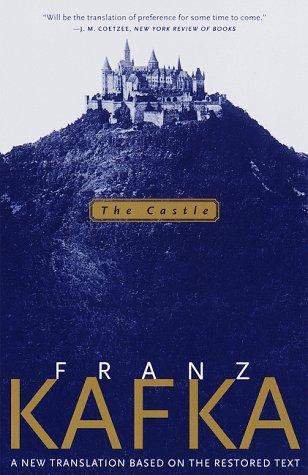
The Castle
A New Translation Based on the Restored Text
Franz Kafka's last novel follows K., a man who arrives in a snowbound village claiming to have been hired as a land surveyor by the authorities in the castle above it. He never reaches the castle, and he never learns whether he is employed, tolerated or simply an intruder. Kafka abandoned the manuscript in 1922, and it appeared in 1926, after his death. This Schocken paperback presents Mark Harman's English translation based on the restored German text, as an alternative to the older Muir version. The book is part comic satire of bureaucracy and part study of belonging, desire and faith. It is one of the classic novels to read for anyone curious about how modernist fiction portrays power that can be neither seen nor questioned.
Where to buy or borrow
Are you selling this book? Bookstores, publishers, authors and libraries can be listed here for free. Request a listing
About this book
The edition profiled here belongs to the Schocken Kafka Library, a series of new English versions made from German texts that stay closer to what Kafka actually wrote. The Castle was first published in 1926 in a text prepared by his friend and literary executor Max Brod. A historical-critical edition that reflects the manuscript more faithfully appeared in 1982. Mark Harman's translation draws on that restored text. It also comes with his translator's preface. For English-language readers, the main alternative is the earlier translation by Willa and Edwin Muir, first published in 1930. Because the novel stops mid-sentence, the book asks readers to live with irresolution rather than expect a conclusion. As translated fiction, it also shows how much a translator's choices shape the tone of Kafka's dry, deadpan prose.
Deep Overview
K. makes a life in the village while he waits. He lodges at an inn, begins a relationship with Frieda, a barmaid connected to Klamm, and is assigned two assistants, Arthur and Jeremias, whom he did not request and cannot dismiss. He ends up with the humble post of school janitor. Each encounter supplies a new theory of how the castle operates. The village Mayor describes an administration so intricately organised that mistakes should be impossible, which means none can ever be admitted. Barnabas, a messenger from a family the village shuns, carries letters whose real authority K. cannot test.
The long central chapters are the book's moral and psychological core. Olga tells K. what happened to her sister Amalia after Amalia rejected an official's improper summons. The family was never formally punished, yet the village withdrew from them anyway. Kafka shows power working through anticipation and fear, as people punish one another on the castle's behalf without being told to. The same chapters show the villagers' ingenuity in rationalising their obedience.
Because so much is told secondhand, readers must weigh what each speaker has an interest in claiming. K. is not a reliable guide either. His claims, his motives and his treatment of Frieda are all open to doubt, and some readers suspect that even the original summons may be his invention.
Kafka began the book in January 1922 as a first-person narrative and later switched to the third person. The manuscript stops in the middle of a sentence. Brod later reported that Kafka had told him how it would end: K. would die in the village, and the castle would grant him permission to stay only on his deathbed. That is Brod's account, so it should be treated as an interesting clue rather than a finished plan.
Interpretation has divided readers. Brod read the castle as divine grace and K. as a seeker. Others see a satire of administrative power, a portrait of alienation, or a story about the desire to be accepted. The book does not choose among these readings. Its tension comes from holding them together, with comedy and menace in the same scenes.
Key Themes
Belonging and recognition: K.'s demand for a defined role in the village is also a demand to be seen as legitimate, and the book asks whether that can be granted from outside.
Interpretation without verification: nearly every fact reaches K. as testimony. The novel is about how people construct meaning from incomplete information.
Desire and power: relationships, especially K.'s with Frieda, are entangled with his ambition to reach the officials.
Complicity: villagers enforce the castle's norms among themselves, as the Amalia episode shows.
Faith, grace and inaccessibility: a religious reading, including Max Brod's, treats the castle as a higher order that cannot be reached by effort. This is one interpretation among several.
Historical Context
The Castle also belongs to a literary and intellectual setting that includes early twentieth-century modernism, reflection on authority after the empires, and Kafka's interest in thinkers such as Schopenhauer and Kierkegaard. Some critics also find echoes of the Bible and of Jewish mystical ideas. The publication history is part of the context too. Brod chose to publish Kafka's manuscripts, even though Kafka had asked him to destroy them. Brod's 1926 edition shaped how the book was read for decades, and a critical edition appeared in 1982. The Muir translation arrived in English in 1930, and the Harman translation in this edition appeared in 1998.
Intended Audience
It may suit less well readers who want a resolved plot, a fast pace or a clear allegory. Those new to Kafka may find a shorter work such as The Metamorphosis or the stories a gentler way in.
Reading Difficulty
No specialist knowledge is needed. At 352 pages in this paperback, the book rewards slow reading, and it helps to keep brief notes on who said what about Klamm and the castle. As translated fiction, it also invites comparison with other versions: the tone of the English depends heavily on the translator's choices about register and rhythm. The paperback includes a translator's preface by Mark Harman.
Helpful Background Knowledge
Some familiarity with the interpretive traditions is optional but rewarding. These include religious readings, readings centred on bureaucracy and power, and psychological or biographical approaches. Reading Kafka's shorter parables first can also help with his tone.
Why Read This Book?
This edition offers a specific advantage: it is a modern translation from the restored German text, accompanied by a translator's preface, so readers encounter a version designed to stay close to Kafka's manuscript. Because the novel remains unresolved, it also gives readers room to form their own judgements instead of being handed an answer.
Reader Takeaways
Strengths
Limitations and Cautions
Important Concepts, People, and Places
The Castle and the village: the castle stands above the village and governs it through officials and messages, while the village is where K. tries to establish his status.
Klamm: a castle official who stays out of reach, whose reputation shapes K.'s hopes and his relationship with Frieda.
Frieda: a barmaid connected with Klamm who becomes K.'s partner and whose position in the village is changed by that relationship.
Barnabas and Olga: members of a shunned family; Barnabas serves as a messenger, and Olga tells the story that forms the book's moral centre.
Amalia: Olga's sister, whose rejection of an official's summons leads to the family's social exclusion.
Arthur and Jeremias: the assistants assigned to K., who complicate his efforts and are never wholly his.
The Mayor: the village official who offers a lengthy account of the administrative system.
Max Brod: Kafka's friend and literary executor, who published the novel in 1926 and offered an influential religious interpretation.
Mark Harman: the translator of this edition, which is based on the restored text.
Schocken Kafka Library: the series in which this edition appears.
Questions the Book Explores
Reading Group Guide
Discussion Questions
2. How does K.'s behaviour affect the way you read his complaints about the village?
3. What does the novel suggest about the relationship between personal relationships and institutional power, especially in K.'s connection with Frieda?
4. Why might Kafka have given so much space to Olga's account of Amalia?
5. How do the assistants, the Mayor and Barnabas each shape K.'s understanding of what is possible?
6. Does the unfinished ending feel like a loss, a fitting form, or both?
7. How does the knowledge that Brod published the book against Kafka's stated wishes affect your reading?
8. Where did the humour land for you, and where did it turn uncomfortable?
9. Do religious, political and psychological interpretations of the castle exclude each other?
10. How might a different translation change your experience of the same scenes?
Sources and Verification
Comments
No published comments yet.
Available editions
Paperback
The Schocken Kafka Library; new translation by Mark Harman based on the restored text
- Publisher
- Schocken
- ISBN-13
- 9780805211061
- Publication date
- Pages
- 352