
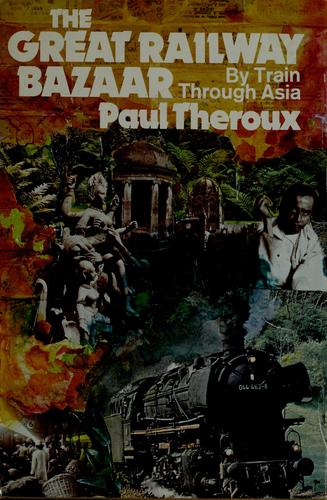
The Great Railway Bazaar
By Train Through Asia
In The Great Railway Bazaar, Paul Theroux recounts a four-month rail journey begun in London in 1973. Traveling east through Europe, Turkey, Iran, the Indian subcontinent, Southeast Asia, and Japan, he eventually returns across the Soviet Union on the Trans-Siberian Railway. The itinerary supplies the book's structure, but its real substance lies in railway compartments, stations, border crossings, delays, landscapes, and conversations with strangers. Theroux treats each train as a temporary society in which class, nationality, loneliness, prejudice, curiosity, and political tension become unusually visible. His approach is literary rather than instructional: he selects telling encounters and sharp impressions instead of offering a comprehensive account of every destination. The result is both a record of a vanished network of overland travel and an influential example of personality-driven travel writing. Its wit and observational force remain central to its appeal, while its judgmen…
Where to buy or borrow
Are you selling this book? Bookstores, publishers, authors and libraries can be listed here for free. Request a listing
About this book
Deep Overview
The journey is not presented as a seamless triumph of transportation. Missed connections, uncomfortable berths, border formalities, damaged infrastructure, uncertain timetables, and political restrictions repeatedly interrupt the fantasy that the railway has made the world orderly. Trains connect regions, yet they also expose divisions. Carriage classes separate passengers by income and status; borders transform routine movement into inspection; and the quality of rolling stock becomes an indirect measure of state priorities, colonial inheritance, or economic inequality.
Theroux is especially interested in passengers. Tourists, railway employees, soldiers, officials, expatriates, merchants, religious travelers, and solitary wanderers enter the narrative briefly and then disappear. These encounters allow him to construct compact social scenes resembling episodes in fiction. The narrator is not invisible: his impatience, amusement, suspicion, homesickness, and literary associations shape what the reader sees. He often understands a new setting by comparing it with books he has read, invoking writers such as Rudyard Kipling, Anton Chekhov, Mark Twain, V. S. Naipaul, Graham Greene, and James Joyce. Travel therefore becomes an encounter not only with places but also with inherited representations of those places.
The historical moment gives the observations additional significance. The trip occurred during the Cold War and near the end of the Vietnam War, while many countries on the route were negotiating postcolonial identities, uneven development, or authoritarian rule. Theroux moves through societies marked by imperial railway construction but now governed under very different political arrangements. The railway can consequently appear as a colonial artifact, a national institution, a commercial corridor, and a shared public space all at once.
The book's deepest tension lies between curiosity and judgment. Theroux listens closely and notices physical detail with unusual intensity, yet he also issues swift, sometimes severe verdicts about individuals and cultures. That combination produces much of the book's energy while creating its most important limitation. Read critically, The Great Railway Bazaar is both a compelling journey and a case study in how a travel writer transforms partial experience into literary authority.
Key Themes
The book also examines the difference between destinations imagined through literature and places encountered in person. Theroux arrives carrying ideas inherited from earlier writers, colonial histories, timetables, and popular myths; actual encounters may confirm, complicate, or expose those expectations. Political borders form another major theme. The railway suggests continuity, but visas, inspections, military conflict, and national suspicion repeatedly divide the route.
Finally, the narrative explores observation as an ethically uncertain activity. Theroux's sharp eye creates memorable portraits, but his authority depends on selecting which moments and people will represent a place. The resulting tension between perceptiveness and caricature is essential to understanding the book.
Historical Context
Many railways described in the book originated or expanded under European and Russian imperial systems. In South and Southeast Asia, railway routes reflected colonial priorities even after independence, linking ports, administrative centers, resource regions, and inland cities. The book captures these inherited networks as working public institutions rather than preserved historical objects.
Literarily, the work appeared during a renewed popular interest in first-person travel narratives. Its combination of novelistic characterization, candid opinion, physical discomfort, and sustained overland movement became influential in modern English-language travel writing.
Intended Audience
It is less suitable for anyone seeking a practical rail guide, an impartial cultural introduction to Asia, or complete accounts of the countries visited. Readers uncomfortable with sardonic judgments or culturally dated generalizations may find parts of the narrative abrasive. For those readers, the book is best approached as a historically situated travel narrative rather than a dependable portrait of present-day places.
Reading Difficulty
Much of the intellectual difficulty comes from interpretation rather than vocabulary. Readers must decide when the narrator is reporting, joking, exaggerating, generalizing, or deliberately shaping an encounter for literary effect. Older geographical names and national boundaries may also require occasional reference checking.
Helpful Background Knowledge
Readers need not know railway engineering. It is more helpful to understand that long-distance trains once served as essential social and commercial links, not merely as tourist experiences.
Why Read This Book?
The book is also worth reading for its formal achievement. Theroux turns repeated acts—boarding, waiting, sharing compartments, eating, watching landscapes, and crossing borders—into a varied narrative. Readers interested in nonfiction craft can study how he uses dialogue, recurring railway imagery, omission, and comic characterization. Just as importantly, the book offers productive material for considering the travel writer's power: who gets observed, who gets interpreted, and how a brief meeting becomes a lasting representation.
Reader Takeaways
Readers may become more attentive to the difference between an immediate impression and a balanced conclusion. Theroux's strongest observations often arise from patience and close listening, while his weakest judgments can emerge from haste or irritation. That contrast offers a useful lesson in reading all first-person nonfiction critically. The journey further illustrates how maps, literature, political history, and personal expectations shape encounters before a traveler has even arrived.
Strengths
Another strength is the disciplined emphasis on trains and stations. By declining to write a comprehensive destination survey, Theroux gives the book a distinctive perspective and thematic unity. The narrative also preserves valuable impressions of railway travel and political geography in the early 1970s. Its most enduring formal contribution is the fusion of documentary journey, comic portraiture, literary allusion, and a conspicuous first-person narrator.
Limitations and Cautions
The chosen method also creates geographical gaps. Major cities, formal engagements, and wider political conditions may receive less attention than incidental railway scenes. Reconstructed dialogue has literary force, but readers cannot treat every extended conversation as a transcript. Finally, the book describes conditions observed in 1973; it should not be used as a guide to contemporary borders, rail services, social conditions, or cultural life.
Important Concepts, People, and Places
London Victoria Station is the symbolic beginning of the circuit, connecting a familiar metropolitan terminus to an imagined route across Eurasia. The Orient Express carries the literary mythology of European rail travel, while services such as the Khyber Pass Local, Frontier Mail, Golden Arrow, Mandalay Express, Japanese trains, and Trans-Siberian Railway reveal sharply different regional systems and social worlds.
India occupies a major part of the narrative and displays the scale, variety, and colonial inheritance of South Asian rail travel. Vietnam appears within the immediate shadow of war, making movement inseparable from military destruction and political division. Japan represents a markedly different experience of railway speed and organization. The Soviet Union forms the final great overland passage and places the traveler inside a system shaped by Cold War controls.
Writers including Rudyard Kipling, Anton Chekhov, Graham Greene, James Joyce, Mark Twain, and V. S. Naipaul matter because Theroux repeatedly interprets travel through prior reading. Their presence demonstrates that travelers rarely encounter places without inherited literary expectations.
Questions the Book Explores
Reading Group Guide
Pay particular attention to the balance between landscape description and conversation. Discuss why Theroux often gives an unknown passenger more narrative space than a famous city. Groups can also identify moments when literary references deepen an observation and moments when inherited books appear to constrain it.
A productive final comparison is between Theroux's observational skill and his tendency toward harsh judgment. Rather than deciding simply whether the narrator is likable, examine how his personality creates the book's style, insight, blind spots, and momentum.
Discussion Questions
2. Which encounter most clearly demonstrates the unusual intimacy of railway travel?
3. When does Theroux's sarcasm sharpen an observation, and when does it distort one?
4. How do differences between first-class and ordinary travel shape the book's treatment of social inequality?
5. What role do colonial railway systems play after the countries using them have achieved independence?
6. How does the narrator's reading influence his interpretations of unfamiliar places?
7. What responsibilities does a travel writer have when representing people encountered only briefly?
8. How should readers evaluate dialogue reconstructed after a journey?
9. Which parts of the book are most valuable as historical evidence, and which require the greatest caution?
10. How might the narrative differ if written by a traveler from one of the countries on the route?
11. Does the continuous railway circuit create a genuine sense of connection across Eurasia, or does it emphasize division?
12. How does the return on the Trans-Siberian Railway change the tone or meaning of the journey?
Sources and Verification
Comments
No published comments yet.
Available editions
Hardcover
First U.S. edition
- Publisher
- Houghton Mifflin
- ISBN-13
- 9780395207086