
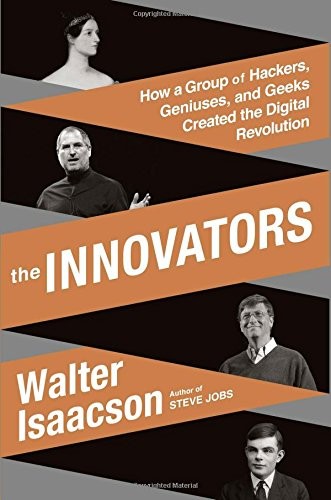
The Innovators
How a Group of Hackers, Geniuses, and Geeks Created the Digital Revolution
Walter Isaacson’s The Innovators traces the development of computers, software, semiconductors, personal computing, the internet, and the web through the people and teams behind them. Beginning with Charles Babbage and Ada Lovelace, the narrative moves through wartime computing, Bell Labs, the microchip, Silicon Valley, hobbyist culture, Microsoft, Apple, online communities, and the World Wide Web. Its central argument challenges the familiar image of the solitary inventor: transformative technologies usually emerge when theorists, engineers, programmers, entrepreneurs, institutions, and earlier generations exchange ideas. Isaacson also emphasizes the productive meeting of technical skill with imagination, design, and human needs. Written as a broad, character-driven history rather than a technical manual, the book explains how linked breakthroughs accumulated into the digital revolution and why collaboration, institutional culture, and the ability to turn concepts into usable systems…
Where to buy or borrow
Are you selling this book? Bookstores, publishers, authors and libraries can be listed here for free. Request a listing
About this book
Deep Overview
The narrative then follows the convergence of mathematical theory, engineering, and wartime necessity. Alan Turing’s work clarified the abstract possibilities of computation, while projects involving machines such as ENIAC turned theoretical principles into working electronic systems. Isaacson gives particular attention to the women who programmed ENIAC, showing that programming was intellectually demanding even when institutions failed to grant it equal recognition. Grace Hopper’s work helps carry the story toward languages and methods that made computers more usable.
A further transition occurs with the transistor and integrated circuit. Bell Labs illustrates the importance of a research environment where theorists and experimentalists could work together, while the later semiconductor story demonstrates both the creative power and volatility of entrepreneurial teams. William Shockley, John Bardeen, Walter Brattain, Robert Noyce, Gordon Moore, and others appear not simply as inventors but as participants in networks shaped by laboratories, management decisions, rivalries, and the movement of talent. The microchip eventually made smaller, cheaper, and more personal machines possible.
Isaacson next connects institutional research with countercultural aspirations. Vannevar Bush imagined systems for organizing knowledge; J. C. R. Licklider promoted interactive and networked computing; Douglas Engelbart developed tools intended to augment human intellect. ARPANET and packet networking grew from collaborations among publicly funded researchers, while the personal-computer movement drew energy from hobbyists who wanted computing power removed from centralized institutions.
The stories of Bill Gates and Paul Allen, and of Steve Wozniak and Steve Jobs, show different combinations of programming, engineering, commercial judgment, and product vision. The book does not deny forceful individual talent, but it repeatedly asks what made partnerships effective—or destructive. It also considers communities that organized creation differently, including open-source software and Wikipedia.
The account culminates in the internet and World Wide Web, distinguishing the underlying network from the web system Tim Berners-Lee devised for linking and navigating information. Across this long arc, Isaacson argues that successful innovation depends on complementary abilities: theory and craft, hardware and software, creativity and execution, individual initiative and shared standards. The digital revolution therefore appears not as one invention but as a cumulative structure built by many people, often across institutions and generations.
Key Themes
• The myth of the lone genius: Isaacson complicates heroic invention stories by tracing borrowed ideas, parallel discoveries, disputed credit, and the work of teams.
• Art joined with technology: Imagination, design, storytelling, and sensitivity to users repeatedly help turn technical capability into something meaningful and widely adopted.
• Theory and implementation: Abstract insight matters, but inventions also require prototypes, debugging, manufacturing, interfaces, standards, and workable business models.
• Open systems and shared knowledge: The development of networks, software communities, and the web demonstrates the creative value of accessible standards and decentralized participation.
• Recognition and exclusion: The experiences of Ada Lovelace and the women who programmed ENIAC expose how gender and institutional status influence whose work becomes visible.
• Productive and destructive conflict: Rivalry can sharpen ideas, but ego, secrecy, and poor leadership can damage teams and obscure collective contributions.
Historical Context
Cold War research contributed to interactive computing and computer networking. ARPA-supported work helped produce ARPANET and the technical culture from which the internet developed. Meanwhile, semiconductor firms clustered in what became Silicon Valley, combining university research, venture capital, skilled labor, and entrepreneurial mobility. During the 1970s and 1980s, hobbyist and countercultural ideas about individual empowerment converged with falling component costs to propel personal computing. By the 1990s, internet infrastructure and Tim Berners-Lee’s World Wide Web enabled information sharing on a global scale. This history explains why the digital revolution cannot be understood solely as a sequence of consumer-product launches: it was also shaped by war, public investment, research institutions, standard-setting, and changing beliefs about access to information.
Intended Audience
It may be less satisfying for readers seeking source code, circuit-level explanations, a systematic computer-science textbook, or exhaustive coverage of every major contributor. Specialists may also want narrower scholarly histories to examine disputed episodes and technical details more closely.
Reading Difficulty
Helpful Background Knowledge
Why Read This Book?
Reader Takeaways
Strengths
Limitations
Important Concepts and People
• Alan Turing: His theoretical work helps define general computation, linking mathematical logic to the future possibilities of computing machines.
• The ENIAC programmers: Women including Jean Bartik and her colleagues translated problems into configurations for an early electronic general-purpose computer, demonstrating that programming was foundational intellectual work.
• Grace Hopper: A programmer and computing pioneer whose work represents the drive to make programming more systematic and accessible.
• Bell Labs: A major research institution used to show how sustained collaboration among scientists and engineers could produce the transistor.
• William Shockley, John Bardeen, and Walter Brattain: Their difficult collaboration around the transistor illustrates both the power of teamwork and the corrosive effects of competition over credit.
• Robert Noyce and Gordon Moore: Semiconductor pioneers central to the integrated-circuit story and the entrepreneurial culture of Silicon Valley.
• Vannevar Bush: An influential research administrator and thinker whose ideas about organizing knowledge anticipated later systems for navigating information.
• J. C. R. Licklider: A leading advocate of interactive, networked computing and a key intellectual influence on research that moved computers beyond isolated calculation.
• Douglas Engelbart: Developed interactive tools, including work associated with the mouse and hypertext, as part of a larger vision of augmenting human intellect.
• ARPA and ARPANET: Publicly supported research institutions and infrastructure central to the emergence of computer networking.
• Bill Gates and Paul Allen: The Microsoft founders embody the rise of software as a commercial force and the opportunities and tensions of a highly unequal partnership.
• Steve Wozniak and Steve Jobs: Their complementary engineering and product instincts exemplify the meeting of technical elegance, design, marketing, and user experience.
• Tim Berners-Lee: Created the foundational technologies of the World Wide Web, enabling linked documents to be navigated across the internet.
• Collaborative creativity: The book’s central idea that innovation usually depends on teams, institutions, shared standards, and exchanges across generations rather than a single moment of solitary genius.
Questions the Book Explores
• How do abstract theories become working machines, commercial products, and shared infrastructure?
• What forms of partnership best combine imagination, engineering, programming, design, and business judgment?
• Why are certain contributors remembered while programmers, technicians, and other collaborators disappear from popular accounts?
• How did public research, corporate laboratories, universities, hobbyist groups, and private companies each contribute to the digital revolution?
• When does openness accelerate innovation, and when do secrecy, patents, or commercial control become decisive?
• What makes a technology not merely functional but intuitive, desirable, and socially transformative?
Reading Group Guide
A second productive angle is credit. Track who designs concepts, who constructs systems, who programs them, who obtains patents, who tells the story, and who becomes publicly famous. The ENIAC chapters are especially useful for examining how gender and occupational status affect historical memory.
Finally, divide the digital revolution into layers—computation, electronic components, chips, personal computers, software, networks, and the web. Ask whether any layer could have become transformative without the others. Groups may also compare the book’s 2014 endpoint with later developments and discuss whether its account of collaborative innovation still explains advances in cloud computing and artificial intelligence.
Discussion Questions
2. Does the book genuinely replace the lone-genius narrative, or does it still rely heavily on exceptional individuals?
3. How do Babbage and Lovelace establish the book’s recurring relationship between imagination and engineering?
4. What conditions made Bell Labs unusually productive, and could they be recreated elsewhere?
5. How do disputes over credit alter the way technological history is remembered?
6. What does the treatment of the ENIAC programmers reveal about the relationship between recognition, gender, and professional status?
7. Which mattered more to the digital revolution: public institutions, private enterprise, or communities of enthusiasts?
8. How does the book distinguish invention from innovation?
9. When does a forceful personality help a creative team, and when does it undermine one?
10. How do open standards and shared knowledge compete with commercial ownership in the history Isaacson tells?
11. Which important region, institution, technology, or contributor receives too little attention?
12. How might a history written after the recent rise of generative artificial intelligence revise the book’s conclusions?
Sources and Verification
Comments
No published comments yet.
Available editions
Hardcover
First Simon & Schuster hardcover edition; hardcover
- Publisher
- Simon & Schuster
- ISBN-13
- 9781476708690
- Publication date