
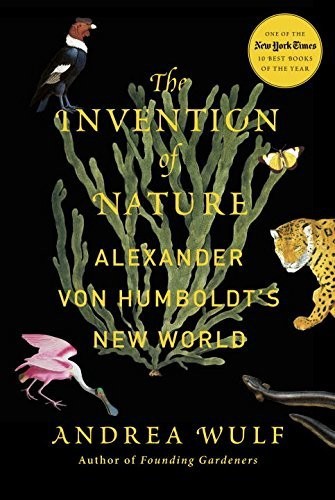
The Invention of Nature
Alexander von Humboldt's New World
Andrea Wulf’s biography restores Alexander von Humboldt to the center of nineteenth-century science and environmental thought. Following the Prussian naturalist from his constrained youth through expeditions in the Spanish Americas and Russia, the book shows how field observation, measurement, aesthetic response, and wide reading shaped his vision of nature as an interconnected whole. Wulf also traces his encounters with figures including Johann Wolfgang von Goethe, Aimé Bonpland, Simón Bolívar, and Thomas Jefferson. The later chapters move beyond Humboldt’s lifetime to examine his influence on Charles Darwin, Henry David Thoreau, George Perkins Marsh, Ernst Haeckel, and John Muir. The result is both an adventure-filled life and a history of ideas: an account of how connections among climate, geography, plants, animals, and human activity became central to understanding the living world—and why Humboldt’s warnings about environmental destruction remain significant.
Where to buy or borrow
Are you selling this book? Bookstores, publishers, authors and libraries can be listed here for free. Request a listing
About this book
Deep Overview
That conviction acquired physical scale during Humboldt’s journey through the Spanish American colonies from 1799 to 1804 with the French botanist Aimé Bonpland. Wulf recounts river travel, disease, dangerous terrain, scientific collecting, and an attempted ascent of Chimborazo in the Andes. The expedition supplied more than specimens. By comparing vegetation, temperature, altitude, geology, and climate across distant regions, Humboldt developed a geographical method for recognizing relationships. His celebrated profile of Chimborazo arranged plant zones by elevation and made ecological patterns visible in a single image.
Wulf also places science inside colonial and political history. Humboldt witnessed plantation economies, slavery, mining, and the destructive consequences of colonial extraction. At Lake Valencia in present-day Venezuela, he connected deforestation and irrigation with environmental change. In Washington, he shared geographical and statistical knowledge with President Thomas Jefferson while confronting the contradiction between republican liberty and enslavement. His later friendship with Simón Bolívar linked scientific exploration to debates over Spanish American independence, although Humboldt remained primarily an observer and intellectual influence rather than a revolutionary leader.
After returning to Europe, Humboldt transformed field experience into lectures, maps, essays, and major works such as Personal Narrative and Cosmos. Wulf emphasizes his gift for synthesis: he communicated specialized knowledge while insisting that climate, organisms, terrain, and human actions belonged to one system. His Russian and Central Asian journey in 1829 extended his comparisons across continents and demonstrated that age had not diminished his appetite for measurement or travel.
The biography’s final movement follows Humboldt’s ideas into other lives. Charles Darwin carried Humboldt’s example into his own voyage and natural history; Henry David Thoreau found a way to unite detail and whole; George Perkins Marsh developed a systematic warning about human damage to the environment; Ernst Haeckel joined science and visual form while advancing ecological language; and John Muir translated interconnected nature into preservationist commitment. Wulf’s larger claim is therefore genealogical: modern ecological consciousness emerged through many thinkers, but Humboldt supplied a particularly powerful model for seeing Earth as a web of relations rather than a warehouse of separate resources.
Key Themes
**Measurement and imagination:** Instruments, data, maps, prose, and visual design all contribute to knowledge. The book rejects a simple opposition between empirical science and emotional or aesthetic response.
**Human-caused environmental change:** Deforestation, plantation agriculture, irrigation, and extraction reveal that societies can alter climates and ecosystems. These observations connect Humboldt’s historical work to present environmental concerns.
**Science across borders:** Humboldt compared continents and circulated ideas through correspondence, travel, books, and personal networks. Knowledge grows through exchange rather than within national or disciplinary isolation.
**Freedom and contradiction:** Encounters with colonialism, slavery, and independence movements expose conflicts between Enlightenment ideals and imperial practice.
**Influence and cultural memory:** A major concern is how an internationally celebrated scientist became less familiar in much of the English-speaking world even while his concepts endured in later science and nature writing.
Historical Context
At the same time, Romantic thinkers challenged purely mechanical accounts of the natural world. Humboldt’s work occupied the productive tension between Enlightenment measurement and Romantic unity: he used precise instruments and comparative data while describing nature as animated by relationships. His Spanish American expedition took place within territories controlled by Spain shortly before independence movements transformed the region. His later career unfolded before modern ecology existed as a fully established discipline, making Wulf’s argument one about intellectual ancestry rather than a claim that Humboldt practiced contemporary environmental science in its present form.
Intended Audience
Reading Difficulty
Helpful Background Knowledge
Why Read It
Reader Takeaways
Strengths
Limitations and Scope
Important Concepts, People, and Places
**Andrea Wulf:** The biographer who reconstructs Humboldt’s life and argues for his importance to ecological and environmental thought.
**Aimé Bonpland:** The French botanist who traveled with Humboldt through the Americas. His fieldwork and botanical expertise were integral to the expedition.
**Johann Wolfgang von Goethe:** German writer and thinker whose friendship encouraged Humboldt to join scientific investigation with imagination and aesthetics.
**Simón Bolívar:** Independence leader who knew Humboldt. Their relationship connects scientific knowledge of Spanish America with political visions of liberation.
**Thomas Jefferson:** United States president who received Humboldt and valued his geographical knowledge, while embodying the contradiction between republican ideals and slavery.
**Charles Darwin:** Naturalist deeply stimulated by Humboldt’s travel writing and example; Wulf presents him as a major carrier of Humboldtian approaches into evolutionary natural history.
**Henry David Thoreau:** American writer who drew on Humboldt while seeking to combine exact observation with a comprehensive vision of nature.
**George Perkins Marsh:** Author of Man and Nature, who developed a consequential account of human environmental destruction.
**Ernst Haeckel:** German biologist and artist associated with the term ecology; his work illustrates the continuing union of scientific pattern and visual form.
**John Muir:** Naturalist and preservation advocate whose thought reflects Humboldt’s emphasis on natural interdependence.
**Chimborazo:** Andean volcano central to Humboldt’s expedition and to his influential visualization of plant geography by elevation.
**Naturgemälde:** Humboldt’s integrated representation of nature, most famously associated with the Chimborazo profile. It expresses the book’s theme that knowledge can be relational and visual.
**Cosmos:** Humboldt’s late, ambitious project to describe the physical universe as a connected order while combining scientific synthesis with evocative writing.
**Spanish America:** The colonial setting of Humboldt and Bonpland’s major expedition, where scientific opportunity, imperial rule, coerced labor, and environmental exploitation intersect.
Questions the Book Explores
Reading Group Guide
Discussion Questions
2. Which mattered more to Humboldt’s achievements—his measurements, his appetite for comparison, or his literary and visual imagination?
3. How does the Chimborazo diagram communicate ideas differently from ordinary prose?
4. What does Aimé Bonpland’s role reveal about collaboration and credit in scientific history?
5. How convincingly does Wulf connect Humboldt to modern environmentalism?
6. How should readers assess Humboldt’s use of colonial access alongside his criticism of slavery and exploitation?
7. Which successor—Darwin, Thoreau, Marsh, Haeckel, or Muir—most clearly extends Humboldt’s way of thinking?
8. Does the book successfully balance life story and intellectual history? Where does one overshadow the other?
9. Why might a scientist famous across the nineteenth-century world become comparatively unfamiliar later?
10. How does Humboldt’s approach challenge present-day divisions between scientific disciplines and the humanities?
11. What are the risks of telling the history of a movement through a heroic individual?
12. Which of the book’s ideas most changes how you observe an ordinary landscape?
Sources and Verification
Comments
No published comments yet.
Available editions
Hardcover
First American edition; hardcover
- Publisher
- Alfred A. Knopf
- ISBN-13
- 9780385350662
- Publication date