
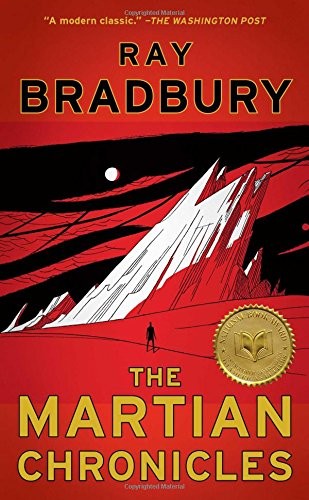
The Martian Chronicles
Ray Bradbury's The Martian Chronicles follows the human settlement of Mars through a chain of linked stories. Early expeditions meet a gentle, sophisticated Martian civilization and wreck it, sometimes by violence and sometimes by accident. Settlers then arrive in numbers, bringing their towns, prejudices and appetites with them, until a catastrophe on Earth cuts the colonies off. Bradbury treats Mars as a mirror: the book reads as a meditation on colonial conquest, nuclear fear, censorship and the cost of treating a new world as a blank slate. Its lyrical, melancholy tone sets it apart from engineering-minded space adventure. Among science fiction books, it is a standard introduction to the genre's literary and humane side, and it remains short enough to read in a weekend.
Where to buy or borrow
Are you selling this book? Bookstores, publishers, authors and libraries can be listed here for free. Request a listing
About this book
Deep Overview
After that point the book turns from encounter to settlement. Lonely miners, preachers, and families of ordinary working people follow the rocket ships. Bradbury lets them rebuild what they left behind: hot dog stands, prefabricated houses, and the social habits of small-town America. The stories do not bring a single plot to a close. Instead they accumulate pressure around a basic irony. Settlers arrive claiming to escape Earth's problems, but they carry those problems in their luggage. A satirical story shows censorship pursuing writers even on a distant planet, and a harder one confronts American racial segregation. In another, the entire Earth economy feels thin when set against a Mars that has been quietly emptied.
The pivot is the nuclear conflict back home. Radio news arrives that war has broken out, and the colonists, many of whom thought they had made a permanent departure, rush toward Earth. One of the best-known pieces, a story set on Earth, follows an automated house that continues its routines after its owners are gone. It works as a quiet counterweight to the Martian chapters: the planet that was supposed to be left behind is the one that is destroyed. The final stretch is dominated by solitary survivors, a man who builds a made-to-order family out of machines, and a last family that looks into the water and sees something different about what it means to be Martian.
Bradbury's method is accumulation, not argument. Each story is a small experiment with a tone, and the pattern only becomes clear from a distance. The overall design is a double reflection. Mars repeatedly stands for earlier frontiers in the Americas, for the displacement of indigenous people and the pioneer habit of calling conquest settlement. The Earth-bound stories gesture at the Cold War present of the late 1940s. The writing is imagistic and elegiac, which is why the book is read as literature and not just as an adventure. It asks readers to consider how a society uses a new place to project its hopes, and what it destroys while doing so.
Key Themes
Nuclear anxiety and the fragility of civilization form a second thread, culminating in the Earth's collapse and the stranded colonists.
Censorship and conformity appear in satire: Bradbury is wary of institutions that police imagination, a concern he took up more fully in his other work.
The book also explores nostalgia and the impulse to rebuild the familiar in unfamiliar places, as well as loneliness, memory and the possibility of renewal. It also asks whether human beings can change when they move, or only transplant themselves.
Historical Context
The project also belongs to the pulp-magazine tradition. Most pieces first appeared in magazines, and the book came together in 1949 and 1950, when Bradbury was moving from magazine work toward book publication. Wikipedia records that radio writer Norman Corwin encouraged him to visit New York, where he found a publisher in Doubleday. The book's literary reputation then grew along with the postwar acceptance of science fiction as a serious form. Bradbury later received a Pulitzer Prize Special Citation in 2007. In a nod to the book's influence, NASA named the Curiosity rover's 2012 landing site Bradbury Landing.
Because the book reflects the 1940s imagination of Mars, readers should remember that it predates modern planetary science. Its canals and breathable atmosphere are inherited from early-twentieth-century speculation, not from space-probe data.
Intended Audience
It may be less satisfying for readers who want hard science, a single protagonist, or a tightly plotted narrative. Some stories are brief and impressionistic, and their handling of race and gender reflects mid-century American assumptions. Younger readers can approach it, but several stories deal with death, violence and nuclear catastrophe.
Reading Difficulty
No scientific or technical background is required. The more demanding work is interpretive, since many stories work as allegory and reward slower reading. This Simon & Schuster edition is a compact mass market paperback of about 256 pages, so the print is small, which some readers may find tiring. Note also that the dating of the sections differs among printings, and the chronology should be read as a loose framework.
Helpful Background Knowledge
Why Read This Book?
It is also a good starting point for readers who want something short but resonant, and it works well as one of the book club books that spark argument. Its reputation as a landmark makes it useful for understanding how later writers handled colonization, ecology and first contact. Because individual stories stand alone, you can sample a few and keep going if they appeal.
Reader Takeaways
Strengths
Limitations and Cautions
Important Concepts, People, and Places
Mars and the Martians: the setting and its ancient inhabitants, whose telepathic, artistic culture is destroyed by contact with humans.
Fix-up novel: the form in which previously published stories are revised and bridged with new material to read as a single work.
Colonization allegory: the reading, supported by Britannica, that the settlement of Mars echoes the European arrival in the Americas.
Captain John Black, Spender and Wilder: representative expedition members through whom the book dramatizes doubt, conscience and leadership. Spender in particular resists the idea of human conquest.
"There Will Come Soft Rains": the story of an automated house that continues its routines after a nuclear disaster, and one of the most widely anthologized pieces.
"Usher II": a satire about censorship that draws on Edgar Allan Poe.
Earth's nuclear war: the off-stage catastrophe that ends the colonial project and turns the final chapters toward survival and renewal.
Doubleday: the New York publisher that issued the first edition in 1950.
Bradbury Landing: the name NASA gave the Curiosity rover's landing site in 2012 in honor of the author.
Questions the Book Explores
Reading Group Guide
Discussion Questions
2. Which Martian encounter did you find most convincing, and what does it suggest about human fear of the unfamiliar?
3. How does Bradbury use nostalgia to shape both characters and plot?
4. In what ways does the book comment on its postwar moment, and which of those comments still apply?
5. How do the stories about censorship and race fit with the stories about exploration?
6. What does the ending suggest about who inherits Mars, and do you read it as hopeful, ironic or both?
7. Which stories feel dated, and which feel current? What explains the difference?
8. How does the lyrical style change your sense of what science fiction can do?
Sources and Verification
Comments
No published comments yet.
Available editions
Paperback
Simon & Schuster mass market paperback
- Publisher
- Simon & Schuster
- ISBN-13
- 9781451678192
- Publication date
- Pages
- 256