Deep Overview
The novella is built in three movements, and each one shifts the balance of power inside the Samsa household. In the first, Gregor wakes late and frets about missing his train and angering his employer, far more than about his altered body. The firm's chief clerk arrives to demand an explanation, and the family realises that Gregor's speech has become unintelligible. When Gregor finally opens his door, the clerk flees, and Gregor's father drives him back into his room. The opening part sets up the story's central irony. Gregor still thinks like a conscientious employee, while everyone around him already treats him as a problem to be managed.
The second part shows the household adapting. His sister Grete takes over feeding him, studying what he will and will not eat, and at first she acts with real tenderness. Yet this stretch also reveals how Gregor's income had allowed the others to avoid work. His father, mother and sister each take up duties they had previously escaped. When Grete and her mother clear furniture out of his room, Gregor clings to a framed picture as the last relic of his human life. His mother collapses at the sight of him, and his father returns and bombards him with apples, one of which lodges in his back.
The third part is the gradual withdrawal of care. The family takes in lodgers, Gregor is neglected, and the sound of Grete's violin playing draws him out of hiding. The lodgers are horrified, and Grete, once his advocate, argues that the family must stop treating the creature as her brother. Gregor retreats and dies. The final pages follow the relieved family on an outing into the countryside, where they begin to plan their futures. Many readers find this the most disturbing passage of all.
Kafka does not set a puzzle with one solution. He examines how affection can be tangled up with usefulness, how a person can be reduced to a role, and how a family can speak the language of love while acting from exhaustion and self-protection. Because the narration stays close to Gregor and rarely leaves the apartment, the reader understands his inner life while also seeing why the others cannot. The transformation is never explained, so attention falls on consequences rather than causes. That openness is a large part of why the story has supported so many different interpretations.
Key Themes
Alienation runs through the book, both from other people and from one's own body. It is tied closely to work. Gregor defines himself through his job, and the story asks what is left of a person once his economic function disappears. Family obligation, and the point at which it turns into resentment, shapes nearly every scene. Guilt and shame follow Gregor even though he has done nothing wrong; he worries about burdening those who now ignore or fear him. Communication is another thread, since Gregor keeps his thoughts but loses the ability to be understood. Finally, the novella traces dehumanisation: how quickly a group can reclassify one of its members as an object, a pest or a duty to be discharged, and how ordinary self-interest can justify that move.
Historical Context
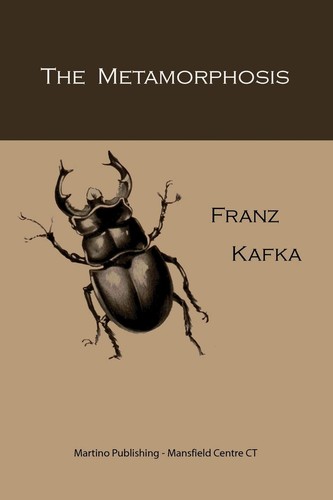
Kafka was a German-speaking Jew in Prague, a city with a Czech majority that was then ruled within the Austro-Hungarian Empire and dominated by a German-speaking elite. He wrote The Metamorphosis in November and December 1912, and at one stage considered publishing it with two other stories about fathers and sons in a collection to be called Sons. He ended up issuing it alone. Publication was slow. After delays caused by the First World War, it appeared in the journal Die weißen Blätter in October 1915, when René Schickele was editor-in-chief and Kafka's friend Max Brod helped in placing the story. The book edition from Kurt Wolff Verlag came out in December 1915 in the series Der jüngste Tag, with the date 1916 printed on it. Its cover drawing was by Ottomar Starke, and Kafka told the publisher that the insect itself must not be depicted. The first English translation did not appear until 1936. In the century since, critics have read the story through Marxist ideas about labour, psychoanalysis, Jewish identity, illness and Kafka's own relationship with his father. These are interpretations, not intentions Kafka confirmed.
Intended Audience
The book suits readers who want a short, self-contained introduction to early twentieth-century literature, students meeting Kafka for the first time, and anyone drawn to stories that use a strange premise to examine ordinary domestic life. It will appeal to readers who enjoy ambiguity and are content to leave questions open. This particular edition also suits people who like having critical essays and background documents in the same volume as the story. Readers who want a fantasy that explains its own rules, a comforting resolution or a creature-feature may be frustrated. So may those who prefer long, immersive novels. People who are sensitive to depictions of neglect, family cruelty and illness should also know that the tone is bleak even where it is darkly funny.
Reading Difficulty
The prose is clear and the vocabulary is not demanding. The challenge is tonal and interpretive, because the narrator describes horrifying events in a level, almost administrative voice, and readers must decide how to weigh the comedy against the distress. The story is short and moves briskly in three parts with little jumping in time, and no specialist knowledge is needed to follow events. Because this is translated fiction, word choices differ between English versions, especially in the opening sentence, and comparing translations is a useful exercise for more advanced readers. The edition is a small mass market paperback, so the print may feel compact. The added essays and documents are more demanding than the novella and are best read after it.
Helpful Background Knowledge
No preparation is essential. A few basics enrich the reading, though. Kafka wrote in German in Prague, and much of his reputation was built on works that reached readers late. A glance at the Austro-Hungarian setting helps explain the family's anxieties about money and respectability. It is also worth knowing that Kafka's word for Gregor's new form, Ungeziefer, is deliberately vague and carries the sense of an unclean pest, which is why English versions use vermin, bug or insect. The novelist Vladimir Nabokov, who was also a keen entomologist, argued that Gregor should be pictured as a beetle rather than a cockroach, a debate that shows how closely the image has been scrutinised. Most readers do best reading the story first and the commentary afterwards.
Why Read This Book?
Few works of fiction pack so much into so few pages. A single impossible event exposes the habits, finances and emotional shortcuts of an ordinary household, and the story gave English the adjective Kafkaesque for situations that are absurd, bureaucratic and oppressive. This edition adds particular value for readers who want more than the text alone. Corngold's translation comes with an introduction, notes, letters, diary entries and critical essays, so a reader can move from the story to the arguments it has provoked. The novella's brevity also makes it practical for anyone working through a reading challenge or trying to read more widely, and it rewards rereading because early details change meaning once the ending is known.
Reader Takeaways
A careful reader may come away with a sharper sense of how narration steers sympathy, since we are inside Gregor's thoughts while the family remains on the outside. You may reconsider how much a person's perceived worth depends on usefulness, and how readily care can harden into duty and then into relief at being free of it. You are likely to notice recurring spaces such as doors, rooms and thresholds, and the way each part ends with an injury or a retreat. You may also become more alert to how translation shapes tone and image, and more precise in using the word Kafkaesque, which is often applied to situations that are merely inconvenient.
Strengths
The story is economical and tightly organised, with a three-part structure that escalates steadily. Its central image is memorable without being explained away, which leaves space for competing readings. The blend of dark comedy and pathos is controlled, and secondary characters, especially Grete and the father, change in ways that feel believable rather than schematic. It is short enough to read in one sitting yet dense enough to reread. For this edition specifically, the inclusion of supporting documents and critical essays gives students and independent readers a ready route into the interpretive debates.
Limitations and Cautions
Readers should not expect an explanation for Gregor's change; the story withholds one, and any claim that it means one particular thing (capitalist alienation, family tyranny, illness, Jewish marginality, the artist's isolation) is an interpretation that critics dispute. The focus is narrow, a single household with little wider social detail. Some scenes depict cruelty toward a helpless character, and the ending is bleak. Catalogues disagree about this edition's printing year and page count, so buyers who care about the exact contents should check the physical copy, since the extras (essays, letters and notes) vary between Corngold editions and printings. The small mass market format may also be uncomfortable for readers who prefer larger print.
Important Concepts, People, and Places
Gregor Samsa: the protagonist, a travelling salesman whose transformation drives the plot and whose perspective governs the narration.
Grete Samsa: Gregor's sister, whose shift from devoted caretaker to the person who insists the family must be rid of him is the story's emotional turning point.
The father and mother: Gregor's father, whose violence and revived authority contrast with the mother's fear and distress.
The chief clerk and the lodgers: outsiders who embody the demands of work and social respectability.
Franz Kafka: the Prague-born author who wrote in German and whose relationship with his own father is often used to read the story.
Stanley Corngold: the scholar who translated and edited this edition.
Max Brod: Kafka's friend and fellow writer, who helped place the story with Die weißen Blätter.
Die weißen Blätter and Kurt Wolff Verlag: the journal and publisher through which the story first reached readers in 1915 and 1916.
Ottomar Starke: the artist who drew the first book cover, with Kafka insisting that the insect not be shown.
Ungeziefer: the German word for Gregor's new form, usually rendered as vermin, whose vagueness is central to the translation debate.
Vladimir Nabokov: the novelist and lepidopterist who argued that Gregor is a beetle and not a cockroach.
Kafkaesque: the adjective derived from Kafka's work for experiences that are absurd, bureaucratic and menacing.
Questions the Book Explores
What makes a person valuable to those around them, and what happens when that value is measured only by income or usefulness? Can family love survive prolonged strain, or does it depend on conditions that are never examined? How much of identity lies in the body, in language, or in the roles we perform? Why do people so readily absorb the extraordinary when it threatens their routines, and what does that acceptance reveal about them? Does the story invite sympathy for the family's exhaustion, for Gregor's suffering, or for both? And how should a reader respond to an event that is refused any explanation?
Reading Group Guide
The novella is short enough to read and discuss in one meeting, which makes it a practical choice among book club books. Consider pausing after each of the three parts to compare reactions. Members may want to mark the moments when their sympathy shifts between Gregor and his family, and to compare the opening sentence in several translations if different editions are on hand. It helps to agree at the outset that economic, psychological, biographical and religious readings are all welcome, as long as each is supported by details from the text. If the group has this edition, the essays and documents can be saved for a second session. Because the story includes neglect and family cruelty, leave time for personal responses before turning to analysis.
Discussion Questions
1. How does Gregor's concern about work in the opening scene shape your first impression of him?
2. Why do you think Kafka never explains the transformation, and how does that choice affect your reading?
3. Is Grete's change from caretaker to accuser believable, and is it justified?
4. What does the father's behaviour in each part suggest about authority within the family?
5. How do doors, rooms and thresholds structure the story?
6. Where do you find humour in the story, and does it make the cruelty more or less disturbing?
7. How do you interpret the final section, in which the family leaves the apartment?
8. Which readings of the story (economic, psychological, biographical, religious or existential) seem most persuasive to you, and what evidence supports them?
9. Does knowing details of Kafka's life change how you read Gregor's situation?
10. If you have read more than one translation, how did differing word choices change your sense of the story?
Sources and Verification
This profile draws on a library catalogue record and an Internet Archive record, which confirm the title, author, translator, series and both ISBNs for this Bantam Classics paperback. Bookseller listings were used only for edition data and for descriptions of the extra contents, never for the prose. Background on composition, first publication, the original cover and Kafka's setting comes from an encyclopedic reference, an antiquarian dealer's catalogue note and a general reference article. Remarks on the translation of Ungeziefer and on Nabokov's beetle argument come from published commentary. Interpretive remarks reflect widely discussed readings, not settled facts. Printing year (1972, 1986 and 2004 all appear in listings) and page count (194, 201 and 224) vary between sources, so neither is stated here.