
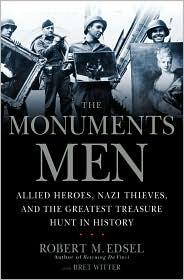
The Monuments Men
Allied Heroes, Nazi Thieves, and the Greatest Treasure Hunt in History
Robert M. Edsel’s narrative history follows a small group of art specialists serving with the Allied forces during the final phase of World War II in Europe. Members of the Monuments, Fine Arts, and Archives program entered damaged cities, advised commanders about culturally important sites, inspected churches and museums, and pursued works stolen or displaced by Nazi agencies. Concentrating largely on the period from the Normandy invasion to Germany’s defeat, the book turns cultural preservation into a frontline story. Figures including George Stout, James Rorimer, Walker Hancock, Ronald Balfour, Rose Valland, and Harry Ettlinger reveal different parts of the undertaking: conservation, intelligence gathering, military coordination, documentation, and recovery. Their work raises a larger question about what victory means when buildings, archives, religious objects, and art embody the histories of communities. The result connects military history with art crime, restitution, museum pra…
Where to buy or borrow
Are you selling this book? Bookstores, publishers, authors and libraries can be listed here for free. Request a listing
About this book
The book is especially distinctive in the way it places museum professionals and conservators inside military history. Their specialized knowledge becomes operational: they identify vulnerable monuments, assess damage, trace ownership records, recognize stolen collections, and arrange the movement of fragile objects. The narrative also demonstrates that protection and restitution were separate challenges. Finding a painting or sculpture did not automatically establish its owner or return it home. Although the title preserves the historical nickname, the wider MFAA program included women and personnel from numerous Allied nations; the book’s central cast represents only part of that larger effort.
Deep Overview
The narrative follows a selected group whose civilian professions unexpectedly become wartime qualifications. George Leslie Stout brings conservation expertise and a practical understanding of how to stabilize, pack, and transport damaged objects. James J. Rorimer combines knowledge of medieval art with investigative persistence. Sculptor Walker Hancock, architect Ronald Balfour, and others assess buildings, negotiate with military units, and search for displaced collections. Their work depends on observation and paperwork as much as courage: inventories, transport records, photographs, labels, maps, and interviews can reveal where stolen objects have gone.
Nazi cultural policy supplies the book’s darker framework. Art was treated simultaneously as ideological evidence, personal property, political prestige, and material loot. Jewish collectors and dealers were dispossessed, occupied countries were stripped of significant works, and objects judged incompatible with Nazi doctrine faced sale, dispersal, or destruction. Adolf Hitler’s cultural ambitions and the collecting appetite of Hermann Göring turned theft into an organized system supported by bureaucracies such as the Einsatzstab Reichsleiter Rosenberg.
As Allied troops move through Western Europe and into Germany, the mission shifts. Protecting churches, monuments, and museums increasingly gives way to locating concealed repositories. The trail leads to castles, tunnels, and mines holding objects removed from public institutions, religious sites, and private collections. Rose Valland’s clandestine observations at the Jeu de Paume in occupied Paris become crucial because they connect individual shipments to destinations and collections. At Neuschwanstein, records and stored objects expose the administrative scale of the plunder. At Altaussee, the recovery of treasures including the Ghent Altarpiece and Michelangelo’s Bruges Madonna gives the search its most dramatic culmination.
Edsel also emphasizes that discovery was not the end of the story. Repositories had to be secured, objects documented, unstable works conserved, and enormous holdings moved without causing further damage. Ownership could be disputed or deliberately obscured. Public collections might be identifiable, while property taken from persecuted families presented harder restitution questions. The book’s central achievement is to show that cultural preservation during war joins ethics to logistics: saving an object requires expertise, authority, records, transport, and a commitment to returning it rather than merely possessing it.
Key Themes
**Expertise in unexpected settings:** Curators, architects, artists, archivists, and conservators possess skills that become strategically valuable when armies encounter monuments and displaced collections.
**Preservation versus military necessity:** The MFAA officers work within armed forces whose immediate priority is defeating Germany. The resulting compromises prevent the story from becoming a simple account of rescuers always able to save what matters.
**Looting as administration:** Nazi theft appears not merely as opportunistic plunder but as a documented, categorized, and transported system involving state agencies, ideological judgments, and powerful individual collectors.
**Evidence and restitution:** Inventories, photographs, shipping records, and provenance information matter because physical recovery alone cannot establish rightful ownership.
**Moral reconstruction:** Restoring cultural objects is presented as part of rebuilding civic and historical continuity after occupation, persecution, and war.
Historical Context
The MFAA emerged within Allied civil-affairs and military-government structures. Its personnel sought to identify important sites before operations, discourage unnecessary damage and misuse, inspect affected monuments, and later locate displaced cultural property. The undertaking had institutional support, including protection directives, but only a small number of specialists were available across a huge and rapidly changing war zone.
The period also shaped later thinking about provenance research, restitution, and the protection of cultural heritage during armed conflict. The book’s wartime discoveries should therefore be understood as the beginning of a prolonged postwar process, not a complete resolution of Nazi-era dispossession.
Intended Audience
Readers seeking an exhaustive administrative history, a systematic study of Holocaust-era property theft, or a full account of every participating nation will need additional sources. The chosen cast and dramatic structure favor narrative momentum over comprehensive institutional coverage.
Reading Difficulty
The greatest challenge is contextual rather than stylistic. Readers must move among military operations, museum practice, Nazi cultural bureaucracy, and individual recovery missions. Some scenes also involve persecution, death, destruction, and the discovery of concentration-camp crimes. No formal background in art history or military studies is required, although familiarity with the geography and chronology of the European war will make the narrative easier to follow.
Helpful Background Knowledge
It is also useful to distinguish preservation, recovery, and restitution. Preservation tries to prevent or limit damage. Recovery concerns locating and securing displaced objects. Restitution asks who legally and morally owns those objects and how they should be returned. Basic awareness of Nazi persecution of Jewish people is essential because much of the looted property came from owners targeted by racial laws, deportation, forced sale, and murder.
Why Read This Book?
The book also provides a strong introduction to the relationship between theft and record keeping. Looting on this scale required inventories, warehouses, trains, officials, and destinations; those same bureaucratic traces later helped investigators reconstruct what happened. Finally, the narrative invites readers to consider why societies risk lives and resources for objects when human survival is already in peril—a question the book treats as a matter of memory, identity, and recovery rather than monetary value alone.
Reader Takeaways
Readers may also become more attentive to provenance—the chain of custody through which an object has passed—and to the difference between finding stolen property and returning it justly. The story demonstrates that successful preservation depends on institutions and preparation as well as individual bravery. It may also prompt reconsideration of the familiar phrase “the Monuments Men,” since the complete historical program was multinational and included women whose work deserves fuller recognition.
Strengths
Edsel also links recognizable masterpieces with less visible forms of cultural property, including archives, religious objects, libraries, and local monuments. The selected biographies give the mission emotional weight without requiring prior knowledge of museum history. Supporting notes, illustrations, and bibliographic material provide routes for readers who want to investigate the subject further.
Limitations and Scope
The treasure-hunt structure can also make recovery appear more conclusive than the wider history warrants. Many objects remained missing, ownership questions persisted, and restitution to individual victims or heirs could be delayed or denied. The book gives readers an effective introduction to these issues but is not a comprehensive study of Holocaust-era dispossession, postwar legal policy, Soviet trophy art, or later restitution disputes. Readers should also avoid treating the 2014 feature-film adaptation as a literal representation of the book or the historical record.
Important Concepts, People, Places, and Institutions
**George Leslie Stout:** An American conservator whose technical knowledge made him especially important in assessing, handling, and transporting endangered works.
**James J. Rorimer:** A Metropolitan Museum of Art curator and medieval-art specialist who pursued looted collections and documentary evidence, including material connected with Neuschwanstein.
**Rose Valland:** A French museum professional who secretly recorded information about Nazi shipments passing through the Jeu de Paume. Her intelligence helped investigators connect stolen collections with repositories.
**Walker Kirtland Hancock:** An American sculptor and MFAA officer whose fieldwork illustrates the varied cultural backgrounds recruited into the program.
**Ronald Edmond Balfour:** A British architectural historian whose work and fate underscore the danger faced by specialists operating close to active combat.
**Harry Ettlinger:** A German-born Jewish refugee serving in the U.S. Army whose language skills and personal history connect the recovery mission to exile and Nazi persecution.
**Adolf Hitler and the planned Führermuseum:** Hitler’s proposed museum at Linz represents the regime’s attempt to convert conquest and dispossession into cultural prestige.
**Hermann Göring:** A senior Nazi leader and major collector of looted art, illustrating how state plunder and personal acquisition overlapped.
**Einsatzstab Reichsleiter Rosenberg (ERR):** A Nazi organization centrally involved in cataloging and seizing cultural property, especially from Jewish owners and institutions in occupied territories.
**Jeu de Paume:** The Paris museum used as a processing point for looted art, where Valland observed and documented German activity.
**Neuschwanstein Castle:** A major repository of objects and records confiscated largely from France; its archives helped reveal the organization of Nazi looting.
**Altaussee salt mine:** An Austrian repository where major works, including the Ghent Altarpiece and Michelangelo’s Bruges Madonna, were recovered.
**Provenance and restitution:** Provenance reconstructs an object’s ownership and custody. Restitution uses such evidence to return property to a state, institution, individual, or heirs with a legitimate claim.
Questions the Book Explores
When military necessity and preservation conflict, who decides what level of destruction is acceptable?
Why did the Nazi regime devote personnel, transport, and administrative effort to controlling art and historical objects?
How can specialists prove ownership when collections have been scattered and records manipulated or destroyed?
What forms of expertise become valuable in a crisis, even when they do not resemble conventional military skills?
Does recovering an object repair the harm caused by persecution and dispossession, or only begin that process?
Why do communities regard certain buildings, archives, and works of art as essential to their identity?
Reading Group Guide
Notice scenes in which the officers possess little formal authority or inadequate transport and supplies. These episodes can open a discussion about whether the book’s achievements arise mainly from individual initiative or from institutional backing. Groups might also compare a public masterpiece such as the Ghent Altarpiece with property stolen from a private Jewish collection: both require protection, but the ownership and restitution questions differ.
Finally, examine the book’s narrative choices. Which people become the emotional center of the history? What is gained by presenting cultural recovery as a treasure hunt, and what complexities might that framing obscure? Readers familiar with the film adaptation can compare its composite characters and compressed events with the book’s historical cast.
Discussion Questions
2. Which participant’s professional background proves most unexpectedly useful in wartime?
3. Does the narrative successfully balance battlefield urgency with the importance of protecting monuments and collections?
4. How do inventories, photographs, labels, and shipping records function as instruments of both theft and recovery?
5. What does Rose Valland’s work reveal about resistance carried out through observation and documentation?
6. How does Harry Ettlinger’s experience complicate the meaning of returning to Germany in an American uniform?
7. In what ways did Nazi art policy combine ideology, personal greed, and state bureaucracy?
8. Does the phrase “treasure hunt” illuminate the story or risk minimizing persecution and dispossession?
9. At what point does safeguarding an object become inseparable from identifying its rightful owner?
10. What limitations arise from building the history around a small central cast?
11. Should cultural-protection specialists be integrated into contemporary military planning? Why?
12. After finishing the book, what do you think societies owe to people whose cultural property was taken during persecution or war?
Sources and Verification
Pagination varies by cataloging convention: the publisher gives the total manufactured extent, while some libraries separately count preliminary pages, numbered pages, and plates. The profile identifies the hardcover edition attached to the supplied ISBN. Interpretive comments about emphasis, accessibility, strengths, and limitations are editorial assessments rather than claims made by those institutions.
Comments
No published comments yet.
Available editions
Hardcover
First edition; hardcover
- Publisher
- Center Street
- ISBN-13
- 9781599951492
- Publication date
- Pages
- 496