
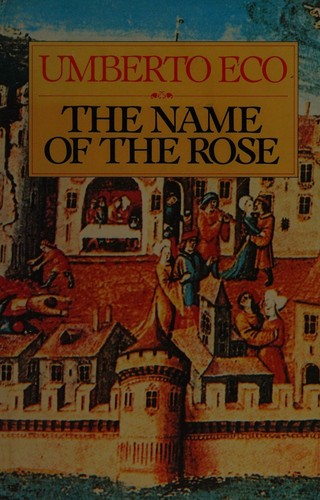
The Name of the Rose
In a secluded Benedictine abbey in 1327, a series of unexplained deaths interrupts preparations for a politically sensitive religious meeting. William of Baskerville, a Franciscan friar skilled in observation and inference, investigates with the help of Adso of Melk, the young novice who later records their experience. Their inquiry leads through theological disputes, concealed histories, encoded manuscripts, and the abbey’s forbidden labyrinthine library. Although structured as a murder mystery, The Name of the Rose is equally concerned with how people interpret signs, preserve knowledge, enforce orthodoxy, and mistake persuasive patterns for truth. Umberto Eco combines a vividly constructed medieval setting with detective fiction, philosophical argument, literary play, and reflections on censorship. The result is a novel in which solving crimes cannot be separated from examining who controls books, how institutions defend authority, and whether certainty is ever justified by the evi…
Where to buy or borrow
We don’t list any stores or libraries for this book yet.
Are you selling this book? Bookstores, publishers, authors and libraries can be listed here for free. Request a listing
About this book
Eco uses the recognizable machinery of detective fiction—clues, deductions, suspects, hidden rooms, and competing explanations—but repeatedly tests the genre’s promise that correct reasoning will produce a complete solution. The abbey functions simultaneously as a historical community, a political meeting place, and a model of knowledge under institutional control. The novel is distinguished by the density of its medieval detail, multilingual passages, philosophical debates, allusions to other writers, and tension between scholarly seriousness and intellectual play.
Deep Overview
William approaches the mystery by observing physical evidence, comparing testimony, testing hypotheses, and treating the world as a field of signs. Adso admires this method, but the novel gradually distinguishes careful inquiry from confidence in an elegant pattern. Signs require interpretation, and interpretation is always vulnerable to incomplete evidence, inherited assumptions, fear, and desire. William’s reasoning can expose falsehoods, yet it cannot guarantee that reality has been arranged as neatly as a detective expects.
The abbey’s library becomes the central image of the novel. Its collection preserves learning from many languages and cultures, but access is governed by a small hierarchy of custodians. The building is designed as a maze, turning knowledge into both treasure and instrument of power. Monks copy, translate, classify, conceal, and compete for books; intellectual curiosity exists beside censorship and institutional self-protection. The mystery therefore concerns more than individual guilt. It asks what happens when an institution claims the right to decide which ideas may circulate and which readers are permitted to encounter them.
The investigation is intertwined with histories of heresy and persecution. Characters such as Remigio of Varagine and Salvatore carry the consequences of earlier radical religious movements into the abbey. When Bernard Gui arrives as an inquisitor, inquiry changes character: ambiguity becomes incriminating, socially vulnerable people become convenient suspects, and confession matters more than open-ended examination. Eco contrasts William’s fallible but revisable reasoning with a judicial system that treats certainty as a tool of authority.
Another major conflict concerns laughter. Comic expression may appear trivial beside murder and political struggle, yet the book treats humor as a challenge to fear-based power. Laughter can puncture solemnity, weaken intimidation, and reveal that apparently permanent arrangements are human constructions. For defenders of absolute authority, that freedom can look dangerous.
By bringing detection, theology, politics, and textual interpretation together, Eco creates a novel about the limits of explanation. Adso’s account preserves fragments of a lost world, but preservation cannot restore everything that has disappeared. The reader is left to consider whether wisdom lies in finding a final pattern or in recognizing how provisional every pattern may be.
Key Themes
**Knowledge and institutional power:** The library embodies the possibility of cultural memory, while its restrictions show how preservation can become possession. Control over reading allows authorities to determine which arguments can be imagined or challenged.
**Faith, heresy, and coercion:** Theological distinctions carry political and mortal consequences. The novel examines how labels such as “heretic” may join sincere doctrinal concern with institutional self-defense.
**Laughter and fear:** Humor is presented as more than entertainment. It can unsettle rigid hierarchies by making the feared, sacred, or powerful appear open to criticism.
**Poverty and political authority:** The debate over whether Christ owned property becomes a struggle over the material foundations of ecclesiastical power.
**Memory, loss, and textual survival:** Adso writes because people, books, and buildings vanish. His testimony also demonstrates that every act of preservation selects, rearranges, and interprets what remains.
Historical Context
The period also saw intense efforts to define and prosecute heresy. The movement associated with Fra Dolcino had already been violently suppressed, but memories of it remained politically useful and personally dangerous. Eco situates fictional characters among these real disputes, showing how theological language could shape legal authority, economic interests, and social survival.
The abbey belongs to a manuscript culture in which books were copied by hand and libraries could preserve rare works unavailable elsewhere. Before printing, the loss, concealment, or destruction of a single manuscript could remove a text from circulation for generations. This gives the novel’s library both historical plausibility and symbolic force.
Intended Audience
It is less suitable for readers seeking a fast, continuously action-driven thriller. Eco frequently interrupts suspense with theological argument, historical exposition, architectural description, and Latin passages. Those willing to accept these elements as part of the mystery’s design are more likely to appreciate the book than readers primarily concerned with discovering the culprit.
Reading Difficulty
The framing narrative and retrospective voice also require attention. Adso is both the inexperienced youth inside the story and the elderly monk shaping it long afterward. The seven-day organization is clear, but numerous characters hold similar religious roles, so a character list can be useful. No formal study of medieval history is required, although patience with ambiguity and dense exposition is important.
Helpful Background Knowledge
It is also useful to recognize that the controversy over Christ’s poverty was not merely abstract theology: it affected arguments about Church property and papal power. Familiarity with the Avignon Papacy, the medieval Inquisition, Aristotle’s influence on scholastic thought, and the manually copied manuscript tradition can deepen the reading, but these subjects may also be explored as they arise. Readers need not translate every Latin sentence to follow the central narrative.
Why Read It?
The novel also turns the preservation of books into a high-stakes human conflict. Its library is not a decorative setting but a system through which authority, curiosity, secrecy, and cultural memory interact. Readers interested in misinformation, restricted access, ideological certainty, or the destruction of knowledge may find the medieval story unexpectedly relevant without reducing it to a simple modern allegory.
Reader Takeaways
The book may also encourage readers to reconsider libraries and archives as institutions shaped by choices: what is collected, classified, restricted, neglected, or destroyed affects what later communities can know. Its treatment of heresy reveals how intellectual disagreement becomes dangerous when authorities can define uncertainty as guilt. Finally, the novel suggests that humor has political force because it loosens the connection between power and unquestioned reverence.
Strengths
The abbey is exceptionally effective as both a physical environment and an intellectual model. Its regulated spaces, multilingual community, scriptorium, and labyrinth give concrete form to questions about access and authority. William and Adso provide a productive contrast between experienced skepticism and youthful formation, while the retrospective narration adds melancholy and distance. The novel also trusts readers to tolerate unresolved meanings rather than converting every symbol into a fixed lesson.
Limitations and Cautions
The story is centered overwhelmingly on male clerical institutions. Its principal female figure is deliberately unnamed and is largely encountered through Adso’s limited perspective, restricting her agency within the narrative. The abbey is a fictional construction rather than a representative portrait of all medieval monastic life, and readers should be cautious about treating every detail as general historical evidence. Eco’s elaborate allusions also create unequal experiences: readers who recognize them may perceive additional jokes and arguments unavailable to others.
Important Concepts, People, and Institutions
**Adso of Melk:** William’s fictional novice companion and the narrator of the events. The distance between young Adso’s experience and old Adso’s memory shapes the novel’s treatment of testimony.
**Jorge of Burgos:** A blind elderly monk closely associated with the library and the regulation of knowledge. His name and the labyrinthine setting evoke the Argentine writer Jorge Luis Borges.
**Bernard Gui:** A historical Dominican inquisitor used as a character in the novel. He represents an investigative method directed toward confession and conviction rather than doubt and revision.
**Pope John XXII:** The historical pope whose conflict with Franciscans over apostolic poverty forms the political background.
**Louis IV of Bavaria:** The ruler opposing John XXII in the broader contest between imperial and papal authority. The proposed meeting at the abbey is connected to this struggle.
**Michael of Cesena:** The historical minister general of the Franciscan order and an important defender of the order’s position in the poverty controversy.
**Ubertino of Casale:** A historical Spiritual Franciscan incorporated into the fiction. He connects the abbey to radical debates over poverty, reform, and heresy.
**Fra Dolcino and the Dulcinians:** Dolcino led an apocalyptic religious movement suppressed before the novel’s events. Memories of the movement haunt characters who survived religious and political violence.
**Apostolic poverty:** The controversy over whether Christ and the apostles owned property. In the novel, its importance lies in what it implies about the legitimacy of a wealthy Church.
**The Inquisition:** Ecclesiastical mechanisms for investigating heresy. Eco contrasts their demand for authoritative judgment with William’s willingness to revise interpretations.
**The library and scriptorium:** The institutional center of the abbey’s learning. Together they show how copying and preserving texts can coexist with secrecy, hierarchy, and censorship.
**Semiotics:** The study of signs and meaning, central to Eco’s scholarly work and dramatized through William’s efforts to read traces without confusing interpretation with certainty.
**Nominalism:** A philosophical position associated with William of Ockham and relevant to the novel’s concern with names, categories, and the uncertain relationship between language and reality.
Questions the Book Explores
Who should control access to knowledge, and can preservation become a form of censorship?
Why might laughter or comedy threaten an authority founded on fear and solemnity?
When does the defense of doctrine become the defense of institutional privilege?
Can legal inquiry remain just when the investigator begins with a predetermined category of guilt?
What survives when books, buildings, witnesses, and communities disappear?
Does naming something bring understanding, or can names conceal the instability of what they claim to describe?
How should a thoughtful person act when certainty is impossible but decisions cannot be postponed?
Reading Group Guide
Track changes in the meaning of the library. It may initially appear to be a setting for adventure, but it gradually becomes an institution with rules, gatekeepers, exclusions, and a theory of intellectual danger. Groups can examine whether its custodians genuinely preserve knowledge or undermine preservation through excessive control.
Give special attention to the debates about laughter. Consider why comedy becomes connected to theology, discipline, fear, and social hierarchy. Another useful approach is to examine old Adso as an editor of his younger self: what does he understand only retrospectively, and where does memory remain uncertain?
Because the novel rewards competing interpretations, participants may each select one image—the maze, mirror, book, rose, fire, poison, or Apocalypse—and trace how its significance changes across the seven days.
Discussion Questions
2. How does Adso’s youthful inexperience affect the story he later tells?
3. Is the abbey’s library primarily a refuge for knowledge, a prison for it, or both?
4. Why does the novel make laughter a matter of intellectual and institutional danger?
5. How does the poverty controversy connect religious doctrine to wealth and political authority?
6. What differences does the novel establish between heresy, dissent, error, and criminality?
7. How does Bernard Gui’s presence change the meaning of investigation and justice?
8. Which parts of the monastery’s crisis arise from individual choices, and which arise from its institutional structure?
9. Does the novel ultimately defend rational inquiry, criticize it, or ask readers to practice a more modest form of it?
10. What does the framing story suggest about the reliability of manuscripts, translations, memories, and narrators?
11. How does Eco use the conventions of Sherlock Holmes-style detection while challenging them?
12. After finishing the novel, what meanings—if any—do you attach to its title?
Sources and Verification
Comments
No published comments yet.
Available editions
Other format
Original Italian first edition; specific English edition not supplied
- Publisher
- Bompiani