
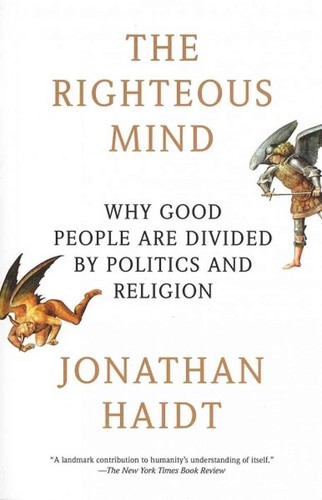
The Righteous Mind
Why Good People Are Divided by Politics and Religion
Why do sincere, decent people reach sharply opposed conclusions about politics, religion, and morality? Social psychologist Jonathan Haidt argues that moral judgment usually begins with rapid intuition, while conscious reasoning often arrives afterward to explain or defend what already feels right. He then presents morality as a plural system: people respond to several concerns—including care, fairness, loyalty, authority, sanctity, and liberty—but cultures and political groups assign them different weight. The final part examines humanity’s capacity to form cohesive groups, proposing that the same moral instincts that make cooperation, institutions, and religious communities possible can also produce tribalism and hostility. Combining psychological research, evolutionary argument, anthropology, political analysis, and memorable metaphors, The Righteous Mind offers a framework for interpreting disagreement without assuming that one’s opponents are merely ignorant or malicious. Its cen…
Where to buy or borrow
Are you selling this book? Bookstores, publishers, authors and libraries can be listed here for free. Request a listing
About this book
Deep Overview
The second movement broadens the content of morality. Haidt argues that much Western psychological research relied heavily on educated, individualistic populations and consequently treated harm and fairness as if they exhausted the moral domain. Drawing partly on cross-cultural work associated with anthropologist Richard Shweder, he presents morality as responsive to several recurring concerns. Care addresses suffering and protection; fairness concerns cooperation, reciprocity, equality, and proportionality; loyalty supports solidarity; authority organizes expectations around rank and legitimate order; sanctity responds to purity, degradation, and elevation; and liberty resists domination. Haidt compares these foundations to taste receptors: cultures and ideologies produce different moral ‘cuisines’ from partly shared capacities.
He applies this framework most extensively to American political differences. In the book’s account, liberals tend to emphasize care and fairness, while conservatives draw more evenly upon care, fairness, loyalty, authority, and sanctity. Libertarians are especially responsive to liberty and coercion. Haidt’s purpose is not to say that every individual fits a fixed profile, but to explain why political messages persuasive within one moral matrix can sound empty or threatening within another. He also argues that conservatives have often possessed a rhetorical advantage because they speak to a wider range of moral concerns.
The final movement turns from individual judgment to collective life. Humans, Haidt argues, are not simply self-interested individuals; they also possess conditional capacities for intense group identification. His controversial evolutionary discussion uses multilevel selection to explain how cooperation among groups could coexist with competition within them. Institutions, rituals, shared threats, and sacred values can activate a ‘hive switch,’ producing trust and self-transcendence. Religion appears here chiefly as a set of practices and communities that coordinate people, not merely as a collection of supernatural propositions.
These strands converge in the claim that morality binds and blinds. Shared values enable sacrifice, cooperation, and durable institutions, yet the same loyalties conceal weaknesses within one’s group and exaggerate the faults of outsiders. The book concludes by urging readers to treat political opponents as inhabitants of intelligible moral worlds and to approach disagreement with greater curiosity, humility, and attention to the concerns the other side is trying to protect.
Key Themes
**Moral pluralism:** A society’s moral language cannot always be reduced to preventing harm or distributing benefits fairly. Communities may also moralize loyalty, legitimate authority, purity, sacredness, and freedom from domination.
**Moral matrices:** Ideologies provide interpretive worlds in which some concerns become vivid and others recede. Disputants can therefore use the same words—such as justice, freedom, or responsibility—while assigning them different meanings.
**Groupishness and cooperation:** Human beings can cooperate at remarkable scale when identities, rituals, institutions, and shared purposes align them. That capacity supports civic and religious life but also intensifies rivalry between groups.
**Sacred values:** When an object, principle, leader, or institution becomes sacred, compromise may feel like betrayal rather than negotiation. Sacredness can inspire devotion while limiting critical scrutiny.
**Understanding without automatic agreement:** Haidt asks readers to reconstruct opponents’ moral concerns before judging them. The intended outcome is not relativism or political neutrality, but more accurate disagreement.
Historical and Intellectual Context
Its cross-cultural argument also reacts against research based disproportionately on people from Western, educated, industrialized, affluent, and democratic societies—the population summarized in the book by the acronym WEIRD. Richard Shweder’s anthropological work in Odisha, India, was especially important to Haidt’s effort to see morality as encompassing autonomy, community, and divinity rather than autonomy alone.
Politically, the book was written amid increasing concern about American partisan polarization and institutional gridlock. It addresses liberalism, conservatism, and libertarianism mainly through a U.S. framework, while drawing broader claims about moral diversity and coalition-building.
The later chapters enter an enduring evolutionary controversy. Haidt draws on Charles Darwin, Émile Durkheim, and modern arguments about multilevel selection to explain religion, ritual, and collective commitment. This places the book at the intersection of social psychology, anthropology, evolutionary theory, political thought, and the sociology of religion.
Intended Audience
Readers who want an accessible entrance to Moral Foundations Theory will find a sustained explanation rather than a technical manual. Politically engaged readers may value the invitation to understand rival outlooks from within, especially if they are tired of explanations based entirely on stupidity, selfishness, or bad faith.
It may be less satisfying for readers seeking a neutral survey of all theories of morality, a systematic philosophical defense of what people ought to value, or a detailed history of partisan polarization. Readers strongly resistant to evolutionary explanations of social behavior may also dispute a substantial part of its framework.
Reading Difficulty
The conceptual difficulty is moderate. Readers must keep several distinctions in view: intuition versus reasoning, descriptive psychology versus normative ethics, individuals versus groups, and moral foundations versus specific political positions. The evolutionary chapters are denser than the opening psychological chapters because they address selection at multiple levels and debates over altruism and cooperation.
The book includes substantial notes, references, and examples. A reader can follow the central argument without consulting every citation, but careful evaluation of the evidence requires attention to the supporting material. Because the three major parts build upon one another, reading them in order is more rewarding than treating the chapters as independent essays.
Helpful Background Knowledge
Readers may also benefit from a basic awareness of evolutionary ideas such as natural selection, adaptation, cooperation, kin selection, and competition among groups. For the sections on moral development, knowing that Lawrence Kohlberg emphasized reasoning about justice provides a helpful contrast. For the discussion of religion, recognizing the difference between evaluating doctrinal truth and investigating social function prevents a common misunderstanding of Haidt’s approach.
No preparatory reading is essential. A simple question is enough to orient the reader: when people disagree morally, are they applying different logic to shared values, or are they beginning from different perceptions of what deserves moral concern?
Why Read This Book?
It is also valuable as an unusually broad synthesis. Experiments in psychology are connected to anthropology, political rhetoric, evolutionary cooperation, institutional design, and religious ritual. Readers can therefore see how a theory of individual judgment scales into an account of parties, congregations, nations, and social movements.
Finally, the book models an intellectually demanding form of charity: taking an opposing view seriously enough to identify the human goods it may be trying to preserve, without requiring agreement with its conclusions or consequences.
Reader Takeaways
The book can also sharpen interpretation of public language. Appeals to compassion, equal treatment, earned reward, patriotism, tradition, purity, and freedom do not merely decorate political arguments; they activate different understandings of moral order.
Readers may leave with a more complex picture of groups. Belonging is neither simply irrational nor automatically virtuous. It makes trust, sacrifice, and cooperation possible, while generating conformity, exclusion, and selective blindness.
The most practical takeaway is a change in conversational sequence: first identify the values and intuitions at stake, then offer reasons. This does not guarantee agreement, but it can reduce caricature and make disagreement more informative.
Strengths
Haidt’s metaphors are unusually effective explanatory tools. The elephant and rider clarify the unequal relationship between automatic reactions and deliberate reasoning; moral taste buds illustrate plurality without implying that every culture or person expresses each concern identically; binding and blinding captures the double character of solidarity.
The analysis is self-implicating. Readers are repeatedly encouraged to examine motivated reasoning within their own group rather than diagnosing only opponents. That feature makes the book useful for discussion across ideological or religious difference.
Its treatment of religion is also broader than a belief-versus-unbelief debate. By examining ritual, coordination, sacredness, and communal commitment, Haidt directs attention to what religious groups do socially as well as what their members affirm doctrinally.
Limitations and Cautions
The book sometimes states the priority of intuition so forcefully that it can underrepresent reflection, education, institutions, and sustained deliberation as causes of moral change. Its memorable rider-and-elephant metaphor is illuminating, but metaphors simplify as well as clarify.
The political analysis centers heavily on U.S. liberal, conservative, and libertarian identities as they appeared around the book’s composition. Political coalitions change, and moral appeals do not belong permanently to one side. Class, race, gender, media systems, leadership, economic interest, and institutional incentives receive less systematic attention than moral psychology.
Haidt generally aims to explain moral outlooks, but descriptive claims can slide toward recommendations that political actors should employ a broader moral palette. Readers should distinguish evidence about what persuades people from arguments about which values or policies deserve endorsement.
The multilevel-selection account of groupishness is stimulating but controversial. It should be read as a substantive theoretical position rather than settled consensus.
Important Concepts, People, and Traditions
**Social intuitionist model:** Haidt’s account of moral judgment as primarily intuitive and socially influenced, with reasoning often used to justify judgments and influence other people.
**Moral Foundations Theory:** The framework used to explain recurring moral concerns and variation among cultures and ideologies. In the book these include care/harm, fairness/cheating, loyalty/betrayal, authority/subversion, sanctity/degradation, and liberty/oppression.
**The rider and the elephant:** A metaphor in which controlled reasoning is the rider and the much larger field of automatic intuition is the elephant. The relationship is influential rather than fully commanding.
**Moral matrix:** A shared web of intuitions, narratives, practices, and sacred values that makes one social world feel self-evidently right while obscuring alternatives.
**The hive switch:** Haidt’s term for conditions under which people experience diminished self-focus and strong identification with a group or collective purpose.
**WEIRD populations:** Western, educated, industrialized, rich, and democratic populations. The acronym highlights the danger of generalizing about humanity from culturally narrow research samples.
**Richard Shweder:** A cultural anthropologist whose work on moral diversity, particularly research in Odisha, India, influenced Haidt’s move beyond an exclusively harm-and-fairness account.
**David Hume:** The Scottish philosopher invoked as an intellectual precursor to the view that sentiment and passion play a foundational role in moral judgment.
**Lawrence Kohlberg:** A psychologist associated with stage theories emphasizing increasingly sophisticated conscious moral reasoning, an approach against which Haidt defines important parts of his argument.
**Charles Darwin:** His work supplies an evolutionary starting point for the book’s discussion of social instincts, cooperation, and competition among groups.
**Émile Durkheim:** The sociologist whose account of collective ritual and sacred community helps frame religion as a force that joins individuals into moral communities.
**Multilevel selection:** An evolutionary approach considering selection operating at more than one level, including competition among groups. Haidt uses it to explain how group-oriented traits could develop despite individual self-interest.
**Sacredness:** The process by which values or objects are placed beyond ordinary bargaining. Sacred commitments can coordinate communities but can also block compromise and critical examination.
Questions the Book Explores
Why can evidence that seems decisive within one political community fail to persuade another?
Is morality principally about protecting individuals from harm and unfairness, or does it also include duties involving loyalty, authority, sacredness, and liberty?
How much of moral diversity reflects shared psychological capacities shaped differently by culture?
Why do liberals, conservatives, and libertarians respond to different moral arguments?
How do rituals, institutions, and sacred values transform individuals into cooperative groups?
Can religion be understood partly through its ability to create trust and coordination, independently of debates about theological truth?
When does group loyalty generate public goods, and when does it encourage conformity, exclusion, or conflict?
What would constructive political disagreement require if reasoning alone rarely changes minds?
Reading Group Guide
For the first part, invite participants to identify an occasion when reasons genuinely changed an intuition and another when reasons merely defended an existing reaction. Compare those experiences with the rider-and-elephant model.
When discussing the foundations, avoid assigning participants permanent ideological labels. Instead, choose a contested issue and map the competing appeals to care, equality, proportionality, loyalty, authority, sanctity, or liberty. Notice whether the same foundation can support opposed positions.
In the final part, compare a group that creates trust and mutual aid with one that demands harmful conformity. Discuss whether the book provides adequate criteria for distinguishing healthy solidarity from dangerous tribalism.
Consider reading the conclusion alongside one scholarly criticism of Moral Foundations Theory. This makes it possible to assess the framework as a testable theory rather than accepting or rejecting it solely because its political implications feel agreeable or uncomfortable.
End by having each participant formulate the strongest good-faith account of a viewpoint they oppose, then identify what evidence or moral concern still prevents agreement.
Discussion Questions
2. What evidence would show that a moral intuition had been changed rather than merely suppressed or redescribed?
3. Are care, fairness, loyalty, authority, sanctity, and liberty separate foundations, or different expressions of more basic concerns?
4. Can a moral value be psychologically widespread yet ethically wrong? How should that affect the use of Moral Foundations Theory?
5. Does Haidt characterize liberalism and conservatism fairly, or does his framework privilege certain forms of community and social order?
6. How might race, class, gender, economic interest, and media institutions complicate the book’s psychological explanation of polarization?
7. Can the same foundation support both progressive and conservative positions? Which examples are most revealing?
8. What distinguishes constructive loyalty from tribalism and legitimate authority from domination?
9. Does explaining religion through cohesion and cooperation illuminate religious life, reduce it too narrowly, or both?
10. When should sacred values be protected from bargaining, and when should they be opened to criticism and compromise?
11. Does greater understanding of an opponent create any obligation to accommodate that opponent?
12. Which of the book’s claims seems most useful for improving political conversation, and which seems most vulnerable to misuse?
Sources and Verification
Comments
No published comments yet.
Available editions
Hardcover
hardcover
- Publisher
- Knopf
- ISBN-13
- 9780307377906
- Publication date