
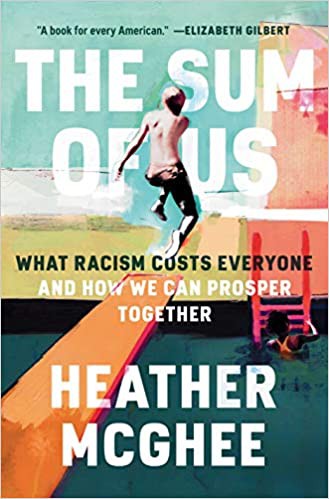
The Sum of Us
What Racism Costs Everyone and How We Can Prosper Together
Heather McGhee examines a central contradiction in American public life: policies shaped by racial division often harm the people they are presented as protecting. Drawing on economic research, political history, interviews, and reporting across the United States, she connects racism to weakened public services, barriers to healthcare, declining worker power, housing inequality, environmental danger, and restrictions on democratic participation. Her governing idea is the “zero-sum” story—the belief that progress for people of color must mean loss for white people. The book’s defining image is the public swimming pool that officials chose to close rather than integrate, sacrificing a shared resource to preserve racial exclusion. Against that pattern, McGhee develops the “Solidarity Dividend”: the material and civic gains made possible when people organize across racial lines. The result is both a diagnosis of American inequality and an argument that racial justice and broadly shared pr…
Where to buy or borrow
Are you selling this book? Bookstores, publishers, authors and libraries can be listed here for free. Request a listing
About this book
Deep Overview
McGhee calls the underlying belief the zero-sum paradigm: if Black, Indigenous, immigrant, or other people of color gain security or opportunity, white people must be losing it. She traces this logic to the creation of racial categories and to systems that offered status to many white people without giving them equal economic power. The bargain encouraged identification with racial privilege rather than solidarity with others facing low wages, insecure housing, weak public services, or concentrated corporate power.
The drained swimming pool becomes the book’s clearest institutional metaphor. In several American cities, public pools were closed or abandoned when desegregation threatened white exclusivity. The immediate victims were Black residents denied equal access, but the decision also deprived white residents of a public amenity. Private alternatives then made recreation more dependent on personal wealth. McGhee treats this as a model for a wider retreat from public goods: rather than extend a shared benefit across racial lines, political leaders and voters may accept diminished provision for everyone.
Subsequent chapters apply this framework to major areas of American life. McGhee considers opposition to universal healthcare and Medicaid expansion; predatory lending that first targeted Black and Latino borrowers before spreading more widely; weakened labor organization in workplaces where racial division frustrates collective bargaining; voter suppression and the unfinished democratization of the United States; housing segregation and the racial wealth gap; and environmental threats that cannot be contained within racial or neighborhood boundaries. These cases are connected by a recurring structure: harms are distributed unequally, but their effects expand outward, weakening institutions on which broader populations depend.
The argument does not suggest that racism’s costs are equal. McGhee remains explicit that people of color bear its most direct and severe injuries. Her intervention is to show that racial hierarchy also produces collateral losses—lower wages, weaker democracy, poorer infrastructure, reduced trust, environmental vulnerability, and moral distortion—that reach beyond its primary targets.
The closing movement turns toward the Solidarity Dividend, McGhee’s term for gains achieved through cross-racial collective action. Labor campaigns, environmental organizing, community renewal, and other alliances demonstrate that solidarity is not merely a benevolent attitude. It can create practical benefits unavailable to divided groups. The book therefore moves from exposure to reconstruction: Americans must replace a story of racial competition with institutions and identities capable of supporting a genuinely inclusive common good.
Key Themes
• Racism as an economic and political system: The book treats racism as more than personal hostility. It operates through rules governing public investment, credit, labor, housing, healthcare, environmental risk, and voting power.
• The decline of public goods: Shared institutions become politically vulnerable when voters associate their benefits with racial groups they have been taught to distrust.
• Divide-and-rule politics: Racial antagonism can protect concentrated wealth and institutional power by preventing people with common material interests from forming durable coalitions.
• Unequal harm with widespread consequences: McGhee does not flatten the differences between racism’s direct targets and its collateral victims. Instead, she shows how an unequal system eventually weakens the society surrounding it.
• Solidarity as productive power: Cross-racial cooperation can generate higher wages, healthier communities, stronger democratic participation, and more capable public institutions. Solidarity produces outcomes, not just goodwill.
• Belonging and national identity: The book asks whether Americans can define the public as genuinely inclusive rather than treating full citizenship as a scarce racial possession.
Historical Context
Twentieth-century public policy expanded opportunity for many Americans through New Deal programs, labor protections, infrastructure, education, and federally supported homeownership. Yet access was often segregated or administered in ways that excluded Black Americans. As the civil rights movement challenged formal racial barriers, political appeals increasingly associated government, taxation, welfare, and urban decline with racialized stereotypes. McGhee places the modern turn against public provision within this post–civil rights history.
The book also belongs to the period following the 2008 financial crisis, when predatory mortgage lending, mass foreclosure, student debt, wage stagnation, and rising inequality intensified debate over whom the economy serves. It was published in February 2021 after nationwide protests following George Floyd’s murder and during the COVID-19 pandemic, events that made racial inequality, public health, policing, and collective responsibility especially visible.
Intended Audience
Readers who understand racism primarily as individual prejudice may find its institutional approach clarifying. Those accustomed to separating class politics from racial justice will encounter a sustained case for analyzing them together. The book may be less suitable for readers seeking a technical economic monograph, a comprehensive chronological history of race in the United States, or a step-by-step organizing manual. Its purpose is synthetic and persuasive: it connects research and reported examples to a broad account of why shared prosperity has proved politically difficult.
Reading Difficulty
The chapter structure is cumulative rather than strictly chronological. Each major policy case adds evidence to the same zero-sum framework, so attention to the recurring concepts matters more than memorizing dates. The original hardcover is substantial at 448 pages and includes extensive supporting notes. Readers unfamiliar with American policy history may progress more slowly through the denser analytical passages, but no specialized academic training is required.
Helpful Background Knowledge
Before beginning, it may be useful to consider how American public goods—schools, parks, transportation, healthcare, clean air, and voting systems—are funded and who controls access to them. Readers should also keep in mind that racial categories have changed historically; the book is concerned not only with fixed identities but with the political work performed by definitions of whiteness and belonging.
Why Read This Book
It is also worth reading because it complicates a common choice between race-centered and class-centered explanations of inequality. McGhee argues that racial division is one of the means by which economic inequality is maintained, while economic insecurity can make zero-sum racial appeals more effective. Readers looking for an account that combines historical responsibility with the possibility of collective action will find a serious attempt to explain both damage and repair.
Reader Takeaways
Readers may also reconsider the meaning of self-interest. McGhee’s examples suggest that supporting racial justice need not be framed as charity from one group to another; it can be part of building institutions that serve a wider public while still addressing unequal harms directly. Finally, the book provides language—the drained pool, the zero-sum paradigm, and the Solidarity Dividend—for discussing how exclusion reduces collective capacity and how cooperation can restore it.
Strengths
Her interviews give abstract systems recognizable human consequences, while the policy research prevents the narrative from becoming a collection of isolated anecdotes. The book is especially effective when demonstrating feedback loops—for example, how racial exclusion weakens a public institution, how that weakness increases reliance on private wealth, and how privatization then deepens inequality.
Another strength is the distinction between primary and collateral harm. The argument that racism damages everyone is not used to deny that its burdens fall most heavily on particular communities. This allows McGhee to make a broad coalition argument without treating all experiences as equivalent.
Limitations and Scope Boundaries
Zero-sum racial thinking is the book’s principal explanatory lens. Readers may reasonably ask how its relative importance varies alongside regional history, party organization, religion, immigration, corporate strategy, gender, and differing forms of class interest. The Solidarity Dividend is a persuasive orienting concept, but the examples do not amount to a universal blueprint for building or maintaining coalitions under every political condition.
Because the book was completed around the upheavals of 2020 and published in early 2021, later policy changes and subsequent political developments fall outside the original hardcover’s scope.
Important Concepts, People, Places, and Institutions
• Zero-sum paradigm: The belief that progress, status, or resources gained by one racial group must be taken from another. It is the book’s central explanation for opposition to broadly beneficial policies.
• Solidarity Dividend: McGhee’s name for gains created when people work across racial divisions toward shared objectives, including better wages, public investment, and environmental protection.
• Drained-pool politics: The pattern symbolized by municipalities closing public swimming pools rather than integrating them. It represents the destruction of common goods to preserve exclusion.
• Montgomery, Alabama; New Orleans, Louisiana; and St. Louis, Missouri: Cities associated in the book and its official reading materials with public pools whose histories illuminate resistance to desegregation.
• Demos: The policy organization McGhee formerly led. Her work there forms part of the intellectual background to her questions about economic inequality and blocked reform.
• Predatory and subprime mortgages: Lending practices central to the book’s explanation of how financial exploitation targeted Black and Latino communities before contributing to a wider foreclosure crisis.
• Redlining and the racial wealth gap: Interconnected structures through which housing policy and discriminatory lending restricted wealth accumulation for Black families while supporting many white homeowners.
• United Auto Workers and the Nissan plant in Mississippi: The union campaign provides a case study in how racial division can weaken worker organization even when employees share economic concerns.
• Fight for $15: A worker movement used to illustrate how organizing around wages can bring people of different racial and immigrant backgrounds into common cause.
• Voting Rights Act and Shelby County v. Holder: Key reference points in the book’s treatment of voter suppression and the unfinished project of multiracial democracy.
• Lewiston, Maine: A former mill city where immigration and community change help McGhee illustrate how newcomers can contribute to renewal rather than fit a zero-sum narrative of scarcity.
• Environmental justice: The principle that pollution and climate risks are distributed through political and racial inequality, while the resulting ecological threats ultimately cross community boundaries.
• James Baldwin and Toni Morrison: Black writers invoked as intellectual predecessors to the argument that racism deforms those who sustain it as well as those it directly oppresses.
Questions the Book Explores
• How has racial hierarchy shaped white Americans’ attitudes toward government and collective provision?
• Who benefits when workers and voters interpret their interests through racial competition?
• Why can discrimination that begins with a targeted group spread into wider institutional and economic harm?
• How are the racial wealth gap, housing segregation, and financial instability connected?
• What prevents multiracial worker coalitions from forming or succeeding?
• Can the United States become a full democracy while access to voting remains racially unequal?
• How do segregation and environmental injustice reduce society’s capacity to respond to climate threats?
• What emotional or moral costs accompany investment in racial hierarchy?
• Under what conditions can cross-racial cooperation produce lasting public benefits?
Reading Group Guide
Assign small groups different policy chapters—healthcare, housing and lending, labor, democracy, segregation, or the environment. Each group can map the direct racial harm, the wider social cost, the actors who benefit from division, and the form of solidarity McGhee presents or implies.
Pay attention to the movement between data and interviews. Discuss which type of evidence is most persuasive to different readers and whether the personal stories complicate or mainly illustrate the larger thesis. The final meeting might examine a local public good and ask what an equitable Solidarity Dividend would require, including how targeted remedies and universal benefits could work together.
Discussion Questions
2. What does the drained swimming pool reveal that a statistical account of disinvestment might not?
3. Does the zero-sum paradigm explain opposition to public programs better in some policy areas than in others?
4. How does McGhee distinguish shared interests from identical experiences of harm?
5. When can appeals to common economic interest overlook the need to repair specifically racial injustices?
6. What obstacles prevent workers of different racial backgrounds from recognizing or acting on common interests?
7. How do housing policy and mortgage lending shape political power as well as household wealth?
8. What relationship does the book establish between racial exclusion and democratic legitimacy?
9. Which example of a Solidarity Dividend seems most transferable to another community, and which depends most on local circumstances?
10. How does McGhee’s use of interviews affect the tone and persuasiveness of the argument?
11. What institutions in your community resemble shared pools, and who has unequal access to them?
12. What would count as evidence that a cross-racial coalition has produced durable change rather than a temporary alliance?
Sources and Verification
Comments
No published comments yet.
Available editions
Hardcover
hardcover
- Publisher
- One World
- ISBN-13
- 9780525509561
- Publication date
- Pages
- 448