
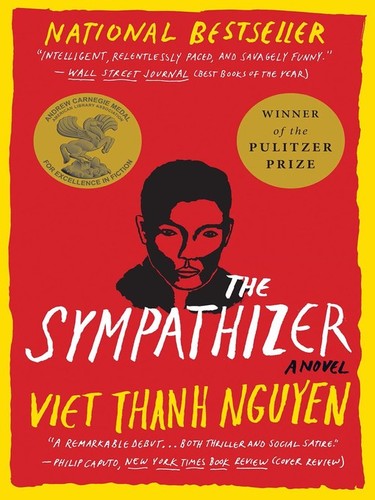
The Sympathizer
The Sympathizer is a literary espionage novel framed as the confession of an unnamed Vietnamese narrator being held and interrogated. A communist agent embedded in the South Vietnamese military, he escapes Saigon with a general and other refugees in April 1975, resettles in Southern California, and continues reporting to his revolutionary contact. His divided assignment forces him to betray people he loves while participating in an exile community that regards communist victory as catastrophe. The novel moves beyond conventional spy suspense by making divided consciousness its central method. The narrator is Vietnamese and partly French, communist and American-educated, observer and participant, betrayer and loyal friend. His ability to recognize competing perspectives gives him unusual insight, but it does not grant moral freedom. Instead, every allegiance creates another obligation he cannot satisfy. The narrative expands from the fall of Saigon and refugee resettlement into politic…
Where to buy or borrow
Are you selling this book? Bookstores, publishers, authors and libraries can be listed here for free. Request a listing
About this book
The novel moves beyond conventional spy suspense by making divided consciousness its central method. The narrator is Vietnamese and partly French, communist and American-educated, observer and participant, betrayer and loyal friend. His ability to recognize competing perspectives gives him unusual insight, but it does not grant moral freedom. Instead, every allegiance creates another obligation he cannot satisfy.
The narrative expands from the fall of Saigon and refugee resettlement into political organizing, assassination, filmmaking, a disastrous attempt to return to Vietnam, imprisonment, and ideological reeducation. A prolonged Hollywood episode satirizes the production of an American war film in which Vietnamese people remain expendable scenery. Through that storyline, the book argues that control over representation can outlast military defeat: America may have lost the war, yet American culture retained enormous power to define what the war meant. Nguyen has described the novel as an attempt to revisit the conflict from Vietnamese perspectives and challenge the recentering of Americans in popular representations. ([groveatlantic.com](https://groveatlantic.com/core/wp-content/uploads/2017/04/Spring2015.pdf))
Deep Overview
The novel moves beyond conventional spy suspense by making divided consciousness its central method. The narrator is Vietnamese and partly French, communist and American-educated, observer and participant, betrayer and loyal friend. His ability to recognize competing perspectives gives him unusual insight, but it does not grant moral freedom. Instead, every allegiance creates another obligation he cannot satisfy.
The narrative expands from the fall of Saigon and refugee resettlement into political organizing, assassination, filmmaking, a disastrous attempt to return to Vietnam, imprisonment, and ideological reeducation. A prolonged Hollywood episode satirizes the production of an American war film in which Vietnamese people remain expendable scenery. Through that storyline, the book argues that control over representation can outlast military defeat: America may have lost the war, yet American culture retained enormous power to define what the war meant. Nguyen has described the novel as an attempt to revisit the conflict from Vietnamese perspectives and challenge the recentering of Americans in popular representations. ([groveatlantic.com](https://groveatlantic.com/core/wp-content/uploads/2017/04/Spring2015.pdf))
Key Themes
• Ideology versus human attachment: Revolutionary principles repeatedly conflict with friendship, love, gratitude, and responsibility. The narrator can justify betrayal politically without escaping its personal consequences.
• Refuge, exile, and displacement: Resettlement in the United States brings safety but also lost status, economic humiliation, nostalgia, racialization, and pressure to construct usable versions of the past.
• War and cultural memory: The novel asks who receives narrative authority after war. Its Hollywood satire shows how Vietnamese suffering can be marginalized even in works supposedly critical of American intervention.
• Colonial inheritance: The narrator’s French-Vietnamese parentage embodies the continuing effects of French colonialism. His mixed background complicates his social position and sense of belonging before American power enters the story.
• Complicity: Few institutions or political factions remain morally untouched. The narrator’s communist commitments do not prevent him from recognizing revolutionary cruelty, while his criticism of the United States does not erase his attraction to parts of American life.
• Confession and coercion: Because the story is addressed to interrogators, narration is never simply private self-expression. Confession becomes a struggle over who may interpret the narrator’s life and what ideological lesson it must yield.
Historical and Cultural Context
Its refugee characters arrive with sharply different interpretations of the war. For many anticommunist exiles, April 1975 represents national loss, abandonment, and the beginning of permanent displacement. For the narrator’s communist comrades, it represents liberation and revolutionary victory. The novel refuses to collapse these incompatible memories into a single reconciled account.
The book was published in April 2015, around the fortieth anniversary of the fall of Saigon, a timing explicitly noted in Grove Press’s publication catalog. Its intervention is also literary and cinematic: Nguyen writes against a large body of American Vietnam War narratives in which Vietnamese people appear primarily as victims, enemies, or background figures in American stories. The author has repeatedly connected the novel to questions about Hollywood, propaganda, memory, and the cultural power to define a war after it ends. ([groveatlantic.com](https://groveatlantic.com/core/wp-content/uploads/2017/04/Spring2015.pdf))
Intended Audience
It is a strong choice for college courses and serious reading groups because its plot can be discussed alongside questions of narrative reliability, ideology, race, representation, and historical memory. Readers primarily seeking a straightforward thriller may find its extended philosophical passages and verbal density demanding. Those sensitive to depictions of assassination, sexual violence, torture, psychological coercion, wartime death, racism, and dehumanizing language should approach it with care.
Reading Difficulty
The confessional structure also complicates interpretation. The narrator writes under coercive conditions, addresses unseen authorities, withholds information, and revises his understanding as the account progresses. Readers must distinguish among what he believed during an event, what he claims while narrating it, and what his interrogators expect him to admit.
Detailed prior knowledge of the war is not required, but familiarity with the 1975 fall of Saigon, South Vietnamese exile communities, French colonialism in Vietnam, and American Vietnam War films will make the satire and political conflicts easier to follow.
Helpful Background Knowledge
It is also useful to recognize that the conflict has different names and narrative traditions. “Vietnam War” centers the place where Americans fought, while “American War,” used in Vietnam, centers the foreign power involved. This difference illustrates the novel’s broader concern with naming and perspective.
Familiarity with American war films—particularly productions that criticize the war while still centering American experience—will sharpen the Hollywood chapters. Readers do not need to identify one exact real-world film behind the fictional production; the sequence works as a critique of an industry and narrative pattern rather than merely as parody of a single movie.
Why Read This Book?
The novel is particularly valuable for readers interested in perspective. Rather than adding Vietnamese characters to an established American war story, it changes the narrative center and makes Americans peripheral, strange, or satirically observed. The book’s formal ambition was recognized by the 2016 Pulitzer Prize for Fiction, which officially lists The Sympathizer by Viet Thanh Nguyen as that year’s winner. ([pulitzer.org](https://www.pulitzer.org/sites/default/files/content/2016/pulitzer100fictionbookmark.pdf))
Potential Reader Takeaways
The book also encourages skepticism toward stories that claim to represent an entire war. Every account selects protagonists, background figures, victims, villains, and meaningful deaths. The novel invites readers to ask not only whether a representation opposes war, but whose suffering and interior life it recognizes.
Finally, the narrative complicates easy distinctions between sympathy and responsibility. Seeing multiple sides can humanize opponents, but insight alone does not prevent cruelty. The narrator’s broad sympathy sometimes becomes an excuse for indecision or an instrument that helps him understand the people he betrays.
Editorial Strengths
The novel also joins multiple genres without reducing itself to any one of them. Espionage supplies secrecy and suspense; satire exposes racial and political absurdities; historical fiction establishes the pressures of 1975 and its aftermath; and the psychological narrative explores guilt, trauma, friendship, and fractured identity.
Its critique of representation is unusually concrete. Rather than discussing cultural erasure only in abstract terms, Nguyen places the narrator inside a film production where money, casting, dialogue, spectacle, and control over death determine whose version of Vietnam reaches an audience. The publisher’s original catalog identifies the book’s concern with the war’s legacy in both literature and film. ([groveatlantic.com](https://groveatlantic.com/core/wp-content/uploads/2017/04/Spring2015.pdf))
Limitations and Reader Cautions
Although the novel broadens the range of Vietnamese perspectives available in American fiction, no single narrator can encompass the experiences of Vietnamese communists, South Vietnamese civilians and soldiers, refugees, women, mixed-race people, or later generations. The narrator’s viewpoint is shaped by his gender, education, political role, and unusual access to elite military and cultural institutions.
Women are crucial to the narrator’s emotional and political education, but much of their characterization remains mediated through his desire, guilt, memory, or incomplete understanding. Reading groups may reasonably debate whether the novel exposes this limitation in its narrator, reproduces it, or does both.
The book contains severe violence and degradation, including torture and sexual violence. These episodes are central to its examination of coercion and ideology, but they can be distressing and should not be treated merely as thriller spectacle.
Important Concepts and Reference Points
• The General: The narrator’s South Vietnamese superior, who becomes a leader within the Los Angeles exile community.
• Man and Bon: The narrator’s two closest friends, whose opposed political positions make personal loyalty inseparable from ideological betrayal.
• The fall of Saigon: The April 1975 collapse of South Vietnam and starting point of the narrative.
• Diaspora: A dispersed population maintaining emotional, cultural, familial, or political relationships with a homeland.
• Assimilation: Adaptation to a receiving society, often accompanied in the novel by pressure, racial hierarchy, economic loss, and contested belonging.
• Colonialism: The political and cultural domination represented by France’s historical rule in Vietnam and by the narrator’s mixed parentage.
• Orientalism and racial representation: Patterns that reduce Asian people to stereotypes, scenery, interchangeable ethnic identities, or objects of Western interpretation.
• The industry of memory: A useful framework for understanding how states, publishers, filmmakers, memorials, and other institutions produce influential versions of war.
• Reeducation: The revolutionary practice of subjecting defeated opponents—or insufficiently compliant comrades—to ideological instruction, confession, detention, and coercion.
Questions the Novel Explores
Reading Group Guide
Before meeting, ask readers to mark one passage where the narrator’s irony conceals pain and another where humor makes violence more disturbing rather than less serious. It can also be useful to list the different audiences for his confession: the commandant, the commissar, himself, and the book’s external reader.
For historical grounding, review a short account of the April 1975 evacuation and refugee resettlement. For comparative discussion, consider a familiar American Vietnam War film and ask whose interior lives it develops. The group should distinguish between evaluating the narrator’s choices and treating him as a spokesperson for all Vietnamese experiences.
Discussion Questions
2. At what point, if any, does political loyalty become indistinguishable from personal betrayal?
3. Why does the novel withhold the narrator’s name? How does anonymity affect his individuality and representative role?
4. How does the confessional structure shape your trust in the narrator?
5. Which aspects of American life attract the narrator, and which provoke his sharpest criticism?
6. How does exile alter the General and the refugee community’s understanding of status, masculinity, family, and nation?
7. What does the fictional film production reveal about the relationship between representation and power?
8. Does criticizing an American-centered war film prevent that film from recentering Americans?
9. How do Man and Bon embody different claims upon the narrator? Are either of those claims just?
10. Where does satire deepen the novel’s treatment of violence, and where might it create emotional distance?
11. How does the book distinguish military victory from victory in memory or storytelling?
12. What does the conclusion suggest about imposed ideological language and the possibility of personal freedom?
Sources and Verification
The publisher listed the edition as 384 pages, while library cataloging describes 371 numbered pages; both figures are retained rather than falsely harmonized. The precise 2015-04-07 publication date is supported by multiple edition databases but only April 2015 is visible in the official publisher catalog. Interpretive evaluations in this profile are original editorial analysis, not attributed reviews.
Comments
No published comments yet.
Available editions
Hardcover
First U.S. edition, hardcover
- Publisher
- Grove Press
- ISBN-13
- 9780802123459
- Publication date