
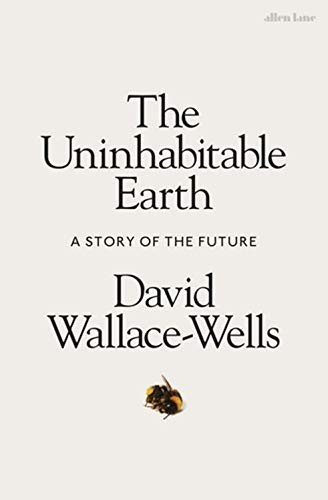
The Uninhabitable Earth
Life After Warming
In The Uninhabitable Earth, journalist David Wallace-Wells surveys the human consequences of a rapidly warming planet. Rather than treating climate change chiefly as a question of rising seas or endangered wildlife, he presents it as a force capable of reshaping food systems, public health, migration, conflict, economic life, politics, and culture. The book moves from physical dangers—including extreme heat, wildfire, water scarcity, ocean damage, and disease—to the social narratives and institutions through which people interpret those dangers. Its central contention is that climate disruption is neither remote nor confined to a single environmental problem: it is an all-encompassing condition created by human choices. Wallace-Wells writes in an intentionally alarming register, but he does not argue that catastrophe is predetermined. The range of possible futures remains politically contingent, making the book both a warning about cascading risks and an argument for collective agency.
Where to buy or borrow
Are you selling this book? Bookstores, publishers, authors and libraries can be listed here for free. Request a listing
About this book
Deep Overview
The central portion, “Elements of Chaos,” considers distinct but connected dimensions of climate danger. Extreme heat threatens human health and labor; altered growing conditions place pressure on food production; ice loss and thermal expansion raise seas; and warmer, drier landscapes encourage more destructive fires. Other chapters examine freshwater scarcity, damaged oceans, polluted air, changing disease patterns, economic losses, conflict, migration, and the difficulty of predicting outcomes within complex systems. The cumulative structure matters. Wallace-Wells wants readers to see that climate change cannot be reduced to any one iconic image, such as a polar bear or flooded shoreline. Its significance lies partly in the possibility that multiple stresses will arrive together and reinforce one another.
The book then turns from projected consequences to interpretation. Wallace-Wells considers why cultures struggle to represent a crisis that is planetary, gradual in some respects, sudden in others, and inseparable from ordinary economic activity. He explores the appeal and limits of technological rescue, disputes the notion that consumer choices can substitute for political transformation, and asks whether familiar stories of perpetual economic and moral progress can survive an era of ecological instability.
Capitalism appears not as a single explanatory villain but as a contested system whose dependence on growth, energy, investment, and unequal exposure becomes increasingly difficult to separate from climate politics. Technology is treated with similar ambivalence: decarbonization requires technological capacity, yet faith in a future invention can also excuse delay. The book consequently emphasizes institutions and public policy over personal purity.
Its final movement addresses ethics and agency. Wallace-Wells rejects the conclusion that frightening projections make action pointless. Because every additional increment of warming carries further consequences, the difference between bad and worse futures remains morally and politically substantial. The book’s deepest argument is therefore not that Earth will literally become empty of human life. It is that habitability exists on a spectrum and that present decisions will determine how much suffering, displacement, instability, and ecological loss future populations must endure.
Key Themes
Wallace-Wells repeatedly examines inequality. Those who contributed least to accumulated emissions are often more exposed to crop losses, dangerous heat, displacement, and weak public infrastructure. He also investigates normalization—the human ability to become accustomed to worsening conditions—and asks whether this adaptability protects societies or encourages complacency.
Other recurring themes include the insufficiency of individual consumer virtue, the necessity and danger of technological optimism, the fragility of faith in continuous progress, and the political consequences of fear. Throughout, uncertainty is presented not as reassurance but as a reason to take seriously the possibility of severe outcomes.
Historical and Intellectual Context
The project also reflects a shift in climate communication. Earlier public messaging often emphasized cautious language and distant projections, partly to preserve scientific precision and avoid accusations of alarmism. Wallace-Wells deliberately adopts a more visceral style. That choice generated debate about how journalists should communicate low-probability, high-consequence scenarios and how clearly they should distinguish central projections from worst cases. Readers should therefore understand the book as both a climate survey and an intervention in arguments about fear, persuasion, and public attention.
Intended Audience
Readers who respond well to urgent, rhetorically intense nonfiction are likely to find it compelling. Those seeking a technical climate-science textbook, a neutral literature review, detailed policy design, or a practical guide to reducing emissions will need supplementary works. The accumulation of disastrous possibilities may also be emotionally difficult for readers experiencing climate anxiety.
Reading Difficulty
The hazard chapters can feel relentless because they are designed to accumulate rather than provide narrative relief. The later essays require a different kind of attention: they shift from concrete physical dangers toward arguments about capitalism, technology, storytelling, historical progress, and ethics. Readers may find the book easier to absorb in sections rather than in a continuous sitting.
Helpful Background Knowledge
It may help to review the purpose of the Intergovernmental Panel on Climate Change and the 2015 Paris Agreement, including the importance attached to limiting warming well below two degrees Celsius while pursuing efforts toward 1.5 degrees. No formal scientific training is required. Readers should, however, remain attentive to distinctions among observed impacts, central projections, severe scenarios, and the author’s broader social interpretations.
Why Read This Book?
It is also a significant example of climate journalism as rhetoric. Readers can study not only the evidence Wallace-Wells assembles but the strategic question behind his presentation: can fear clarify a danger that conventional language has failed to communicate, or can it distort probabilities and encourage paralysis? The book remains especially useful as a starting point for examining how societies imagine the climate future and how those imagined futures influence present action.
Reader Takeaways
Readers may also reconsider the division between personal and collective responsibility. Wallace-Wells does not claim that private choices are meaningless, but he argues that planetary stabilization depends on decisions at the scale of governments, energy systems, infrastructure, finance, and mass politics. Finally, the book provides a vocabulary for recognizing both denial and fatalism as possible forms of inaction.
Strengths
Another strength is the refusal to restrict climate discussion to the natural sciences. By addressing politics, economics, technology, culture, psychology, and ethics, the book explains why scientific knowledge alone has not produced an adequate response. Its extensive notes also give interested readers pathways into the research and reporting behind individual discussions.
Limitations and Cautions
Some critics have also identified exaggerations or factual errors and questioned whether the title adequately represents the book’s more qualified argument about shrinking habitability. The cultural and philosophical chapters are interpretive essays rather than scientific findings. In addition, the book offers less detail on mitigation policy, adaptation, organized movements, and community-level experience than on the dangers themselves. Its critique of consumer-focused action may strike some readers as too dismissive of the ways personal conduct, social norms, and political participation can interact.
Important Concepts, Institutions, and Events
The Intergovernmental Panel on Climate Change is the United Nations-associated scientific body whose assessment process provides an essential background for public understanding of warming, impacts, and emissions pathways. The Paris Agreement is the 2015 international climate accord that frames the book’s discussion of temperature targets and the political difficulty of meeting them.
Climate cascades are interacting chains of consequence in which one disturbance amplifies others across natural and social systems. Feedback loops are processes that can reinforce climatic change, such as the loss of reflective ice exposing darker surfaces that absorb more heat. Climate injustice describes the unequal distribution of responsibility, protection, and harm among nations and social groups.
The book also examines climate conflict, meaning the ways environmental stress can intensify existing political, economic, and social tensions rather than functioning as a simple, independent cause of war. Crisis capitalism concerns the possibility that markets and powerful interests will exploit disruption while leaving vulnerable people less protected. The “church of technology” is Wallace-Wells’s critical name for excessive faith that innovation will rescue society without difficult political or institutional change.
The politics of consumption refers to arguments over whether individual purchasing and lifestyle decisions can meet a crisis produced by large energy, transportation, agricultural, and economic systems. The anthropic principle, borrowed from debates about the conditions permitting human existence, becomes part of the book’s concluding reflection on human exceptionalism, responsibility, and the possibility of collective action.
Questions the Book Explores
Can technological innovation decarbonize modern life quickly enough, and when does confidence in innovation become an excuse for delay? Are consumer choices meaningful contributions, distractions from structural reform, or both? What happens to familiar beliefs in growth and historical progress when environmental conditions become less stable? Who bears moral responsibility for harms extending across borders and generations? Finally, how should people understand agency when some damage is unavoidable but the scale of future damage remains open?
Reading Group Guide
Track the idea of cascades across several chapters. A group might map how one event—such as drought, crop failure, or wildfire—could move through health, insurance, migration, employment, and politics. Compare this systems approach with media coverage that treats disasters as isolated events.
Pay particular attention to the transition from “Elements of Chaos” to the cultural and philosophical chapters. Consider whether reflections on storytelling, capitalism, technology, and progress strengthen the scientific discussion or move beyond what the earlier evidence can establish. Groups may also compare the original 2019 argument with a recent scientific assessment or local climate-adaptation plan, noting what has changed and what remains unresolved.
Discussion Questions
2. Does the book distinguish clearly enough among observed effects, likely outcomes, and worst-case possibilities?
3. When does alarming language become an appropriate response to risk, and when might it become counterproductive?
4. Which “element of chaos” most changed your understanding of climate change, and why?
5. How does inequality affect both exposure to climate harm and the ability to adapt?
6. Is Wallace-Wells persuasive in prioritizing political action over consumer-focused responsibility?
7. Can individual behavior help create collective change even when it cannot solve the problem by itself?
8. How does the book complicate faith in technology as a climate solution?
9. What assumptions about capitalism and economic growth does the book challenge?
10. Does the possibility of adaptation weaken the author’s warning, or does it introduce another field of political and moral choices?
11. How might climate disruption alter ideas of progress, responsibility, and justice between generations?
12. After finishing the book, did you feel more capable of acting, more overwhelmed, or both? What features of the writing produced that response?
Sources and Verification
Comments
No published comments yet.
Available editions
Hardcover
First edition, hardcover
- Publisher
- Tim Duggan Books
- ISBN-13
- 9780525576709
- Publication date
- Pages
- 320